
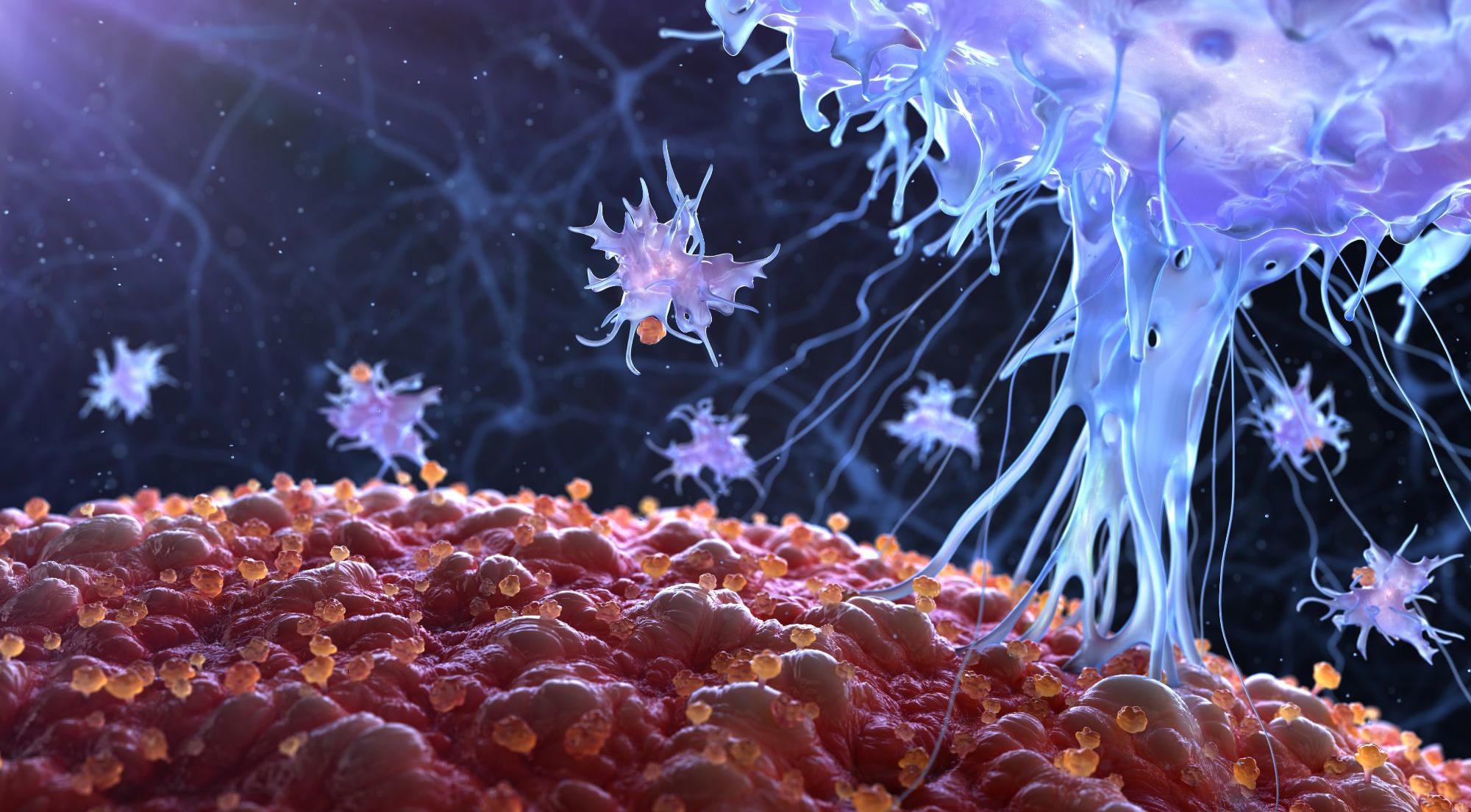
Researchers in Bonn have decoded the interaction between monocytes and platelets in human blood.
Monocytes, a unique type of white blood cell, release cytokines as inflammatory signals essential for a proper immune response. Researchers at University Hospital Bonn (UKB) and the University of Bonn have discovered that platelets, also called thrombocytes, interact with monocytes, enhancing their inflammatory capability.
By understanding the platelet-monocyte interaction, they hope to improve the treatment of immune disorders and associated diseases. The results of the study have now been published in the renowned journal EMBO Molecular Medicine and will be featured on the cover of August issue.
Monocytes are white blood cells, known as leukocytes. They are an important part of the innate immune system and contribute to host defense in the blood by secreting large quantities of pro-inflammatory cytokines. Abnormal activity of monocytes leads to hyperinflammation, i.e. very severe inflammation, as well as life-threatening cytokine storms. On the other hand, disturbed monocyte function is associated with “immune paralysis.”
In this condition, the immune system’s ability to fight off invaders such as viruses and bacteria is inhibited. This increases susceptibility to infections.

“It is, therefore, crucial to understand how the functions of monocytes are regulated,” says senior and corresponding author Prof. Dr. Bernardo Franklin from the Institute of Innate Immunity at the UKB and the Cluster of Excellence ImmunoSensation2 at the University of Bonn, explaining the motivation to investigate the role of platelets in the regulation of monocyte-induced inflammation.
Platelets as a central checkpoint in immune defense
Platelets play a central role in blood clotting, but are also thought to perform important functions in the immune system. Prof. Franklin’s research team has already identified platelets as an important regulator of inflammation. They now report that a low platelet count in the rare blood disorder immune thrombocytopenia (ITP) or the artificial removal of platelets from healthy monocytes results in “immunoparalysis”. This is characterized by a disturbed cytokine reaction and is an immunological challenge. “Remarkably, supplementing monocytes with fresh platelets reverses this condition and restores the monocyte cytokine response,” says corresponding and co-first author Dr. Ibrahim Hawwari, a postdoctoral fellow of the University of Bonn at the Institute of Innate Immunity at the UKB. The Bonn researchers discovered that the pro-inflammatory signals, including NF-κB and p38 MAPK, propagate from platelets to monocytes and maintain their inflammatory capacity. “Platelet vesicles as an extended arm of platelets control this intercellular communication,” says co-first author Lukas Roßnagel, PhD student ot the University of Bonn at the Institute of Innate Immunity of the UKB.
The results of the study point to a new intercellular communication mechanism in which platelets regulate monocyte function. “Clinically, this suggests potential therapeutic strategies to counteract monocyte immune paralysis in conditions such as ITP and other inflammatory diseases with the addition of platelets,” says Prof. Franklin, who hopes that an understanding of platelet-monocyte interactions will lead to improved treatment of immune disorders and related diseases.
Reference: “Platelet transcription factors license the pro-inflammatory cytokine response of human monocytes” by Ibrahim Hawwari, Lukas Rossnagel, Nathalia Rosero, Salie Maasewerd, Matilde B Vasconcelos, Marius Jentzsch, Agnieszka Demczuk, Lino L Teichmann, Lisa Meffert, Damien Bertheloot, Lucas S Ribeiro, Sebastian Kallabis, Felix Meissner, Moshe Arditi, Asli E Atici, Magali Noval Rivas and Bernardo S Franklin, 8 July 2024, EMBO Molecular Medicine.
DOI: 10.1038/s44321-024-00093-3
Never miss a breakthrough: Join the SciTechDaily newsletter.
Follow us on Google and Google News.