
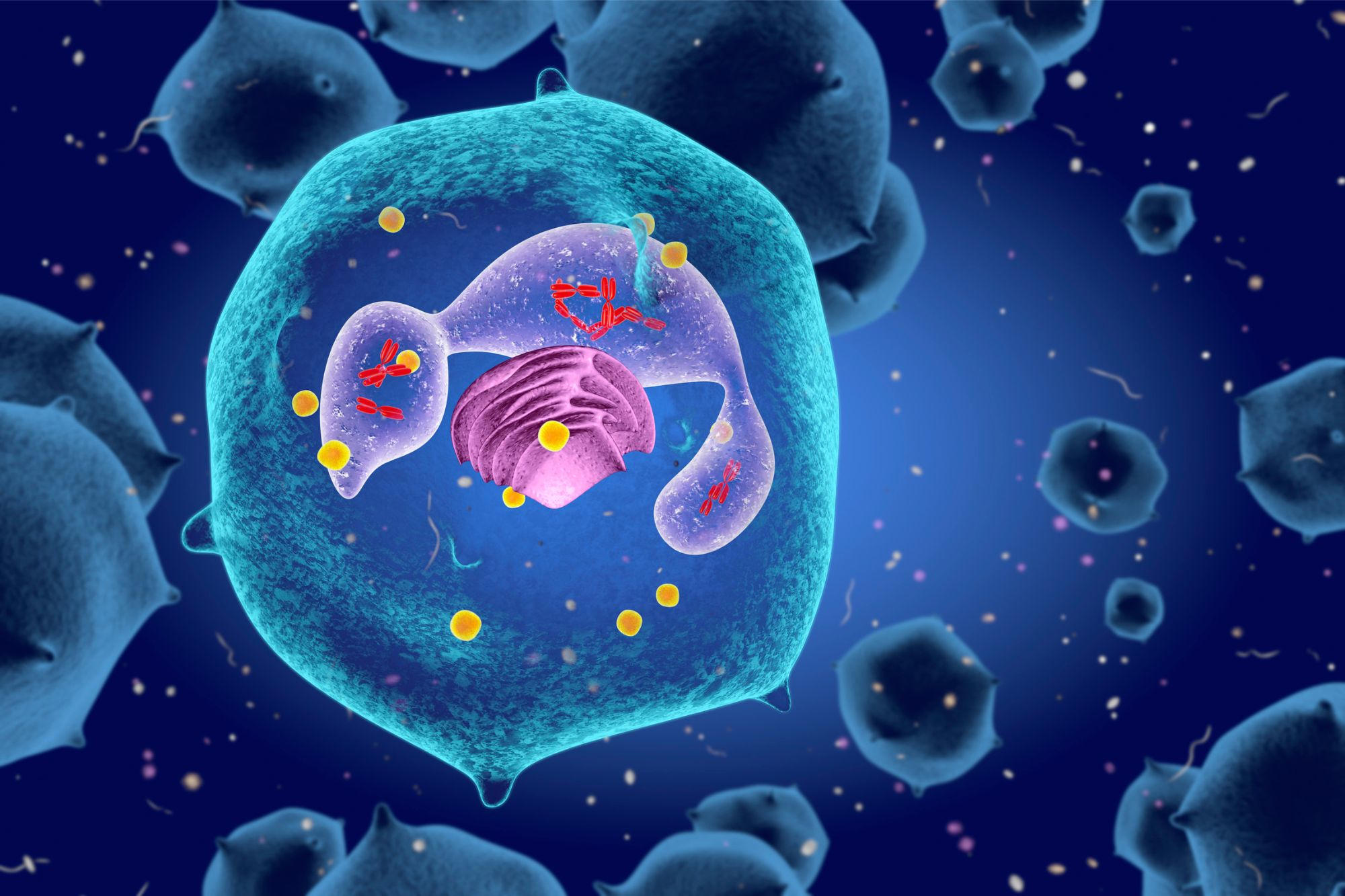
Immune cells demonstrate a higher level of self-directed mobility than previously recognized. Jonna Alanko, a researcher with InFLAMES, has unveiled that these cells are not merely passive reactors to chemical signals in their surroundings. Instead, they actively modify these signals and adeptly navigate complex environments through self-organization.
Directional cell movement is an essential and fundamental phenomenon of life. It is an important prerequisite for individual development, reformation of blood vessels, and immune response, among others.
A study conducted by Postdoctoral Researcher Jonna Alanko focused on the movement and navigation of immune cells within the body. Chemokines, a class of signaling proteins, play a crucial role in guiding immune cells to specific locations. Chemokines are formed, for instance, in the lymph nodes and create chemical cues called chemokine gradients for cells to follow within the body. According to Alanko, these chemokine gradients are like a trail of scent left in the air, it gets lighter the further you are from its source.
The traditional idea has been that immune cells recognize their target by following existing chemokine gradients. In other words, the cells following these cues have been seen as passive actors, which is not the case in reality.
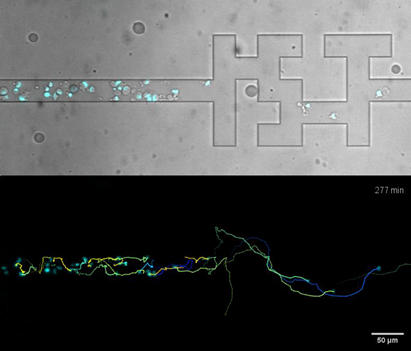
“We were able to prove for the first time that contrary to the previous conception, immune cells do not need an existing chemokine gradient to find their way. They can create gradients themselves and thereby migrate collectively and efficiently even in complex environments,” explains Alanko.
Cells consume chemokines
Immune cells have receptors with which they can sense a chemokine signal. One of these receptors is called CCR7 and can be found in dendritic cells.
Dendritic cells are professional antigen-presenting cells with an important role in activating the entire immune response. They need to locate an infection, recognize it, and then migrate to the lymph nodes with the information. In the lymph nodes, the dendritic cells interact with other cells of the immune system to initiate an immune response against pathogens.
The study conducted by Alanko revealed that dendritic cells do not only register a chemokine signal with their CCR7 receptor, but they also actively shape their chemical environment by consuming chemokines. By doing this, the cells create local gradients that guide their own movement and that of other immune cells. The researchers also discovered that T-cells, another type of an immune cell, can benefit from these self-generated gradients to enhance their own directional movement.
“When immune cells are capable of creating chemokine gradients, they can avoid upcoming obstacles in complex environments and guide their own directional movement and that of other immune cells,” explains Jonna Alanko.
This discovery increases our understanding of how immune responses are coordinated within the body. However, it can also reveal how cancer cells guide their movement to create metastases.
“The CCR7 receptor has also been discovered in many cancer types and in these cases, the receptor has been seen to boost cancer metastasis. Cancer cells may even use the same mechanism as immune cells to guide their movement. Therefore, our findings may help design new strategies to modify immune responses as well as to target certain cancers,” notes Jonna Alanko.
Reference: “CCR7 acts as both a sensor and a sink for CCL19 to coordinate collective leukocyte migration” by Jonna Alanko, Mehmet Can Uçar, Nikola Canigova, Julian Stopp, Jan Schwarz, Jack Merrin, Edouard Hannezo and Michael Sixt, 1 September 2023, Science Immunology.
DOI: 10.1126/sciimmunol.adc9584
Jonna Alanko is a postdoctoral researcher in the InFLAMES Flagship, at the MediCity research laboratory of the Faculty of Medicine at the University of Turku in Finland. She conducted a majority of her recently published study at the Institute of Science and Technology Austria (ISTA), in Austria, in a research group led by Professor Michael Sixt.
Never miss a breakthrough: Join the SciTechDaily newsletter.
Follow us on Google and Google News.