
Researchers have found that common food ingredients can interact inside immune cells in ways that significantly enhance each other’s anti-inflammatory effects.
Chronic inflammation often develops quietly, without obvious symptoms in its early stages. Over time, however, this persistent immune activity can contribute to serious health conditions, including type 2 diabetes, cardiovascular disease, obesity, arthritis, and certain cancers. At its core, inflammation is driven by immune cells that release signaling molecules to respond to injury or infection.
Diet plays an important role in shaping this process. Common foods and seasonings such as herbs, spices, and aromatic plants contain natural compounds known as phytochemicals that can influence inflammatory pathways. These ingredients have been combined in traditional diets and remedies for centuries, long before their biological effects were understood.
Despite this long history, scientists have struggled to explain exactly how plant-based ingredients reduce inflammation. Individual compounds often show anti-inflammatory activity in laboratory experiments, but typically only at concentrations far higher than what people consume through everyday diets.
This gap has led to uncertainty about whether “anti-inflammatory foods” can meaningfully affect the body. Another unresolved question is how different compounds might interact inside cells. It has been hypothesized that combinations of ingredients could produce stronger effects together than individually, but these interactions have rarely been tested or explained at the molecular level.
Testing plant compound synergy in immune cells
To investigate this, a research team led by Professor Gen-ichiro Arimura from the Department of Biological Science and Technology, Tokyo University of Science, Japan, examined how combinations of plant-derived compounds influence inflammation in immune cells. Their study, published in the journal Nutrients, focused on compounds commonly found in mint, eucalyptus, and chili peppers, testing whether pairing them could suppress inflammatory responses more effectively than using each one alone.
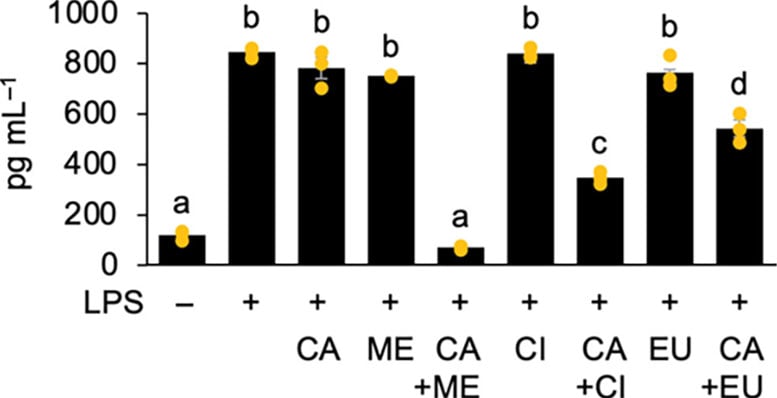
The team studied macrophages, immune cells that play a central role in inflammation by producing signaling proteins called cytokines. To simulate an inflammatory response, murine macrophages were exposed to lipopolysaccharide, a bacterial component frequently used in laboratory models. The researchers then treated the cells with menthol (from mint), 1,8-cineole (from eucalyptus), capsaicin (from chili peppers), and β-eudesmol (from hops and gingers), both individually and in specific combinations.
They evaluated the effects using gene expression analysis, protein measurements, and calcium imaging. The team also investigated whether these compounds acted through transient receptor potential (TRP) channels, which are proteins in the cell membrane that respond to chemical and physical signals and regulate calcium activity, a key factor in immune cell behavior.
Synergistic effects amplify anti-inflammatory response
On its own, capsaicin showed the strongest anti-inflammatory effect among the compounds tested. However, the most notable results emerged when compounds were combined. “When capsaicin and menthol or 1,8-cineole were used together, their anti-inflammatory effect increased several hundred-fold compared to when each compound was used alone,” highlights Prof. Arimura.
Further analysis helped clarify why this happens. Menthol and 1,8-cineole influenced inflammation through TRP channels and calcium signaling, while capsaicin appeared to act through a separate pathway that does not depend on TRP. “We demonstrated that this synergistic effect is not a coincidence, but is based on a novel mode of action resulting from the simultaneous activation of different intracellular signaling pathways,” says Prof. Arimura. “This provides clear molecular-level evidence for the empirically known effects of combining food ingredients.”
Implications for diet and functional foods
These findings offer insight into how combinations of plant compounds may produce measurable biological effects even at the relatively low levels typically found in food. They also point to new possibilities for developing functional foods, supplements, seasonings, or fragrances designed to deliver stronger effects using smaller amounts of active ingredients.
More broadly, the results support the idea that the benefits of plant-rich diets may arise from interactions among many compounds working together, rather than from any single “super” ingredient. Although further research in animal models and humans is needed, this study provides a clearer framework for understanding how everyday foods and natural compounds may help regulate chronic inflammation and support long-term health.
Reference: “Functional Phytochemicals Cooperatively Suppress Inflammation in RAW264.7 Cells” by Kaori Terashita, Masato Kohakura, Katsura Sugawara, Shinichi Miyagawa and Gen-ichiro Arimura, 23 January 2026, Nutrients.
DOI: 10.3390/nu18030376
This work was partially supported by Japan Society for the Promotion of Science (JSPS) KAKENHI (24K01723) and Tokyo University of Science Research Grants.
Never miss a breakthrough: Join the SciTechDaily newsletter.
Follow us on Google and Google News.
6 Comments
If you have ever eaten cayenne, you know your tongue has increased inflammation. It kills bugs in bad water, whad-ya think a Hot Tamale is?
Interested in this information for lung and joint ailments.
I’ve found that Horseradish, which contains sinagrin, helps with the awful bone ache of arthritis. I wonder how mixing this into the study might affect the results?
Fancy that; granny knew more than the quacks of her day. And cod-liver oil is very good for certain types of arthritis. Its anti-inflannatory property was recognised by medicine in the mid-1980os and thus its price shot-up rapidly and it got trapped in capsules of gelatine.
This is VERY interesting to me… an old Navy injury (1963) causes extreme pain and arthritic inflammation… Remembering my Czech grandma’s remedies (several from Kaw & Pottawatimie ‘Indians’,. the bulb came ON – yep, wild mint, horseradush, and fish oil… Yep, they were VERY smart (“real”, not “book” smart!
This is VERY interesting to me… an old Navy injury (1963) causes extreme pain and arthritic inflammation… Remembering my Czech grandma’s remedies (several from Kaw & Pottawatimie ‘Indians’,. the bulb came ON – yep, wild mint, horseradush, and fish oil… Yep, they were VERY smart (“real”, not “book” smart!