
Close Menu
    Facebook X (Twitter) Instagram
    SciTechDaily
    • Biology
    • Chemistry
    • Earth
    • Health
    • Physics
    • Science
    • Space
    • Technology
    Facebook X (Twitter) Pinterest YouTube RSS
    SciTechDaily
    Home»Health»Thought To Be Impossible – New Method Could Diagnose Early-Stage Parkinson’s Disease
    Health

    Thought To Be Impossible – New Method Could Diagnose Early-Stage Parkinson’s Disease

    By The Hebrew University of JerusalemAugust 29, 2022No Comments3 Mins Read
    Facebook Twitter Pinterest Telegram LinkedIn WhatsApp Email Reddit
    Share
    Facebook Twitter LinkedIn Pinterest Telegram Email Reddit
    Brain Scan Concept Animation
    Parkinson’s disease is a neurological disorder that causes unintentional or uncontrolled movements such as trembling, stiffness, and issues with balance and coordination.

    Parkinson’s Disease May Be Detected in Its Early Stages Through the Use of Special Brain Scans

    Parkinson’s disease is a debilitating brain condition that worsens with time and affects sufferers’ ability to walk and even talk. It’s complex to diagnose, and in the early stages – impossible.

    Most of us are acquainted with a method known as MRI, which is often used to visualize brain structure. However, it is currently only used to rule out other potential diagnoses since it is not sensitive enough to show the biological changes that occur in Parkinson’s patients’ brains.

    Advancing Diagnosis with Quantitative MRI (qMRI)

    Researchers at the Hebrew University of Jerusalem (HU), under the direction of Professor Aviv Mezer, came to the conclusion that by modifying a related method known as quantitative MRI (qMRI), it could be possible to reveal the cellular changes in Parkinson’s. With the use of their technique, they were able to examine the microstructures of the striatum, an area of the deep brain that is known to degenerate as Parkinson’s disease progresses.
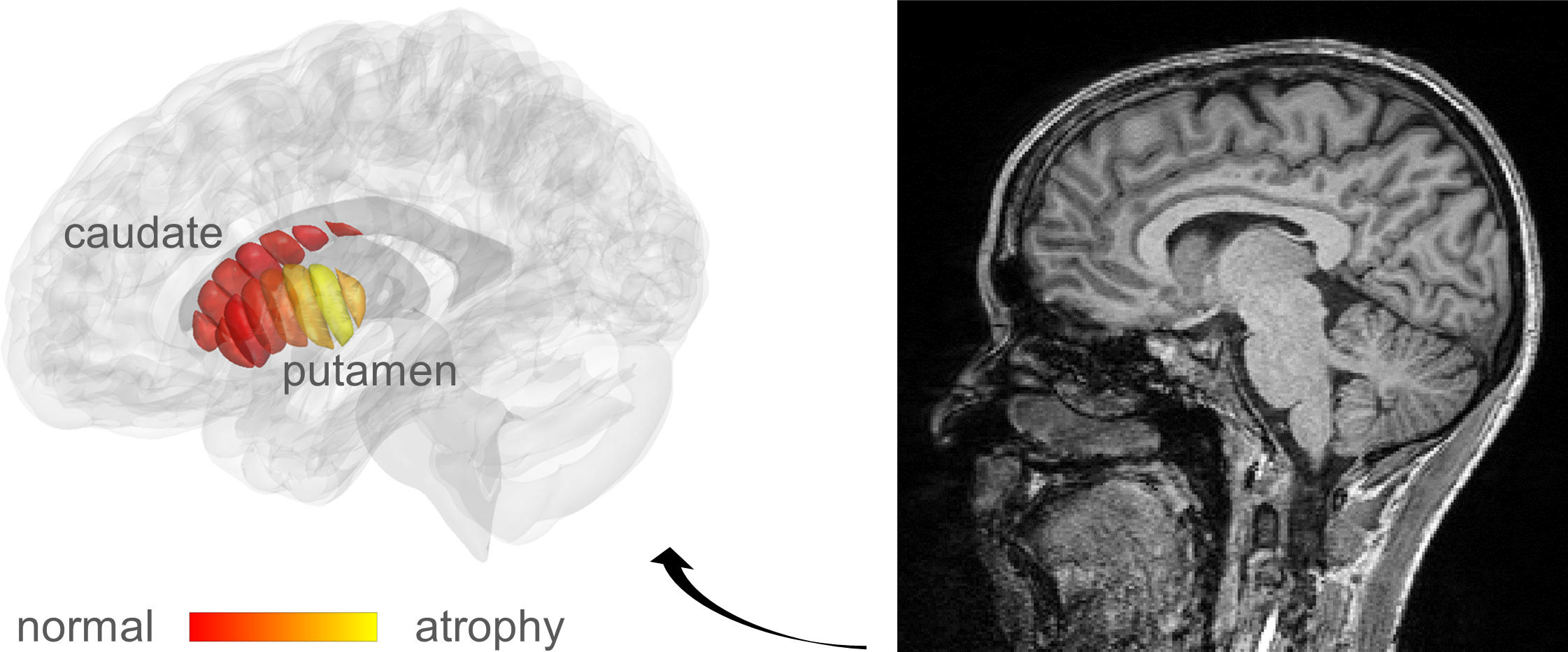
    MRI Images Parkinson's
    MRI images used for the automatic detection of microstructural changes in early-stage Parkinson’s Disease (PD) patients. Marked in yellow are areas in the putamen where PD patients show tissue damage, compared to healthy controls. Credit: Mezer Lab/Hebrew University

    Using a new method of analysis, developed by Mezer’s doctoral student, Elior Drori, biological changes in the cellar tissue of the striatum were clearly revealed. Moreover, they were able to demonstrate that these changes were associated with the early stages of Parkinson’s and patients’ movement dysfunction. Their findings were recently published in the prestigious journal Science Advances.

    Sensitivity Beyond Standard MRI Techniques

    qMRI achieves its sensitivity by taking several MRI images using different excitation energies – rather than taking the same photograph in different colors of lighting. The HU researchers were able to use their qMRI analysis to reveal changes in the tissue structure within distinct regions of the striatum. The structural sensitivity of these measurements could only have been previously achieved in laboratories examining the brain cells of patients post-mortem. Not an ideal situation for detecting early disease or monitoring the efficacy of a drug!

    “When you don’t have measurements, you don’t know what is normal and what is abnormal brain structure, and what is changing during the progress of the disease,” explained Mezer. The new information will facilitate early diagnosis of the disease and provide “markers” for monitoring the efficacy of future drug therapies.

    “What we have discovered,” he continued “is the tip of the iceberg.” It is a technique that they will now extend to investigate microstructural changes in other regions of the brain. Furthermore, the team is now developing qMRI into a tool that can be used in a clinical setting. Mezer anticipates that is about 3-5 years down the line.

    Drori further suggests that this type of analysis will enable the identification of subgroups within the population suffering from Parkinson’s disease – some of whom may respond differently to some drugs than others. Ultimately, he sees this analysis as “leading to personalized treatment, allowing future discoveries of drug with each person receiving the most appropriate drug.”

    Reference: “Mapping microstructural gradients of the human striatum in normal aging and Parkinson’s disease” by Elior Drori, Shai Berman and Aviv A. Mezer, 15 July 2022, Science Advances.
    DOI: 10.1126/sciadv.abm1971

    The study was funded by the Israel Science Foundation.

    Never miss a breakthrough: Join the SciTechDaily newsletter.
    Follow us on Google and Google News.

    Brain MRI Parkinson's Disease The Hebrew University of Jerusalem
    Share. Facebook Twitter Pinterest LinkedIn Email Reddit

    Related Articles

    Unexpected Discovery: Vascular Defects Appear to Underlie the Progression of Parkinson’s Disease

    Deep Brain Stimulation Research Shows Promising Results for Treating Parkinson’s Disease

    Artificial Intelligence Classifies Brain Tumors With Single MRI Scan

    Brain Mapping Method Illuminates Targets for Treating Depression and Parkinson’s Disease

    Simple Blood Test Can Accurately Reveal Underlying Neurodegeneration (Dementia, ALS)

    Parkinson’s Gene PINK1 May Impair How New Neurons Are Made Throughout Our Lifetime

    Identifying “The Terrorist Inside My Husband’s Brain” – Living Brain Imaging Can Clearly Differentiate Between Types of Dementia

    Parkinson’s Disease Eliminated in Mice by One-Time Genetic Treatment that Generates New Neurons

    Do Children’s Brains Really Get Thinner? Neuroscientists Striking Results Are Unexpected.

    Leave A Reply Cancel Reply

    • Facebook
    • Twitter
    • Pinterest
    • YouTube

    Don't Miss a Discovery

    Subscribe for the Latest in Science & Tech!

    Trending News

    Popular Sugar-Free Sweetener Linked to Liver Disease, Study Warns

    What Is Hantavirus? The Deadly Disease Raising Alarm Worldwide

    Scientists Just Discovered How the Universe Builds Monster Black Holes

    Scientists Unveil New Treatment Strategy That Could Outsmart Cancer

    A Simple Vitamin May Hold the Key to Treating Rare Genetic Diseases

    Scientists Think the Real Fountain of Youth May Be Hiding in Your Gut

    Ravens Don’t Follow Wolves, They Predict Them

    This Common Knee Surgery May Be Doing More Harm Than Good

    Follow SciTechDaily
    • Facebook
    • Twitter
    • YouTube
    • Pinterest
    • Newsletter
    • RSS
    SciTech News
    • Biology News
    • Chemistry News
    • Earth News
    • Health News
    • Physics News
    • Science News
    • Space News
    • Technology News
    Recent Posts
    • Why Are So Many New Fathers Dying? Scientists Say the U.S. Has a Dangerous Blind Spot
    • Scientists Identify Simple Supplement That Greatly Reduces Alzheimer’s Damage
    • You May Have a Dangerous Type of Cholesterol Even if Your Tests Look Normal
    • Study Reveals Dangerous Flaw in AI Symptom Checkers
    • New MRI Breakthrough Captures Stunningly Clear Images of the Eye and Brain
    Copyright © 1998 - 2026 SciTechDaily. All Rights Reserved.
    • Science News
    • About
    • Contact
    • Editorial Board
    • Privacy Policy
    • Terms of Use

    Type above and press Enter to search. Press Esc to cancel.