

Evolution Might Be Less Random Than We Thought
Evolution has long been thought of as a relatively random process, with species’ features being formed by random mutations and environmental factors and thus largely unpredictable.
But an international team of scientists headed by researchers from Yale University and Columbia University discovered that a specific plant lineage independently developed three similar leaf types repeatedly in mountainous places scattered across the Neotropics.
The research revealed the first examples in plants of “replicated radiation,” which is the repeated development of similar forms in different regions. This discovery raises the possibility that evolution is not necessarily such a random process and can be anticipated.
The study was recently published in the journal Nature Ecology & Evolution.
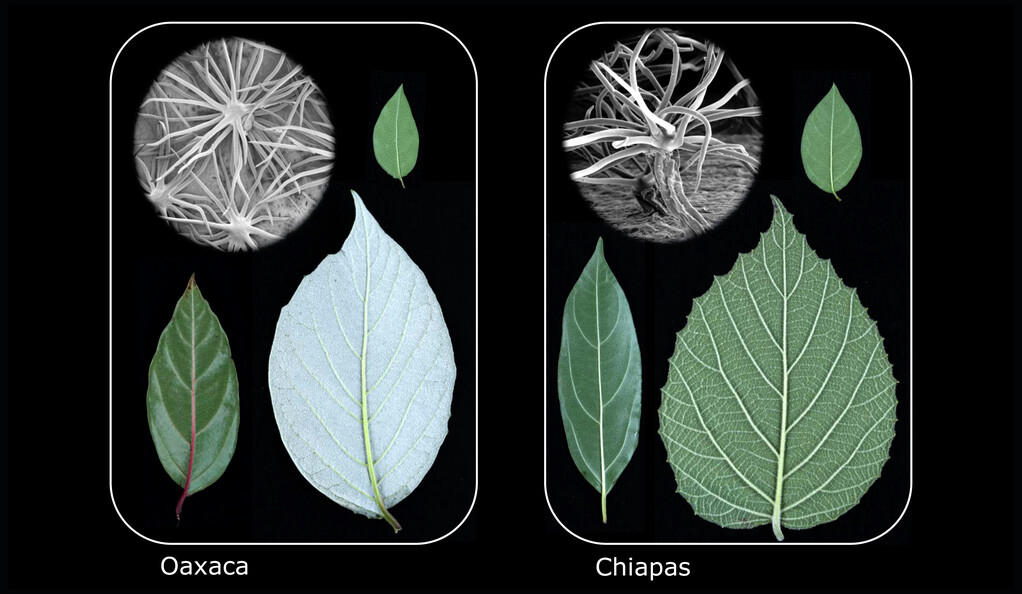
“The findings demonstrate how predictable evolution can actually be, with organismal development and natural selection combining to produce the same forms again and again under certain circumstances,” said Yale’s Michael Donoghue, Sterling Professor Emeritus of Ecology & Evolutionary Biology and co-corresponding author. “Maybe evolutionary biology can become much more of a predictive science than we ever imagined in the past.”
The research team examined the genetics and morphology of the Viburnum plant lineage, a genus of flowering plants that started to spread into Central and South America from Mexico around 10 million years ago. Donoghue conducted research on this plant group for his Ph.D. dissertation at Harvard 40 years ago. At the time, he advocated an alternate theory according to which large, hair-covered leaves and small, smooth leaves both evolved early in the history of the group and later migrated separately, being scattered by birds, through the different mountain ranges.
Genetic Analysis Challenges Older Theories
However, the new genetic analyses presented in the study demonstrate that the 2 different leaf types evolved separately and simultaneously in each of many mountain regions.
“I came to the wrong conclusion because I lacked the relevant genomic data back in the 1970s,” Donoghue said.
The team found that a very similar set of leaf types evolved in nine of the 11 regions studied. However, the full array of leaf types may have yet to evolve in places where Viburnum has only more recently migrated. For instance, the mountains of Bolivia lack the large hairy leaf types found in other wetter areas with little sunshine in the cloud forests in Mexico, Central America, and northern South America.
“These plants arrived in Bolivia less than a million years ago, so we predict that the large, hairy leaf form will eventually evolve in Bolivia as well,” Donoghue said.
Several examples of replicated radiation have been found in animals, such as Anolis lizards in the Caribbean. In that case, the same set of body forms, or “ectomorphs,” evolved independently on several different islands. With a plant example now in hand, evolutionary biologists will try to discover the general circumstances under which solid predictions can be made about evolutionary trajectories.
“This collaborative work, spanning decades, has revealed a wonderful new system to study evolutionary adaptation,” said Ericka Edwards, professor of ecology and evolutionary biology at Yale and co-corresponding author of the paper. “Now that we have established the pattern, our next challenges are to better understand the functional significance of these leaf types and the underlying genetic architecture that enables their repeated emergence.”
Reference: “Replicated radiation of a plant clade along a cloud forest archipelago” by Michael J. Donoghue, Deren A. R. Eaton, Carlos A. Maya-Lastra, Michael J. Landis, Patrick W. Sweeney, Mark E. Olson, N. Ivalú Cacho, Morgan K. Moeglein, Jordan R. Gardner, Nora M. Heaphy, Matiss Castorena, Alí Segovia Rivas, Wendy L. Clement and Erika J. Edwards, 18 July 2022, Nature Ecology & Evolution.
DOI: 10.1038/s41559-022-01823-x
Never miss a breakthrough: Join the SciTechDaily newsletter.
Follow us on Google and Google News.
10 Comments
I predict evolution.
Seems to work. Kudos to the fellows.
Yes! Sure ! Random can be predicted … why Not?
I guess, By some ‘clever’ definition … “Anything” “can be” “predicted” “almost” “Exactly”
p.s.
Please Create your own Definitions for all this “words”, and you will be OK, thank you.
Until that … by definition !!
Life can’t be predicted, because Life is base on Darvin’ Compeat & Survive process … unless … scitechdaily believed that some Birdy Man already created all this … 6000 years ago.
/* Have a wonderful delusions */
~Vladimir Joseph Stephan Orlovsky
The Army of plant species can be all or anything they can be, over time. But logically, the point of this “excursion” into Semantics, is a clear instance of a Spiced Baloney Sandwich. Slicing it wafer thin doesn’t make it any less BALONEY. Drowning it in Catsup doesn’t change the “flavor”, particularly if one swallows it WHOLE, wrapped in WRY Bread.
It avoids the influence of micro-climate and other localized influences.
Hmm… my stomach is growling…
Make mine alfalfa sprouts and avocado with green chilis and Tahini, on whole wheat… Something vaguely germaine to the issue, that…
My prediction for plant evolution is this at the molecular level there is a method to accelerated fossilization which causes singular molecular fusion a process which would produce a brand new periodic table with billions of chemicals. i predict there is timelines and planets that exist with said fossilization process as a reality.
But don’t you know that if that happens the quantum foam will discombobulate the particulate matter! That would implode all matter in the universe!
Not sure how pertinent this is, but it’s weird to think how much humans are shaping evolution. In the eastern US a big portion of the “wild” plants and animals aren’t native and I would assume the same is true in other temperate areas. A few species that may not have been very common without human activity take advantage of man made conditions like certain cockroaches or Japanese honeysuckle and I would imagine the course of evolution will look a lot different long after the human race has died out.
Sort of a pointless and narrow evidence based statement not even a model of anything. Useless. A waste of my time.
I kitty cat Philippines Titicaca poop waffle meow meow
It’s not easy being green.
It’s amazing how many of these posts have words that are spelled wrong.