
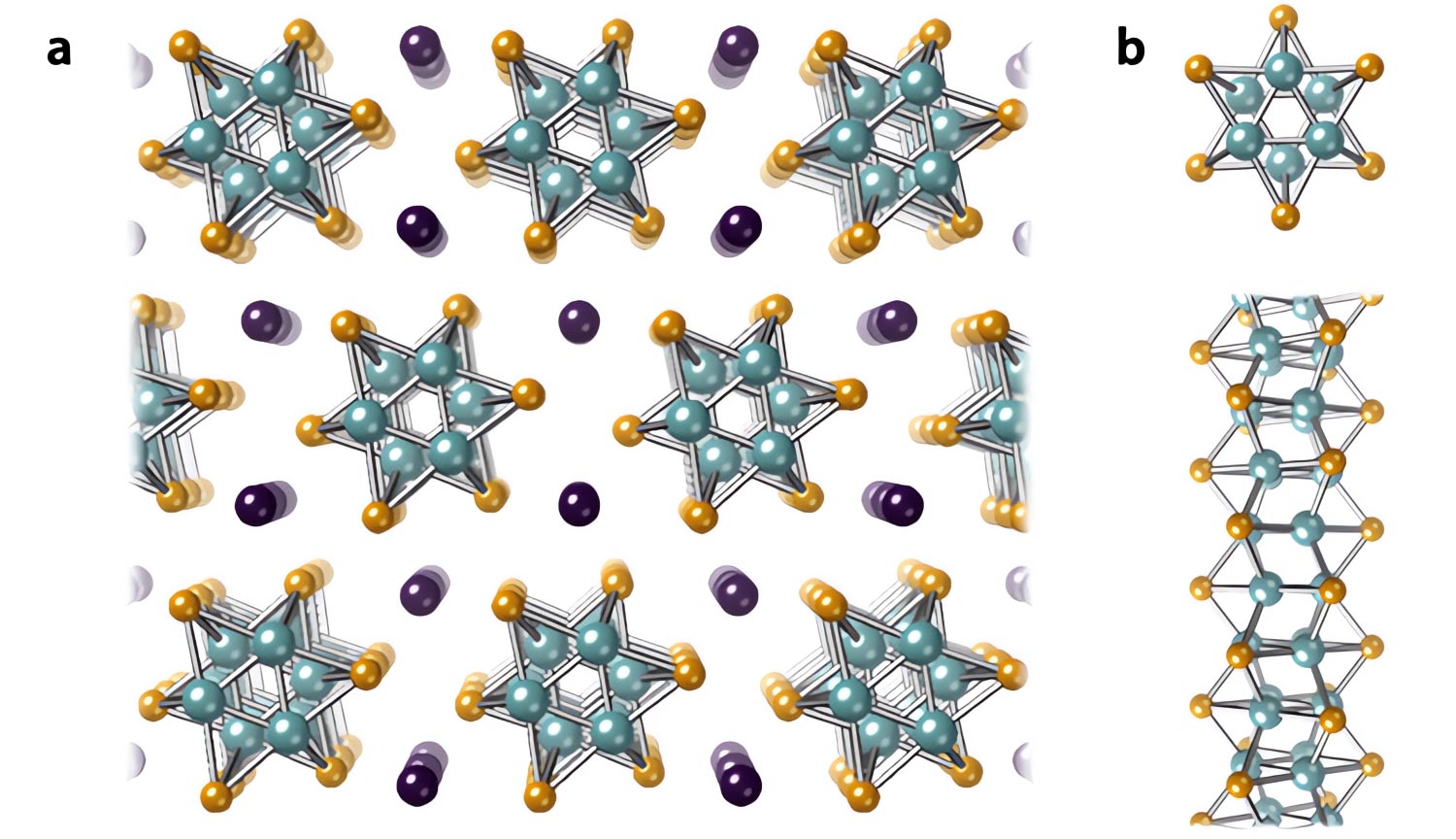
Intercalation of indium into nanostructures promises applications to nanocircuitry.
Researchers from Tokyo Metropolitan University have successfully threaded atoms of indium metal in between individual fibers in bundles of transition metal chalcogenide nanofibers. By steeping the bundles in indium gas, rows of atoms were able to make their way in between the fibers to create a unique nanostructure via intercalation. Through simulations and resistivity measurements, individual bundles were shown to have metallic properties, paving the way for application as flexible nanowires in nanocircuitry.
Atomic wires of transition metal chalcogenides (TMCs) are nanostructures consisting of a transition metal and a group 16 element like sulfur, selenium, and tellurium. They are able to self-assemble into a wide range of structures with different dimensionality, putting them at the heart of a revolution in nanomaterials that has been the focus of intense research in recent years.
In particular, a class of 3D TMC structures has garnered particular interest, consisting of bundles of TMC nanofibers held together by metallic atoms in between the fibers, all forming a well-ordered lattice in its cross-section (see Figure 1). Depending on the choice of metal, the structure could even be made to become a superconductor. Furthermore, by making the bundles thin, they could be made into flexible structures that conduct electricity: this makes TMC nanostructures a prime candidate for use as wiring in nanocircuitry. However, it has been difficult to make these structures into the long, thin fibers that are required to study them in-depth, as well as for nanotechnology applications.

A team led by Assistant Professor Yusuke Nakanishi and Associate Professor Yasumitsu Miyata has been studying synthesis techniques for TMC nanostructures. In recent work, they showed that they could produce long, thin bundles of TMCs (with no metal) over unprecedentedly large length scales. Now, they have used a vapor phase reaction to thread atomically-thin rows of indium into thin bundles of tungsten telluride. By exposing their long nanofiber bundles to indium vapor under vacuum at 500 degrees Celsius (930 degrees Fahrenheit), the indium metal atoms made their way into the space between the individual nanofibers that make up the bundles, forming an intercalating (or bridging) row of indium that binds the fibers together.
Metallic Properties of Intercalated TMC Bundles
Having successfully produced large amounts of these threaded TMC bundles, they proceeded to study the properties of their new nanowires. By looking at the resistivity as a function of temperature, they showed conclusively that individual bundles behave like a metal and thus conduct electricity. This agreed with computer simulations, and also demonstrated how well-ordered the structures were. Interestingly, they found that this structure was slightly different to bulk batches of bundled nanofibers, in that the intercalated rows caused each nanofiber to rotate slightly about its axis.
The team’s technique is not only limited to indium and tungsten telluride, nor to this particular structure. They hope their work might inspire a new chapter for nanomaterial development and the study of their unique properties.
Reference: “Vapor-Phase Indium Intercalation in van der Waals Nanofibers of Atomically Thin W6Te6 Wires” by Ryusuke Natsui, Hiroshi Shimizu, Yusuke Nakanishi*, Zheng Liu, Akito Shimamura, Nguyen Tuan Hung, Yung-Chang Lin, Takahiko Endo, Jiang Pu, Iori Kikuchi, Taishi Takenobu, Susumu Okada, Kazu Suenaga, Riichiro Saito and Yasumitsu Miyata, 23 February 2023, ACS Nano.
DOI: 10.1021/acsnano.2c10997
This work was supported by JSPS KAKENHI Grant Numbers JP18H01810, JP20H02572, JP20H02605, JP20J21812, JP20K05413, JP20H05664, JP20H05862, JP20H05867, JP20K15178, JP21H05232, JP21H05233, JP21H05234, JP21H05235, JP21H05236, JP22H00215, JP22H00280, JP22H00283, JP22H01899, JP22H04957, JP22H05478, and JP22K19059, JST CREST Grant Numbers JPMJCR1715, JPMJCR1993, JPMJCR20B1, and JPMJCR20B5, and FOREST Grant Number JPMJFR213X.
Never miss a breakthrough: Join the SciTechDaily newsletter.
Follow us on Google and Google News.