
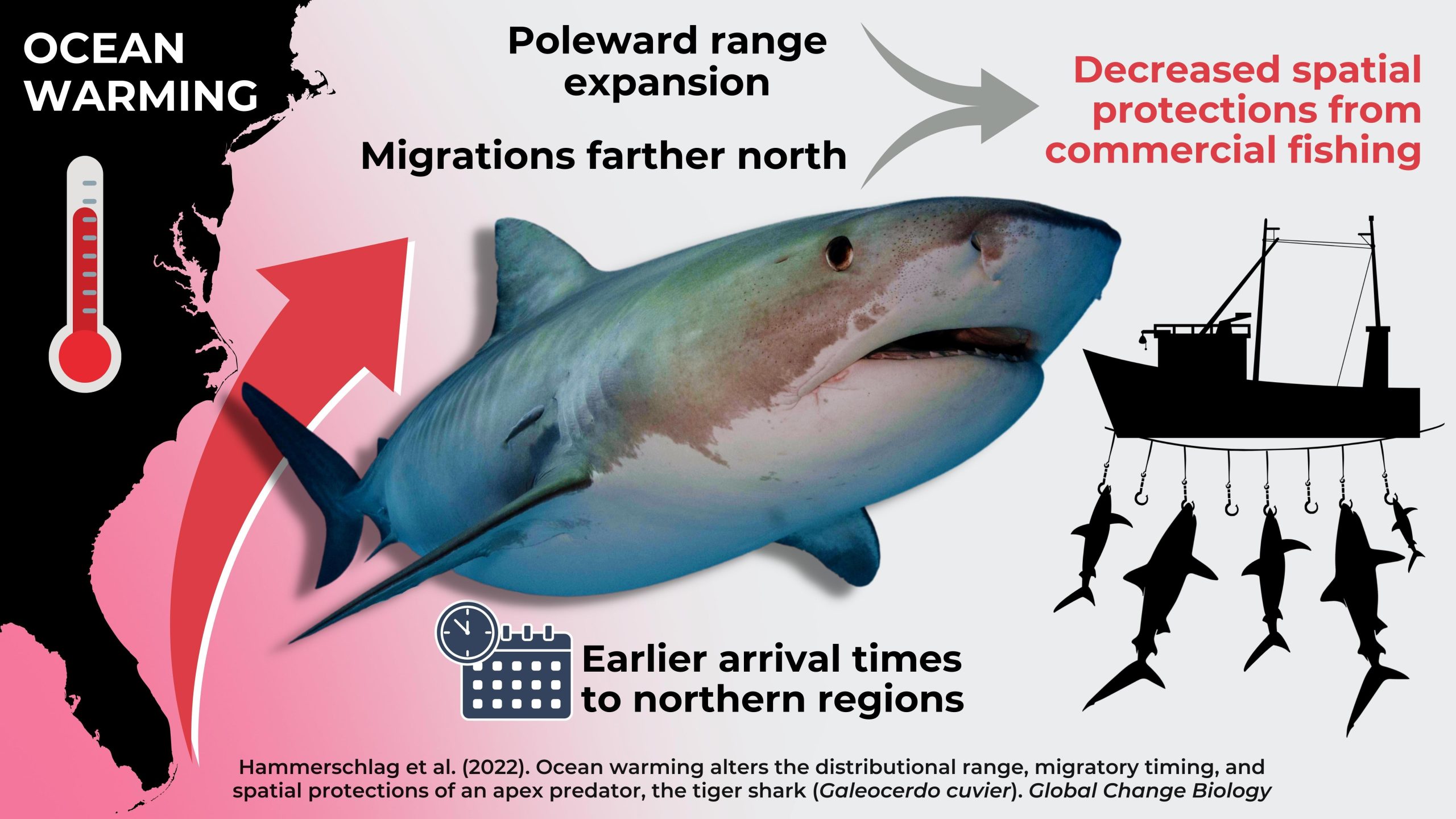
Climate change is pushing tiger sharks in the western North Atlantic into warmer, unprotected waters, increasing their exposure to fishing and potentially upsetting marine ecosystems.
A new study led by scientists at the University of Miami (UM) Rosenstiel School of Marine and Atmospheric Science revealed that the locations and timing of tiger shark movement in the western North Atlantic Ocean have changed from rising ocean temperatures. These climate-driven changes have subsequently shifted tiger shark movements outside of protected areas, leaving the sharks more vulnerable to commercial fishing.
Temperature Impact on Tiger Shark Habitats
The movements of tiger sharks, (Galeocerdo cuvier) the largest cold-blooded apex predator in tropical and warm-temperate seas, are constrained by the need to stay in warm waters. While waters off the U.S. northeast coastline have historically been too cold for tiger sharks, temperatures have warmed significantly in recent years making them suitable for the tiger shark.
Research Findings on Migration Patterns
“Tiger shark annual migrations have expanded poleward, paralleling rising water temperatures,” said Neil Hammerschlag, director of the UM Shark Research and Conservation Program and lead author of the study. “These results have consequences for tiger shark conservation, since shifts in their movements outside of marine protected areas may leave them more vulnerable to commercial fishing.”
Hammerschlag and the research team discovered these climate-driven changes by analyzing nine years of tracking data from satellite-tagged tiger sharks, combined with nearly forty years of conventional tag and recapture information supplied by the National Oceanic and Atmospheric Administration (NOAA) Cooperative Shark Tagging Program and satellite derived sea-surface temperature data.
Implications of Shifted Tiger Shark Migrations
The study found that during the last decade, when ocean temperatures were the warmest on record, for every one-degree Celsius increase in water temperatures above average, tiger shark migrations extended farther poleward by roughly 250 miles (over 400 kilometers) and sharks also migrated about 14 days earlier to waters off the U.S. northeastern coast.
The results may have greater ecosystem implications. “Given their role as apex predators, these changes to tiger shark movements may alter predator-prey interactions, leading to ecological imbalances, and more frequent encounters with humans,” said Hammerschlag.
Reference: “Ocean warming alters the distributional range, migratory timing, and spatial protections of an apex predator, the tiger shark (Galeocerdo cuvier)” by Neil Hammerschlag, Laura H. McDonnell, Mitchell J. Rider, Garrett M. Street, Elliott L. Hazen, Lisa J. Natanson, Camilla T. McCandless, Melanie R. Boudreau, Austin J. Gallagher, Malin L. Pinsky and Ben Kirtman, 13 January 2022, Global Change Biology.
DOI: 10.1111/gcb.16045
The study’s authors include: Neil Hammerschlag, Laura McDonnell, Mitchell Rider, Ben Kirtman from the UM Rosenstiel School; Garrett Street and Melanie Boudreau from Mississippi State University; Elliott Hazen, Lisa Natanson, Camilla McCandless from NOAA Fisheries; Austin J. Gallagher from Beneath the Waves; and Malin Pinsky from Rutgers University.
The Batchelor Foundation, Disney Conservation Fund, Wells Fargo, Guy Harvey Ocean Foundation, the Herbert W. Hoover Foundation, the International Seakeepers Society, Oceana, Hoff Productions for National Geographic, and the West Coast Inland Navigation District provided support for the study.
Never miss a breakthrough: Join the SciTechDaily newsletter.
Follow us on Google and Google News.
3 Comments
It could also be poisoned ocean waters from humans dumping all their sins into the oceans. You should dig deeper before crowing success.
“Tiger shark annual migrations have expanded poleward, paralleling RISING WATER TEMPERATURES,”
Where are the numbers?
From the journal article, “Taken together, tiger sharks possess traits hypothesized to accelerate climate-driven range shifts, namely large body size, high mobility, NARROW THERMAL TOLERANCE, …”
Perhaps that should be “narrow thermal PREFERENCE.” From the same article, Table S1, recovered tags show that tracked individuals experienced temperatures from 7°C (45°F) to 34°C (93°F), or at least a 27°C (49°F) range. I would consider that a substantial range in temperature, really only excluding the Polar Regions.
For context, water has a very high specific heat capacity — about 4 times that of air — meaning it takes 2-4 times as much energy to warm a given volume of water compared to the same volume of air.
A commonly accepted rate of global warming of the atmosphere is about 0.2°C per decade, or less than 0.8°C over the 40-year analysis period. The water probably only increased less than half that, or 0.4°C. So, with individual sharks obviously being able to tolerate a range of at least 27°C, it would seem that a 0.4°C climate warming (~1%) is lost in the noise of the weather induced temperature changes!
Perhaps they have missed something in their haste to blame climate change for all the evils in the world.
There exists no temperature record of the last 150 years that shows any variations greater than science tells us have occurred naturally over the last 5000 years.