

Mild electrical ear stimulation boosted the impact of self-compassion meditation. The findings suggest new possibilities for enhancing mental health interventions.
A new study from University College London (UCL) has found that stimulating the vagus nerve through a device placed on the outer ear can enhance the effectiveness of compassion meditation, increasing people’s ability to practice self-kindness and mindfulness.
The study, published in Psychological Medicine, adds to evidence of the potential benefits of stimulating this key nerve that connects the brain with major organs in the chest and abdomen.
The vagus nerve is a central component of the parasympathetic “rest-and-digest” system, which counters the body’s “fight-or-flight” stress response. It serves as a communication pathway between the brain and internal organs, while also helping regulate key psychological functions, including emotional control and aspects of social behavior.
How the stimulation was applied
The researchers delivered gentle electrical pulses to participants’ vagus nerve by targeting the tragus, the small cartilage flap in front of the ear canal. These pulses were designed to activate nearby nerve fibers beneath the skin.
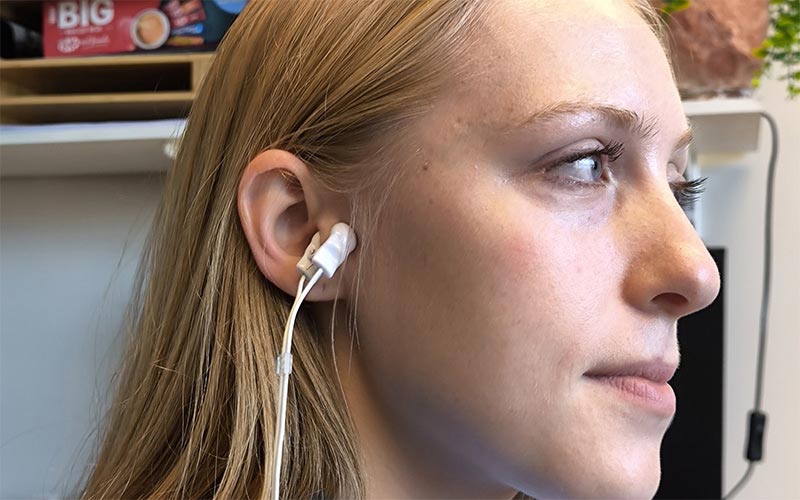
A total of 120 healthy volunteers took part in the study. Some received vagus nerve stimulation through the tragus, while others were given a placebo stimulation on a different part of the ear. Both groups were further divided, with participants completing either self-compassion meditation training or an alternative training program not intended to foster compassion.
Stronger impact on self-compassion and mindfulness
Those who received vagus nerve stimulation in combination with self-compassion meditation showed a more immediate and pronounced improvement in self-compassion compared with the other groups. Their mindfulness—defined as present-moment awareness with calm recognition of one’s thoughts and emotions—was also assessed. Results indicated that while some benefits appeared right away, others grew progressively over repeated training sessions, highlighting both immediate and cumulative effects.
Lead author Professor Sunjeev Kamboj (UCL Psychology & Language Sciences) said: “We found that delivering a small shock to the ear, to stimulate the vagus nerve, can amplify the benefits of certain meditation techniques, particularly those involved in cultivating self-compassion.
“Our findings reveal how neuroscience technology may have a meaningful impact on how we feel about ourselves. Neurostimulation alone had limited benefits, but it may have an important role to play in supporting meditation therapies, which are increasingly used to help people with mental and physical health problems. Meditation can be hard work, requiring persistence and dedication, so a way to boost and accelerate its impacts could be a welcome development for therapists and patients alike.”
The researchers say that further research is needed to refine the technique and to see how long the effects last. Additionally, as this study only investigated healthy participants without a diagnosed psychological disorder, further research is needed to see if this approach could benefit people with conditions such as anxiety, depression, or trauma.
In a separate study, a separate team co-led by a UCL researcher also found that vagus nerve stimulation could help to improve fitness and exercise tolerance.
Reference: “Electroceutical enhancement of self-compassion training using transcutaneous vagus nerve stimulation: results from a preregistered fully factorial randomized controlled trial” by Sunjeev K. Kamboj, Matthew Peniket, Jessica Norman, Rosalind Robshaw, Amit Soni-Tricker, Caroline Falconer, Paul Gilbert and Louise Simeonov, 4 August 2025, Psychological Medicine.
DOI: 10.1017/S0033291725101013
Funding: Fundação Bial
Never miss a breakthrough: Join the SciTechDaily newsletter.
Follow us on Google and Google News.