
Close Menu
    Facebook X (Twitter) Instagram
    SciTechDaily
    • Biology
    • Chemistry
    • Earth
    • Health
    • Physics
    • Science
    • Space
    • Technology
    Facebook X (Twitter) Pinterest YouTube RSS
    SciTechDaily
    Home»Space»Tiny Space Probes Using “Laser Sails” Could Speed to Outer Planets and Beyond
    Space

    Tiny Space Probes Using “Laser Sails” Could Speed to Outer Planets and Beyond

    By American Chemical SocietyFebruary 23, 20222 Comments3 Mins Read
    Facebook Twitter Pinterest Telegram LinkedIn WhatsApp Email Reddit
    Share
    Facebook Twitter LinkedIn Pinterest Telegram Email Reddit
    Project Starshot
    Project Starshot, an initiative sponsored by the Breakthrough Foundation, is intended to be humanity’s first interstellar voyage. Credit: breakthroughinitiatives.org

    Using silicon nitride and boron nitride sails, low-power lasers could launch small probes at unprecedented speeds, revolutionizing space exploration and offering new possibilities for interstellar missions.

    Space travel can be agonizingly slow: For example, the New Horizons probe took almost 10 years to reach Pluto. Traveling to Proxima Centauri b, the closest habitable planet to Earth, would require thousands of years with even the biggest rockets. Now, researchers calculate in ACS’ Nano Letters that low-power lasers on Earth could launch and maneuver small probes equipped with silicon or boron nitride sails, propelling them to much faster speeds than rocket engines.

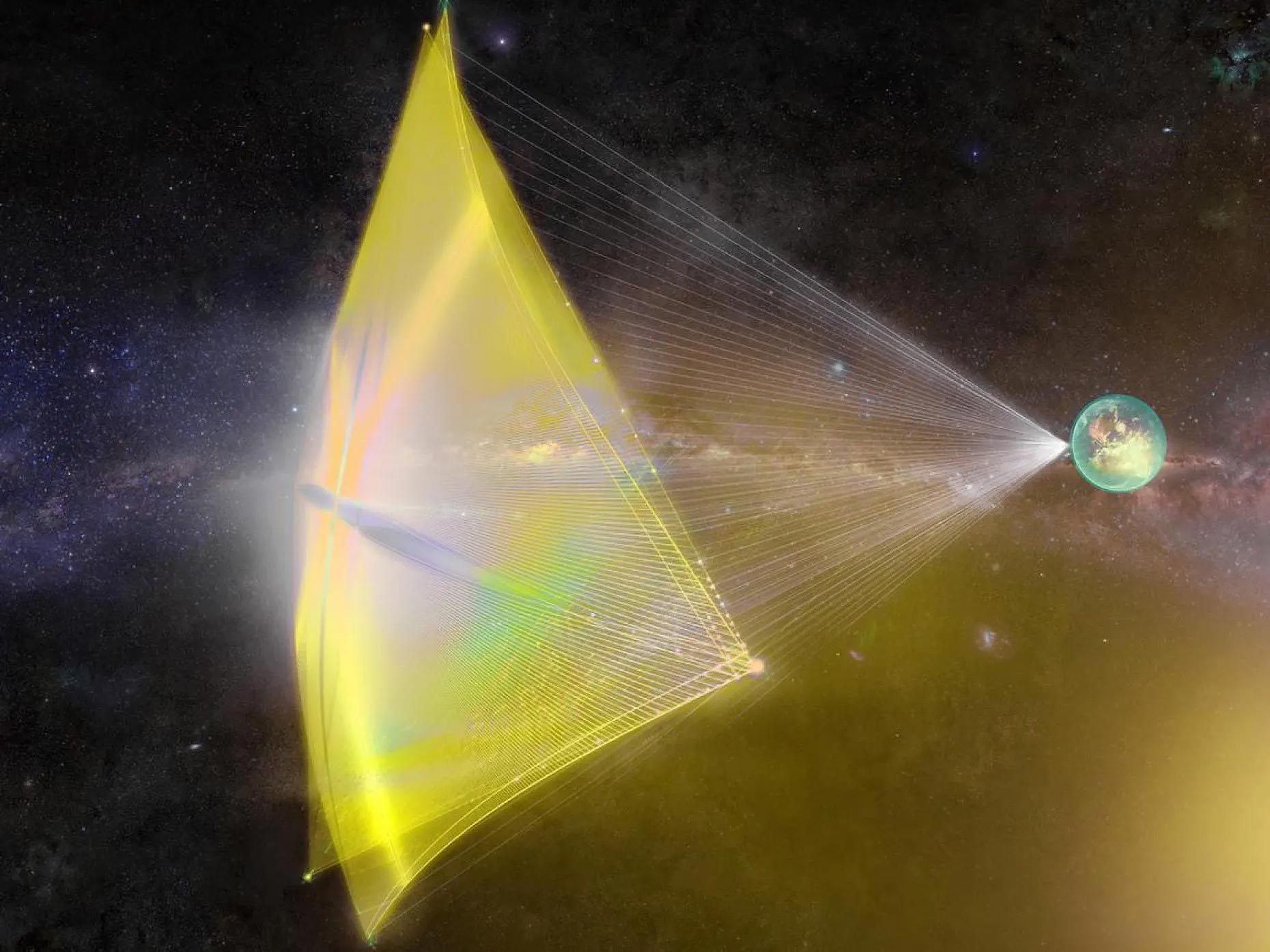
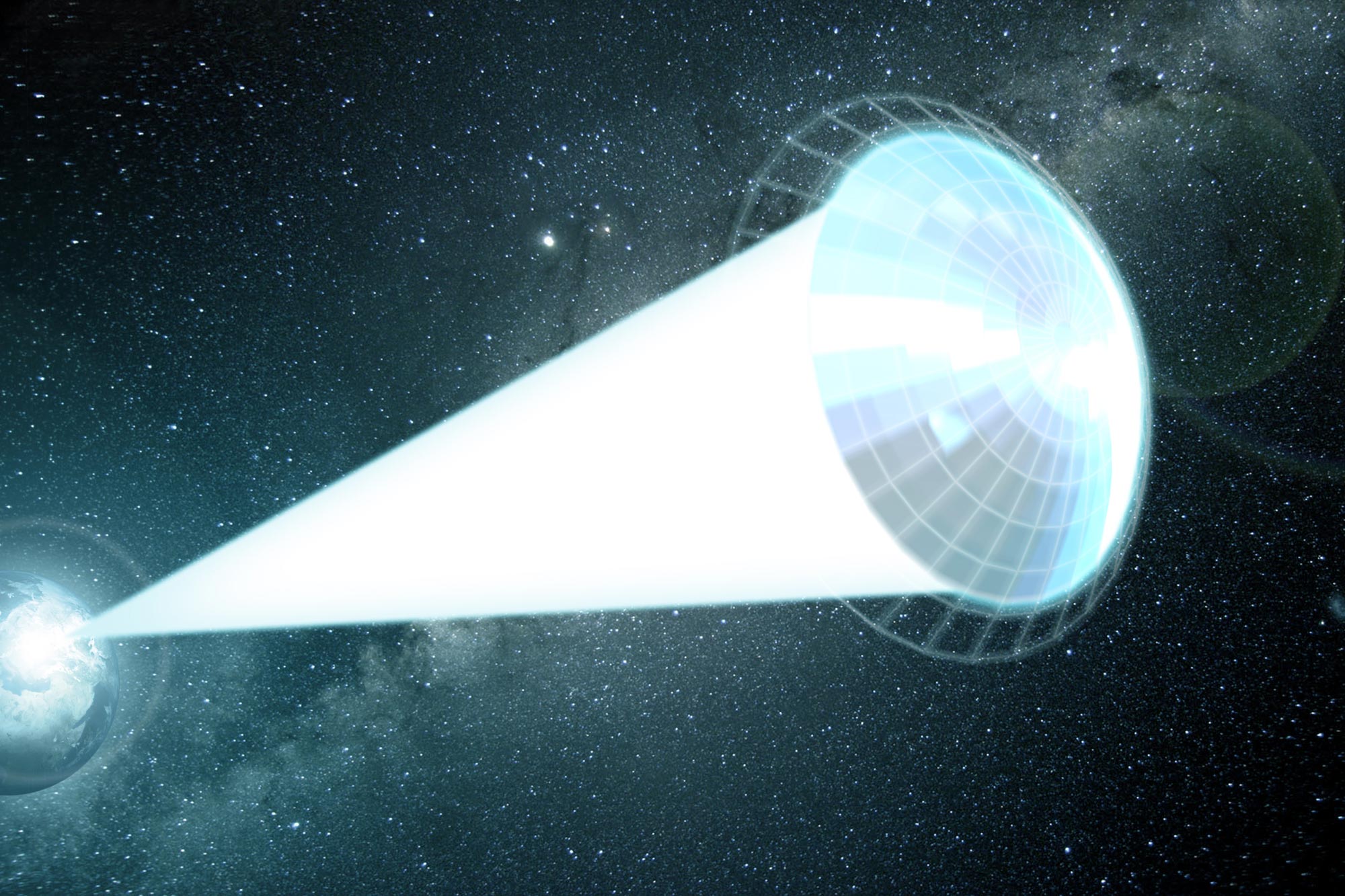
    Instead of catching wind, like the sails on boats, “laser sails” would catch laser beams and could, in principle, push spacecraft to nearly the speed of light. Scientists have been working on this concept for a while. For example, one privately funded project called the Breakthrough Starshot initiative aims to send a small, sailed probe weighing about a gram to Proxima Centauri b with a flight taking only 20 years. It would be propelled to 20% of light speed by a 100 GW, kilometer-square laser array. Ho-Ting Tung and Artur Davoyan wondered if much lower-power, smaller laser arrays could find use in applications where conventional electric and chemical rockets are now used. The lasers might someday be able to adjust the orbit of satellites after launch or propel tiny sailed probes on interplanetary or interstellar missions, without requiring large amounts of fuel.
    Starshot Lightsail Spacecraft Concept
    An artist’s conception of the Starshot Lightsail spacecraft during acceleration by a ground-based laser array. Previous conceptions of lightsails have imagined them being passively pushed by light from the sun, but Starshot’s laser-based approach requires rethinking the sail’s shape and composition so it won’t melt or tear during acceleration. Credit: Masumi Shibata, courtesy of Breakthrough Initiatives

    The researchers performed calculations to show that even lasers with powers of about 100 kW and array sizes of about a meter could power a 1-gram probe at velocities far exceeding the current record, with only minutes to hours of laser illumination. According to their calculations, the lasers could maneuver small probes between different Earth orbits in only a day, which is not possible with current electrical and chemical rockets. The team determined that the best materials for the laser sails, which allowed high reflectivity and rapid cooling, were silicon nitride and boron nitride structured at the nanoscale.

    Finally, the researchers calculated that these tiny laser-propelled probes could travel fast enough to escape the solar system, reaching 5 times higher velocities than the New Horizons probe. These prototype sailed spacecraft, driven by low-power lasers, could pave the wave for fast space exploration and future interstellar flight, the researchers say.

    Tiny Laser Sail Probes
    In this illustration, a low-power laser (red cone) on Earth could be used to shift the orbit (red lines) of a small probe (grey circle), or propel it at rapid speeds to Neptune and beyond. Credit: Adapted from Nano Letters 2022, DOI: 10.1021/acs.nanolett.1c04188

    Reference: “Low-Power Laser Sailing for Fast-Transit Space Flight” by Ho-Ting Tung and Artur R. Davoyan, 31 January 2022, Nano Letters.
    DOI: 10.1021/acs.nanolett.1c04188

    The authors acknowledge funding from NASA, the Air Force Office of Scientific Research, UCLA and the Hellman Society of Fellows.

    Never miss a breakthrough: Join the SciTechDaily newsletter.
    Follow us on Google and Google News.

    American Chemical Society Astrophysics Lasers Popular
    Share. Facebook Twitter Pinterest LinkedIn Email Reddit

    Related Articles

    Unlocking the Secrets of the Universe: Researchers Use High-Powered Lasers to Study Magnetic Reconnection

    Astronomers Detect Powerful “Galactic Space Laser” Five Billion Light Years From Earth

    Testing Whether Einstein’s Theory of General Relativity Is Right With a Record-Breaking Laser Link

    Ancient Galactic Collision Created Stellar Swirls of NGC 5907

    The Bolshoi Simulation: Boxing the Universe

    Lasers Mimic Supernova to Explain Cosmic Magnetic Fields

    Adaptive Optics Will Put Gemini Twin Telescopes at the Forefront of Astronomy Again

    Scientists Convene to Take a Picture of the Supermassive Black Hole at the Center of the Milky Way

    Black Hole Fires Cosmic Bullets of Ionized Gases

    2 Comments

    1. Gayland Andrew Machala on February 25, 2022 7:43 pm

      So lasers, adjusted for the rotation of the Earth, or from orbit, would have to held on a point in space. If from the surface of the earth they would have to be adjusted for diffraction of the atmosphere. If space based they would have to get power, from the sun supposedly. Why not just use a sun sail? The whole thing does not make sense.

      Reply
    2. M Zehnder on February 25, 2022 9:44 pm

      Wow, the whole payload of this theoretical starship is One Gram!? Not much larger than a match stick. I’m sure impressed by how helpful this will be. If we can reduce human passengers or cargo to sizes less than an amoeba, we can waay out there. How does one get Back, by the way, if you have to fly against these super powerful solar winds?

      Reply
    Leave A Reply Cancel Reply

    • Facebook
    • Twitter
    • Pinterest
    • YouTube

    Don't Miss a Discovery

    Subscribe for the Latest in Science & Tech!

    Trending News

    Largest-Ever Study Finds Medicinal Cannabis Ineffective for Anxiety, Depression, PTSD

    250-Million-Year-Old Egg Solves One of Evolution’s Biggest Mysteries

    Living With Roommates Might Be Changing Your Gut Microbiome Without You Knowing

    Century-Old Cleaning Chemical Linked to 500% Increased Risk of Parkinson’s Disease

    What if Your Memories Never Happened? Physicists Take a New Look at the Boltzmann Brain Paradox

    One of the Universe’s Largest Stars May Be Getting Ready To Explode

    Scientists Discover Enzyme That Could Supercharge Ozempic-Like Weight Loss Drugs

    Popular Sweetener Linked to DNA Damage – “It’s Something You Should Not Be Eating”

    Follow SciTechDaily
    • Facebook
    • Twitter
    • YouTube
    • Pinterest
    • Newsletter
    • RSS
    SciTech News
    • Biology News
    • Chemistry News
    • Earth News
    • Health News
    • Physics News
    • Science News
    • Space News
    • Technology News
    Recent Posts
    • Scientists Say This Overlooked Organ Could Hold the Key to Longer Life
    • Want Less Stress? Landmark Study Points to a Simple Habit
    • Scientists Reveal Eating Fruits and Vegetables May Increase Your Risk of Lung Cancer
    • AI Reveals Explosive Growth of Floating Algae Across the World’s Oceans
    • 5.5 Million Bees Discovered Living Beneath a New York Cemetery
    Copyright © 1998 - 2026 SciTechDaily. All Rights Reserved.
    • Science News
    • About
    • Contact
    • Editorial Board
    • Privacy Policy
    • Terms of Use

    Type above and press Enter to search. Press Esc to cancel.