
Close Menu
    Facebook X (Twitter) Instagram
    SciTechDaily
    • Biology
    • Chemistry
    • Earth
    • Health
    • Physics
    • Science
    • Space
    • Technology
    Facebook X (Twitter) Pinterest YouTube RSS
    SciTechDaily
    Home»Earth»Tornado Damage: Nighttime Satellite Images Detail Kentucky Blackout
    Earth

    Tornado Damage: Nighttime Satellite Images Detail Kentucky Blackout

    By Michael Carlowicz, NASA Earth ObservatoryDecember 17, 2021No Comments2 Mins Read
    Facebook Twitter Pinterest Telegram LinkedIn WhatsApp Email Reddit
    Share
    Facebook Twitter LinkedIn Pinterest Telegram Email Reddit
    Nighttime Satellite Images Detail Kentucky Blackout
    December 12, 2021

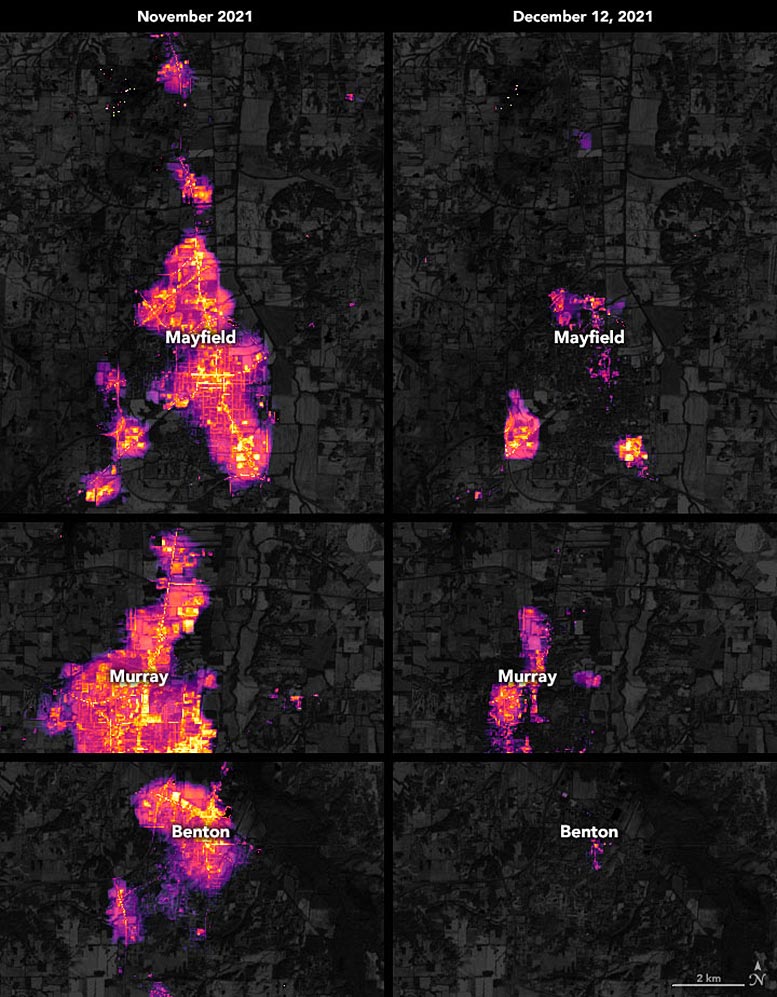
    Tornadoes and severe winds knocked out power to Mayfield and surrounding towns.

    On the night of December 10-11, 2021, a potent storm front and dozens of tornadoes blew across the midwestern United States, killing more than a hundred people and destroying homes and businesses across at least four states. One of the worst-hit areas was western Kentucky near the town of Mayfield. As of December 15, nearly half of the customers in Graves County were still without power.

    The maps above show nighttime light emissions before and after the severe storms passed through Kentucky. A team of scientists from the Universities Space Research Association (USRA) and NASA’s Goddard Space Flight Center (GSFC) processed and analyzed data from the Visible Infrared Imaging Radiometer Suite (VIIRS) on the NOAA–NASA Suomi NPP satellite. The base map was built from data collected by the Landsat 8 satellite. The November image is a composite of lighting across the month, representing the baseline, pre-storm conditions.

    VIIRS measures nighttime light emissions and reflections via its day/night band. This sensing capability makes it possible to distinguish the intensity of lights and to observe how they change. (Sometimes this can help decipher sources and types of light.) The data are processed by researchers in the USRA-GSFC Black Marble Project to account for changes in the landscape, the atmosphere, and the Moon phase, and to filter out stray light from sources that are not electric lights.

    “Because VIIRS DNB satellite data is global in scope, it is especially useful for assessment of the impacts of large-scale disasters like this tornado,” said Kellie Stokes, a USRA scientist in The Black Marble Project. “Though these images show only towns in Kentucky, outages were perceived by Black Marble across a large swath in the Midwest and as far north as the Great Lakes. The Black Marble product is available in near-real time—within about 3 to 5 hours—making it often one of the first datasets available for disaster assessments, particularly in remote areas.”

    Precision is critical for studies with night lights. Raw, unprocessed images can be misleading because moonlight, clouds, pollution, seasonal vegetation—even the position of the satellite—can change how light is reflected and can distort observations of human-made lights.

    NASA Earth Observatory images by Joshua Stevens, using Black Marble data courtesy of Ranjay Shrestha/NASA Goddard Space Flight Center and Landsat data from the U.S. Geological Survey.

    Never miss a breakthrough: Join the SciTechDaily newsletter.
    Follow us on Google and Google News.

    Atmospheric Science NASA NASA Earth Observatory Storms Tornadoes Weather
    Share. Facebook Twitter Pinterest LinkedIn Email Reddit

    Related Articles

    Satellite Imagery Shows 16 Mile Line of Destruction From EF-3 Tornado Ripping Through Gaylord

    Rapid Intensification for Super Typhoon Chanthu

    Flash Floods From Ida Swamp the Northeast – Areas Hit With 6-10″ of Rain Fall in Just a Few Hours

    NASA Satellite Observes Massive Power Outages in New Orleans

    Hurricane Ida Batters Louisiana: 5th-Strongest Storm Ever To Make Landfall in the Continental U.S.

    Tropical Storm Henri Continues To Strengthen

    Incredible View of Tropical Storm Elsa Captured From Space

    A Cirrus Sign of Tornadoes – An Early Clue of Destructive Weather

    Early Tropical Storm in the Eastern Pacific Sets a New Record

    Leave A Reply Cancel Reply

    • Facebook
    • Twitter
    • Pinterest
    • YouTube

    Don't Miss a Discovery

    Subscribe for the Latest in Science & Tech!

    Trending News

    Millions Take These IBS Drugs, But a New Study Finds Serious Risks

    Scientists Unlock Hidden Secrets of 2,300-Year-Old Mummies Using Cutting-Edge CT Scanner

    Bread Might Be Making You Gain Weight Even Without Eating More Calories

    Scientists Discover Massive Magma Reservoir Beneath Tuscany

    Europe’s Most Active Volcano Just Got Stranger – Here’s Why Scientists Are Rethinking It

    Alzheimer’s Symptoms May Start Outside the Brain, Study Finds

    Millions Take This Popular Supplement – Scientists Discover a Concerning Link to Heart Failure

    The Universe Is Expanding Too Fast and Scientists Can’t Explain Why

    Follow SciTechDaily
    • Facebook
    • Twitter
    • YouTube
    • Pinterest
    • Newsletter
    • RSS
    SciTech News
    • Biology News
    • Chemistry News
    • Earth News
    • Health News
    • Physics News
    • Science News
    • Space News
    • Technology News
    Recent Posts
    • Doctors Surprised by the Power of a Simple Drug Against Colon Cancer
    • Why Popular Diabetes Drugs Like Ozempic Don’t Work for Everyone: The “Genetic Glitch”
    • Scientists Create Improved Insulin Cells That Reverse Diabetes in Mice
    • Scientists Stunned After Finding Plant Thought Extinct for 60 Years
    • A Common Diabetes Drug May Hold the Key to Stopping HIV From Coming Back
    Copyright © 1998 - 2026 SciTechDaily. All Rights Reserved.
    • Science News
    • About
    • Contact
    • Editorial Board
    • Privacy Policy
    • Terms of Use

    Type above and press Enter to search. Press Esc to cancel.