
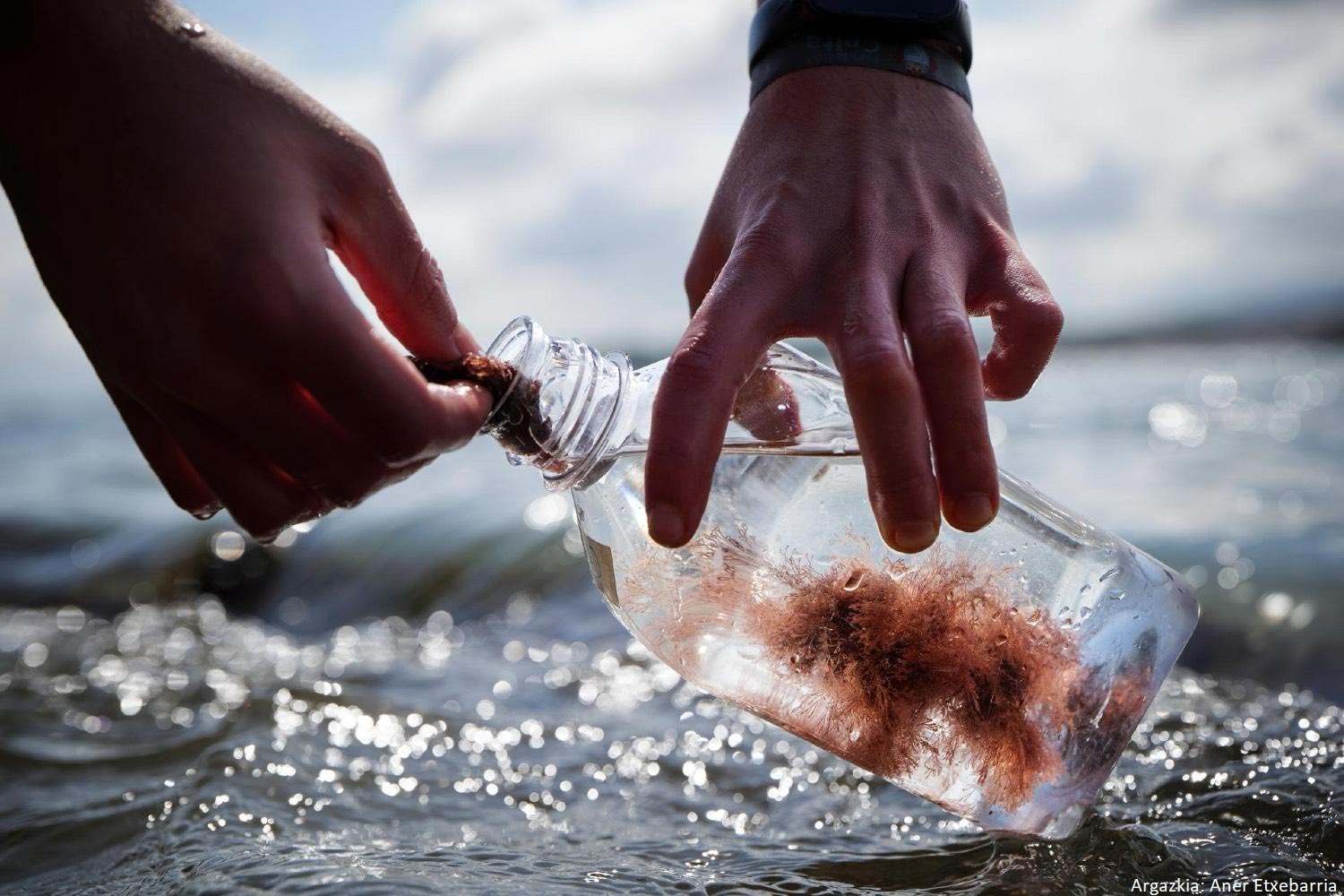
The spread of the Ostreopsis ovata algae is not a cause for concern, but ongoing monitoring is recommended, according to Laurenns Balparda, a researcher at the University of the Basque Country (UPV/EHU).
Ostreopsis is a microscopic alga that thrives in shallow waters. Certain species produce toxins that can cause symptoms such as coughing, fever, skin irritation, and mild respiratory issues. Originally native to tropical regions, rising ocean temperatures have expanded their suitable habitats, including the Basque coast.
In the Bay of Biscay, Ostreopsis was first detected in 2007. Initially, its presence was sporadic, but in recent years, large blooms have become common along the coastline during summer. While these blooms do not always pose a threat, the first recorded cases of poisoning occurred in Lapurdi-Labourd in 2020, followed by Donostia/San Sebastián in 2021.
In this context, a team from the UPV/EHU’s phytoplankton laboratory studied the proliferation of Ostreopsis in La Concha Bay: “We analyzed their presence in two locations: in the west of Ondarreta and in the east of La Concha. The aim was to find out about their development in both locations and to detect the factors that led to the huge growth of the microalgae in Donostia,” explained the researcher Yago Laurenns-Balparda.
The study revealed that Ostreopsis is more abundant in Ondarreta and its authors concluded that this is due to the type of substrate: “The two locations where we took samples are quite similar in terms of temperature, current, wind, and salinity. What distinguishes them is the substrate: the seabed of Ondarreta is completely covered by rocks of varying sizes where there is a large amount of macroalgae, which is one of the favorite places for Ostreopsis to grow. By contrast, almost the entire seabed of La Concha is sand; there are few rocks or macroalgae. So, the substrate does not encourage the development of Ostreopsis.”
Laurenns-Balparda pointed out that the fact that this microalga is abundant on our coasts does not mean that bathing from these beaches is always dangerous: “In fact, even though the samples collected in the summers of 2022 and 2023 indicated a massive presence of Ostreopsis in La Concha Bay, no cases of poisoning were recorded on the beaches of Donostia during those years. It is advisable to continue taking measurements to find out the level of concentration of these algae and to keep the situation under control, but their abundance is not always a cause for alarm. Just because there is a lot of Ostreopsis doesn’t mean that toxicity is high.”
Presence of potentially toxic species ovata confirmed for the first time in La Concha Bay
Besides corroborating the importance of the type of substrate as a determining factor in encouraging the massive growth of Ostreopsis, the research carried out by the UPV/EHU has served to confirm that, of the thirteen species that exist, the toxic ovata is present in La Concha Bay. This is something new, given that until now only research in which the harmless species Siamensis was detected has been published. Laurenns-Balparda pointed out that “in the past, it could be assumed or taken for granted that ovata was also present because it is a priori the only toxic species of Ostreopsis. However, it could not be confirmed. Our study was the first to prove it.”
Even so, there are still questions to be answered, since although the study showed that Siamensis and Ovata coexist in La Concha and Ondarreta, it was not able to determine the proportion in which each of the species is present: “We weren’t able to do this because they are very similar to each other and cannot be differentiated even under a microscope. However, thanks to molecular studies, we did manage to confirm that many of the strains of cells that we isolated from the samples collected on the beaches were ovata, but these analyses do not allow us to know which of the two species is more abundant,” explained Laurenns-Balparda.
The UPV/EHU biologist emphasizes the importance of conducting further research to gain a better understanding of the dynamics of these microalgae, “to get more comprehensive knowledge about what other factors may affect their growth and toxicity, and to be able to implement some technology that will help to determine which species predominates.”
Reference: “Summer Ostreopsis blooms in San Sebastian (South-East Bay of Biscay): The importance of substrate features” by Yago Laurenns-Balparda and Sergio Seoane, 21 December 2024, Marine Pollution Bulletin.
DOI: 10.1016/j.marpolbul.2024.117484
Never miss a breakthrough: Join the SciTechDaily newsletter.
Follow us on Google and Google News.