
Close Menu
    Facebook X (Twitter) Instagram
    SciTechDaily
    • Biology
    • Chemistry
    • Earth
    • Health
    • Physics
    • Science
    • Space
    • Technology
    Facebook X (Twitter) Pinterest YouTube RSS
    SciTechDaily
    Home»Space»Traces of Dwarf Planet Ceres’ Icy Crust Found at Occator Crater
    Space

    Traces of Dwarf Planet Ceres’ Icy Crust Found at Occator Crater

    By Planetary Science InstituteAugust 19, 2021No Comments3 Mins Read
    Facebook Twitter Pinterest Telegram LinkedIn WhatsApp Email Reddit
    Share
    Facebook Twitter LinkedIn Pinterest Telegram Email Reddit
    Ceres Occator Crater
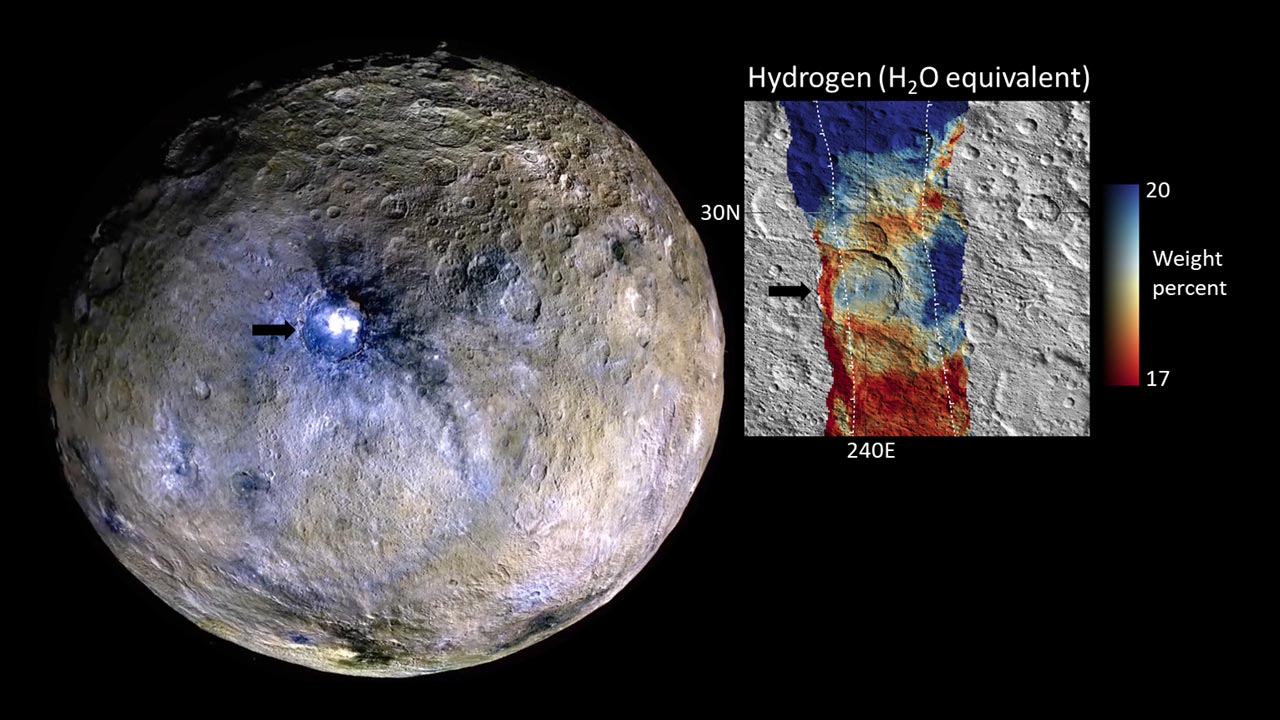
    The study focused on Occator crater (left), which contains Ceres’ most prominent bright spots. The newly reported map (right) reveals higher concentrations of hydrogen than expected if the near sub-surface within Occator crater and its ejecta blanket was ice free. Results indicate that the crustal materials excavated by the crater-forming impact were rich in water ice. Credit: NASA/JPL-CalTech/UCLA/MPS/DLR/IDA and Prettyman et al. (2021).

    NASA’s Dawn mission revealed water ice beneath Ceres’ Occator crater, suggesting a long-lived, ice-rich crust and raising prospects for habitability.

    Anomalies in the distribution of hydrogen at Occator crater on the dwarf planet Ceres reveal an icy crust, says a new paper led by Tom Prettyman, a Senior Scientist at the Planetary Science Institute. 

    The evidence comes from data acquired by the Gamma Ray and Neutron Detector (GRaND) aboard NASA’s Dawn spacecraft. A detailed map of the concentration of hydrogen in the vicinity of Occator was derived from observations from elliptical orbits that brought the spacecraft very close to the surface during the final mission phase, said Prettyman. The paper entitled “Replenishment of near-surface water ice by impacts into Ceres’ volatile-rich crust: Observations by Dawn’s Gamma Ray and Neutron Detector” appears in the journal Geophysical Research Letters. PSI scientists Yuki Yamashita, Norbert Schorghofer, Carle Pieters and Hanna Sizemore, are co-authors. 

    GRaND’s neutron spectrometer found elevated hydrogen concentrations in the outermost meter of the surface of Occator, a large, young crater 92 kilometers (57 miles) in diameter, the paper says. The paper argues that the excess hydrogen is in the form of water ice. Results confirm Ceres outer crust is ice rich and that water ice can survive within impact ejecta on airless, icy bodies. The data imply partial control of the distribution of near-surface ice by large impacts and provide constraints on surface age and regolith thermophysical properties. 

    “We think that ice has survived in the shallow subsurface during the roughly 20 million years following the formation of Occator. Similarities between the global distribution of hydrogen and the pattern of large craters suggest impact processes have delivered ice to the surface elsewhere on Ceres. This process is accompanied by the loss of ice by sublimation caused by heating of the surface by sunlight,” Prettyman said. 

    “The impact that formed Occator would have excavated crustal materials as deep as 10 kilometers (about 6 miles). So, observed enhancements in the concentration of hydrogen within the crater and ejecta blanket support our interpretation that the crust is ice rich. The findings reinforce the emerging consensus that Ceres is a differentiated body in which ice separated from rock to form an icy outer shell and subcrustal ocean,” Prettyman said. 

    “Smaller, water-rich bodies, including the parent bodies of the carbonaceous chondrite meteorites, may not have experienced differentiation. So, the findings could have implications for the evolution of icy bodies, small and large,” Prettyman said. “More broadly, as an ocean world, Ceres could be habitable and is therefore an attractive target for future missions.”  

    Reference: “Replenishment of Near-Surface Water Ice by Impacts Into Ceres’ Volatile-Rich Crust: Observations by Dawn’s Gamma Ray and Neutron Detector” by T. H. Prettyman, N. Yamashita, M. E. Landis, J. C. Castillo-Rogez, N. Schörghofer, C. M. Pieters, H. G. Sizemore, H. Hiesinger, S. Marchi, H. Y. McSween, R. S. Park, M. J. Toplis, C. A. Raymond and C. T. Russell, 21 July 2021, Geophysical Research Letters.
    DOI: 10.1029/2021GL094223

    Funding for the study was provided by a grant from NASA’s Discovery Data Analysis Program, the NASA Dawn Mission, and by the SSERVI TREX project.

    Never miss a breakthrough: Join the SciTechDaily newsletter.
    Follow us on Google and Google News.

    Asteroid Ceres Geophysics Planetary Science Institute Planets
    Share. Facebook Twitter Pinterest LinkedIn Email Reddit

    Related Articles

    Meteorites That Helped Form Earth May Have Originated in the Outer Solar System

    Widespread Megaripple Activity Detected Across the North Polar Region of Mars

    Preserved Billion Year-Old Dune Fields on Mars Offer Insights Into Martian History

    NASA InSight Lander Takes Deep Mars Measurements: Seismograph Data Reveals Boundaries From Crust to Core

    Evidence Pluto Started Out With Liquid Oceans That Have Been Slowly Freezing Over Time

    How’s the Weather on Mars? Electrically Charged Dust Storms Drive Martian Chlorine Cycle

    What’s Mars Made Of? Simulating Martian Core to Investigate Its Composition and Origin

    ‘Asteroid’ Hygiea Could Actually Be Smallest Dwarf Planet in the Solar System

    Small Asteroids Completely Shattered the Moon’s Upper Crust

    Leave A Reply Cancel Reply

    • Facebook
    • Twitter
    • Pinterest
    • YouTube

    Don't Miss a Discovery

    Subscribe for the Latest in Science & Tech!

    Trending News

    Scientists Discover How Coffee Impacts Memory, Mood, and Gut Health

    Why Did the Neanderthals Disappear? Scientists Reveal Humans Had a Hidden Advantage

    Physicists Propose Strange Experiment Where Time Goes Quantum

    Magnesium Magic: New Drug Melts Fat Even on a High-Fat, High-Sugar Diet

    Weight-Loss Drugs Like Ozempic May Come With an Unexpected Cost

    Mezcal “Worm” in a Bottle Mystery: DNA Testing Reveals a Surprise

    New Research Reveals That Your Morning Coffee Activates an Ancient Longevity Switch

    This Is What Makes You Irresistible to Mosquitoes

    Follow SciTechDaily
    • Facebook
    • Twitter
    • YouTube
    • Pinterest
    • Newsletter
    • RSS
    SciTech News
    • Biology News
    • Chemistry News
    • Earth News
    • Health News
    • Physics News
    • Science News
    • Space News
    • Technology News
    Recent Posts
    • Harvard Scientists Reveal Secret Structure Behind How You Smell
    • Scientists Just Discovered the Hidden Trick That Keeps Your Cells Alive
    • This Simple Movement Could Be Secretly Cleaning Your Brain
    • Male Birth Control Breakthrough: Scientists Find Way To Turn Sperm Production Off and Back On
    • A Common Vitamin Could Hold the Key to Treating Fatty Liver Disease
    Copyright © 1998 - 2026 SciTechDaily. All Rights Reserved.
    • Science News
    • About
    • Contact
    • Editorial Board
    • Privacy Policy
    • Terms of Use

    Type above and press Enter to search. Press Esc to cancel.