
A daring new laser-based technique lets researchers trap and charge a single aerosol particle, opening a window into how tiny ice crystals in clouds might store and release electrical energy.
As the team discovered, laser photons can knock electrons off these particles one by one, allowing scientists to watch them charge up, discharge, and behave in ways that echo what may be happening high above in thunderstorm clouds.
The work could illuminate one of nature’s most mysterious processes—how the very first spark of lightning begins.
Aerosols and Their Hidden Complexity
Aerosols are tiny particles of liquid or solid material that drift through the air and are constantly present in our surroundings. Some are big enough to spot, like spring pollen, while others, including flu-season viruses, are far too small to see. A few are even detectable by taste, such as the salt particles floating in seaside air.
PhD student Andrea Stöllner, a member of the Waitukaitis and Muller groups at the Institute of Science and Technology Austria (ISTA), studies the behavior of ice crystals found in clouds. To investigate how these crystals form and build up electrical charge, she works with model aerosols made of small, transparent silica particles.
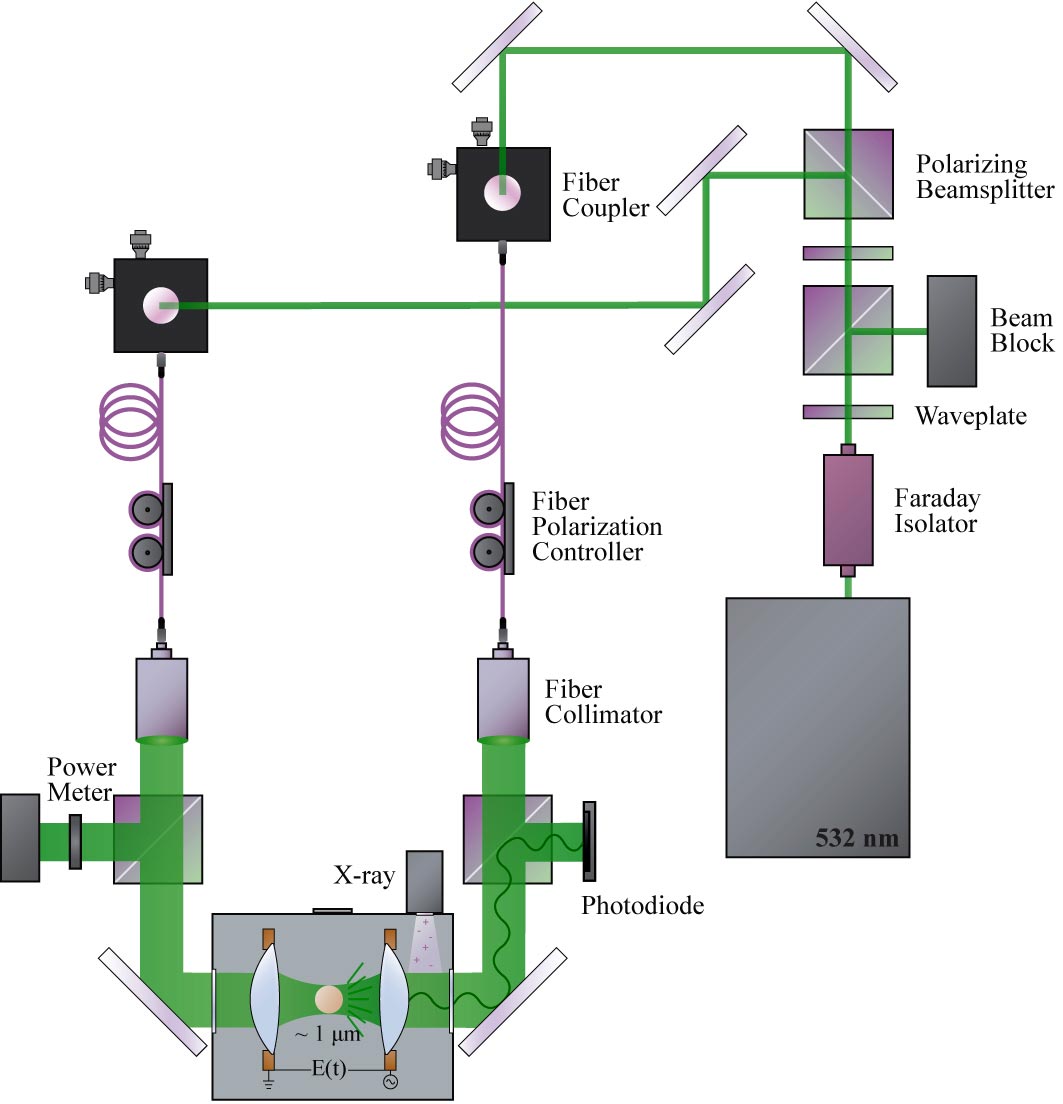
Together with former ISTA postdoc Isaac Lenton, ISTA Assistant Professor Scott Waitukaitis and colleagues, Stöllner has created a method to capture, hold, and electrically charge a single silica particle using two focused laser beams. The technique could be used to explore a range of scientific questions, including how clouds become electrically active and what initiates lightning.
Catching a micron-sized particle is challenging. To get the job done, two laser beams come in handy. Acting like tweezers, they can trap, secure, and charge a solitary particle. Credit: © Andrea Stöllner / ISTA
Laser Trapping Breakthroughs in Aerosol Research
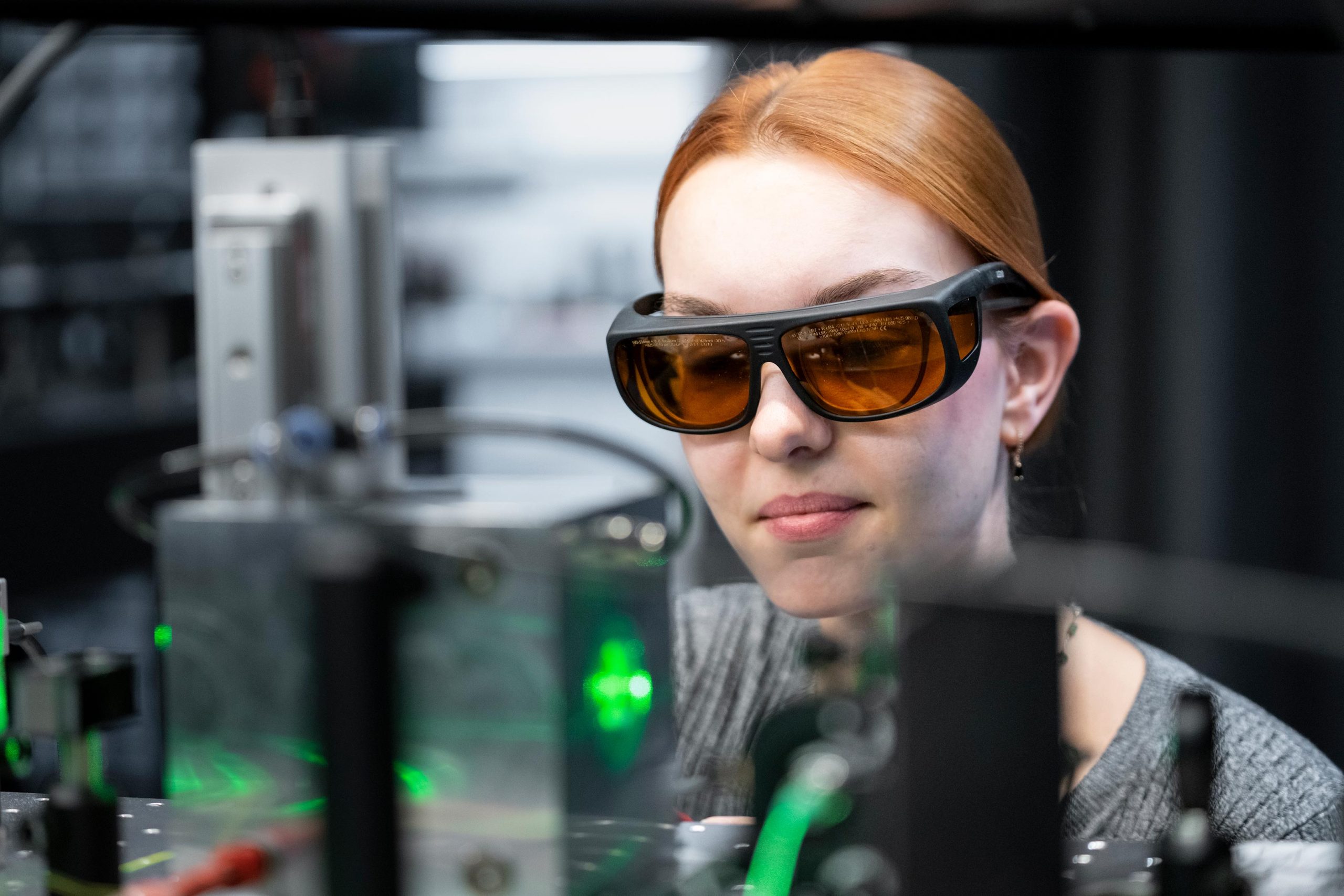
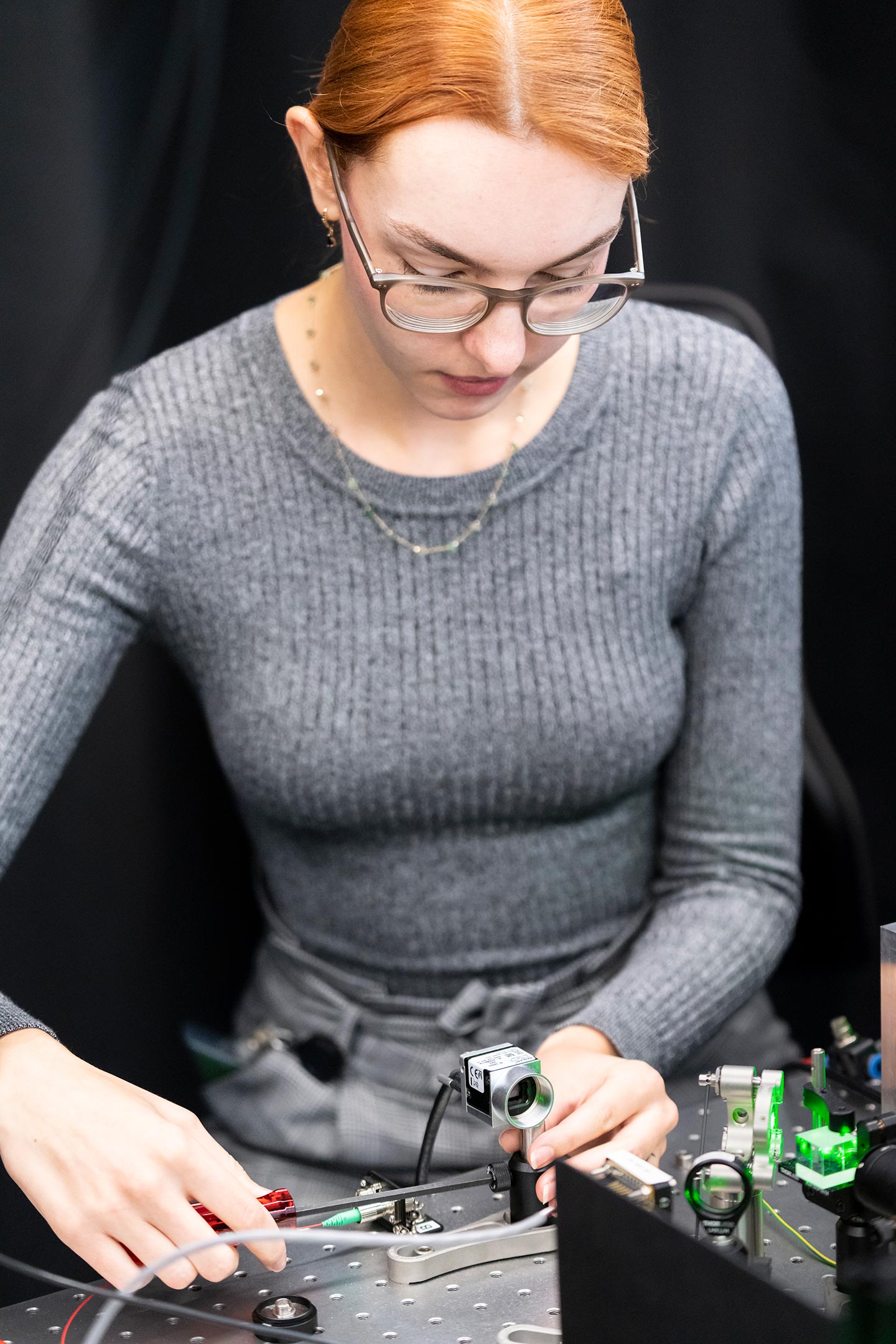
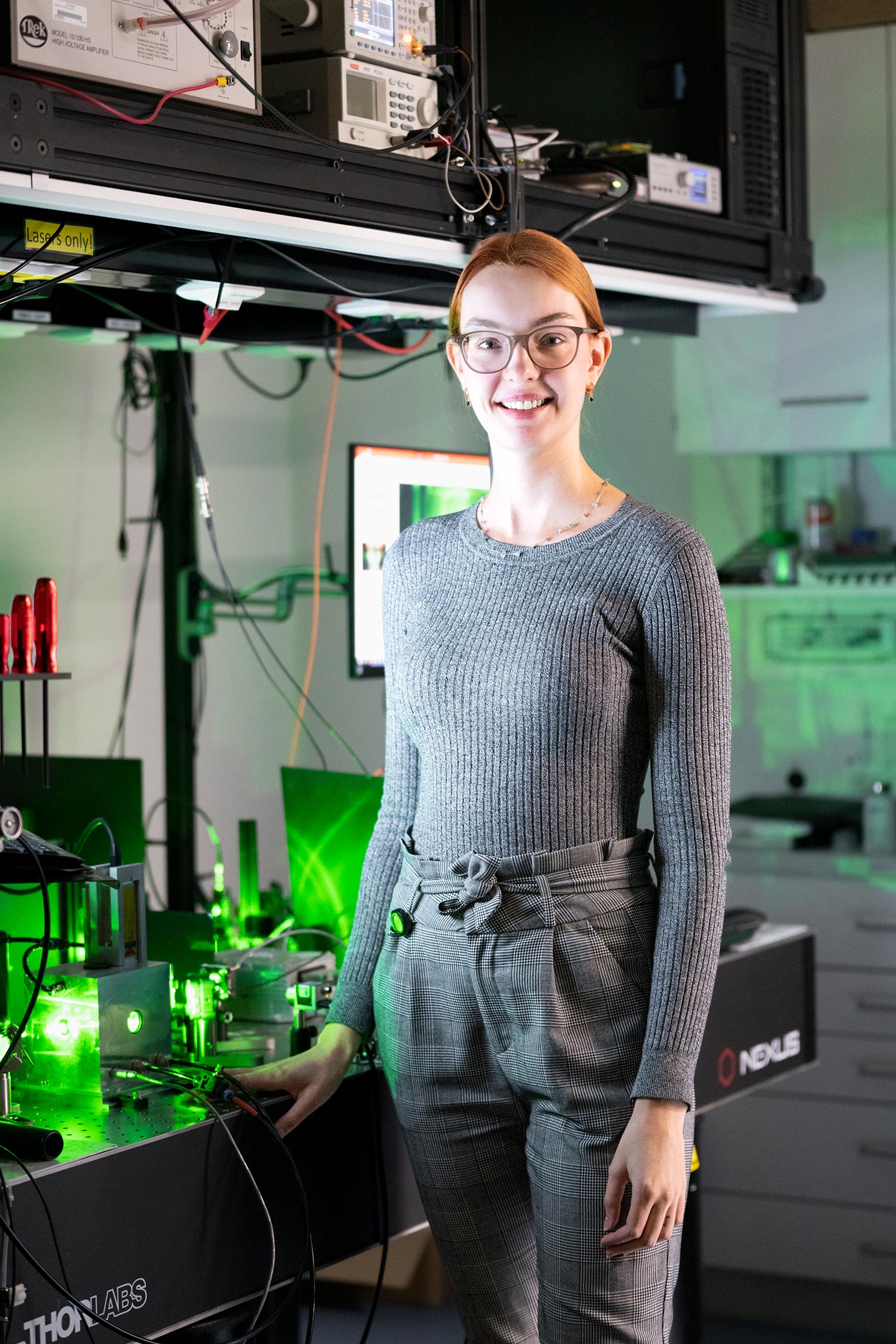
In her lab, Stöllner stands beside a wide table filled with polished metal instruments. Green laser beams move across the setup, reflecting from one tiny mirror to another. The table emits a soft, steady hiss like escaping air. “It’s an anti-vibration table,” she explains, emphasizing how it prevents small disturbances from interfering with the delicate laser work.
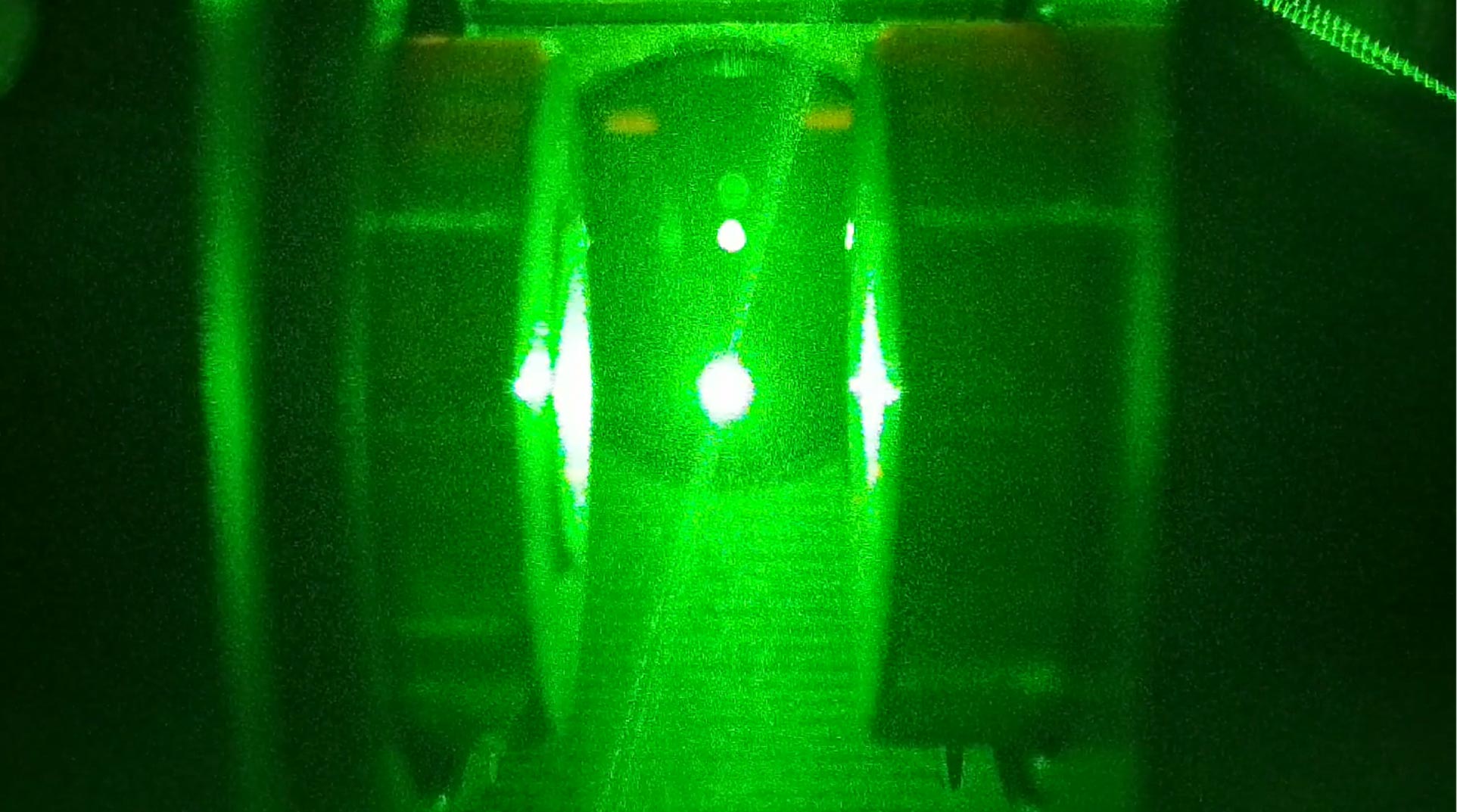
The lasers weave their way through a carefully arranged sequence of components before merging into two aligned beams that enter a small enclosure. At that point they form a light-based “trap,” functioning as “optical tweezers” that can keep minuscule objects suspended in place. As particles drift through the enclosure, one may suddenly light up in bright green, revealing that it has been successfully captured inside the trap.
“The first time I caught a particle, I was over the moon,” Stöllner says as she recalls her Eureka moment two years ago, just before Christmas. “Scott Waitukaitis and my colleagues rushed into the lab and took a short glimpse at the captured aerosol particle. It lasted exactly three minutes, then the particle was gone. Now we can hold it in that position for weeks.”
Reaching this level of stability took nearly four years of refinement, building on an earlier setup designed by Lenton. “Originally, our setup was built to just hold a single particle, analyze its charge, and figure out how humidity changes its charges,” explains Stöllner. “But we never came this far. We found out that the laser we are using is itself charging our aerosol particles.”
How Light Kicks Out Electrons
The scientist and her colleagues discovered that lasers charge the particle through a “two-photon process.”
Typically, aerosol particles are close to neutrally charged, with electrons (negatively charged entities) swirling around in every atom of the particle. The laser beams consist of photons (particles of light traveling at the speed of light), and when two of these photons are absorbed simultaneously, they can ‘kick out’ one electron from the particle. In this way, the particle gains one elemental positive charge. Step by step, it becomes increasingly positively charged.
For Stöllner, uncovering this mechanism is an exciting discovery that she can leverage in her research. “We can now precisely observe the evolution of one aerosol particle as it charges up from neutral to highly charged and adjust the laser power to control the rate.”
This observation also reveals that, as the particle becomes positively charged, it begins to discharge, meaning that it occasionally releases charge in spontaneous bursts.
Way above our heads, something similar might also be happening in clouds.
Electrified Clouds and the Origins of Lightning
Thunderstorm clouds contain ice crystals and larger ice pellets. When these collide, they exchange electric charges. Eventually, the cloud becomes so charged that lightning forms. One theory suggests that the first little spark of a lightning bolt could be initiated at the charged ice crystals themselves. However, the exact science behind the phenomenon of lightning formation remains a mystery. Alternative theories meanwhile suggest cosmic rays initiate the process as the charged particles they create accelerate from pre-existing electric fields. According to Stöllner, however, the current understanding in the scientific community is that – in either case – the electric field in clouds seems too low to cause lightning.
“Our new setup allows us to explore the ice crystal theory by closely examining a particle’s charging dynamics over time,” Stöllner explains. While ice crystals in clouds are much larger than the model ones, the ISTA scientists are now aiming to decode these microscale interactions to better understand the big picture. “Our model ice crystals are showing discharges and maybe there’s more to that. Imagine if they eventually create super tiny lightning sparks—that would be so cool,” Stöllner says with a smile.
Reference: “Using Optical Tweezers to Simultaneously Trap, Charge, and Measure the Charge of a Microparticle in Air” by Andrea Stoellner, Isaac C. D. Lenton, Artem G. Volosniev, James Millen, Renjiro Shibuya, Hisao Ishii, Dmytro Rak, Zhanybek Alpichshev, Grégory David, Ruth Signorell, Caroline Muller and Scott Waitukaitis, 20 November 2025, Physical Review Letters.
DOI: 10.1103/5xd9-4tjj
Never miss a breakthrough: Join the SciTechDaily newsletter.
Follow us on Google and Google News.
4 Comments
Thunderstorm clouds contain ice crystals and larger ice pellets. When these collide, they exchange electric charges. Eventually, the cloud becomes so charged that lightning forms. however, the current understanding in the scientific community is that – in either case – the electric field in clouds seems too low to cause lightning.
WHY? WHY? WHY?
The branch of mathematics known as topology has become a cornerstone of modern physics. The perpetually swirling topological vortices defy traditional physics’ expectations. Topological Vortex Theory (TVT) may have a profound impact on the development direction and research methods of modern physics. Please ask the researchers to think deeply:
Can spin, self-organization, and synchronization cause excitation?
When we pursue the ultimate truth of all things, the space in which our bodies and all things exist may itself be the final and deepest puzzle we need to explore. This is not only the pursuit of physics, but also the most magnificent exploration of the origin of the universe by human reason.
Based on the Topological Vortex Theory (TVT), space is an uniformly incompressible physical entity. Space-time vortices are the products of topological phase transitions of the tipping points in space, are the point defects in spacetime. Point defects do not only impact the thermodynamic properties, but are also central to kinetic processes. They create all things and shape the world through spin and self-organization.
In today’s physics, some so-called peer-reviewed journals—including Physical Review Letters, Nature, Science, and others—stubbornly insist on and promote the following:
1. Even though θ and τ particles exhibit differences in experiments, physics can claim they are the same particle. This is science.
2. Even though topological vortices and antivortices have identical structures and opposite rotational directions, physics can define their structures and directions as entirely different. This is science.
3. Even though two sets of cobalt-60 rotate in opposite directions and experiments reveal asymmetry, physics can still define them as mirror images of each other. This is science.
4. Even though vortex structures are ubiquitous—from cosmic accretion disks to particle spins—physics must insist that vortex structures do not exist and require verification. Only the particles that like God, Demonic, or Angelic are the most fundamental structures of the universe. This is science.
5. Even though everything occupies space and maintains its existence in time, physics must still debate and insist on whether space exists and whether time is a figment of the human mind. This is science.
6. Even though space, with its non-stick, incompressible, and isotropic characteristics, provides a solid foundation for the development of physics, physics must still insist that the ideal fluid properties of space do not exist. This is science.
and go on.
Is this the counterintuitive science they widely promote? Compromising with pseudo academic publications and peer review by pseudo scholars is an insult to science and public intelligence. Some so-called scholars no longer understand what shame is. The study of Topological Vortex Theory (TVT) reminds us that the most profound problems in physics often lie at the intersection of different theories. By exploring these border regions, we can not only resolve contradictions in existing theories but also discover new physical phenomena and application possibilities.
Under the topological vortex architecture, it is highly challenging for even two hydrogen atoms or two quarks to be perfectly symmetrical, let alone counter-rotating two sets of cobalt-60. Contemporary physics and so-called peer-reviewed publications (including Physical Review Letters, Science, Nature, etc.) stubbornly believe that two sets of counter rotating cobalt-60 are two mirror images of each other, constructing a more shocking pseudoscientific theoretical framework in the history of science than the “geocentric model”. This pseudo scientific framework and system have seriously hindered scientific progress and social development.
For nearly a century, physics has been manipulated by this pseudo scientific theoretical system and the interest groups behind it, wasting a lot of manpower, funds, and time. A large amount of pseudo scientific research has been conducted, and countless pseudo scientific papers have been published, causing serious negative impacts on scientific and social progress, as well as humanistic development.
Complexity does not necessarily mean that there is no logical and architectural framework to follow. Mathematics is the language and tool that reveals the motion of spacetime, rather than the motion itself. Although the physical form of spacetime vortices is extremely simple, their interaction patterns are highly complex, and we must develop more and richer mathematical languages to describe and understand them.
The development of the Topological Vortex Theory (TVT) reflects a progression from concrete physical phenomena to abstract mathematical modeling and, ultimately, to interdisciplinary unification. Its core innovation lies in forging the continuous spacetime geometry of general relativity with the discrete interactions of quantum field theory within the same topological dynamical system.
——Excerpted from https://scitechdaily.com/microscope-spacecrafts-most-precise-test-of-key-component-of-the-theory-of-general-relativity/#comment-909171.
Please ask researchers to think deeply:
1. Is it unverifiable and untested that the topological vortex theory predicts the existence of cosmic vortices?
2. Is there no vortex from particle spin to cosmic accretion disk?
3. What does it mean that two sets of cobalt-60 rotating in opposite directions, even if asymmetric, are mirror images of each other?
The dirtiness and ugliness of certain individuals and publications in physics today have seriously hindered scientific progress and development. Are the Physical Review series publications (including Physical Review Letters) scientific and honest?
Topological structures, such as vortices, are prevalent in nature and science across a wide range of length scales, ranging from macroscopic cosmic strings (1), mesoscale liquid crystals (2, 3) and ferromagnets (4), nanoscale ferroelectrics and superconductor/superfluid Bose-Einstein condensate states (5, 6), down to the atomic nucleus (7).
——Excerpted from https://www.science.org/doi/10.1126/sciadv.adu6223.