

Successful root canal treatment may help lower inflammation associated with heart disease and improve blood sugar and cholesterol levels.
Treating an infected tooth with a successful root canal procedure may do more than relieve pain. New research suggests it could also lower inflammation tied to heart disease and improve blood sugar and cholesterol levels.
In a first-of-its-kind clinical investigation, researchers at King’s College London monitored changes in blood chemistry after patients received treatment for a common dental infection known as apical periodontitis. This infection occurs when bacteria invade the root of a tooth and surrounding tissue. If left untreated, bacteria can enter the bloodstream, trigger inflammation, and potentially raise the risk of cardiovascular problems while also interfering with the body’s ability to regulate blood sugar.
Although previous studies have linked dental infections to broader health concerns, no research has directly examined whether successful root canal treatment could produce measurable improvements in heart and metabolic health. This study set out to explore that possibility.
Dental infection affects systemic health
The team discovered that successful root canal treatment was associated with:
- Healthier blood sugar control: Over the two years following treatment, patients showed a meaningful decline in blood glucose levels, an important step in lowering the risk of developing diabetes.
- Stronger cholesterol and fat balance: In the short term, levels of blood cholesterol and circulating fatty acids improved, both of which play a central role in maintaining heart health.
- Lower levels of inflammation: Biological markers associated with inflammation, which are commonly tied to cardiovascular disease and other long-term health conditions, gradually decreased.
- System-wide metabolic effects from oral bacteria: Microbes originating from infected teeth were linked to measurable shifts in the body’s overall metabolic processes, suggesting that dental infections can influence more than just oral tissues.
Root canal infections can cause bacteria to enter the blood, leading to inflammation, heart disease, and diabetes risk. Successful treatment reduces these risks
Blood markers track recovery
The study followed the health of 65 patients from Guy’s and St Thomas’ NHS Foundation Trust over two years after root canal treatment. Scientists analyzed molecules in the blood of patients to reveal how the body processes sugar, fat, other key substances, and responds to disease and treatment. They used a technique known as nuclear magnetic resonance (NMR) spectroscopy, used to analyze proteins in the body.
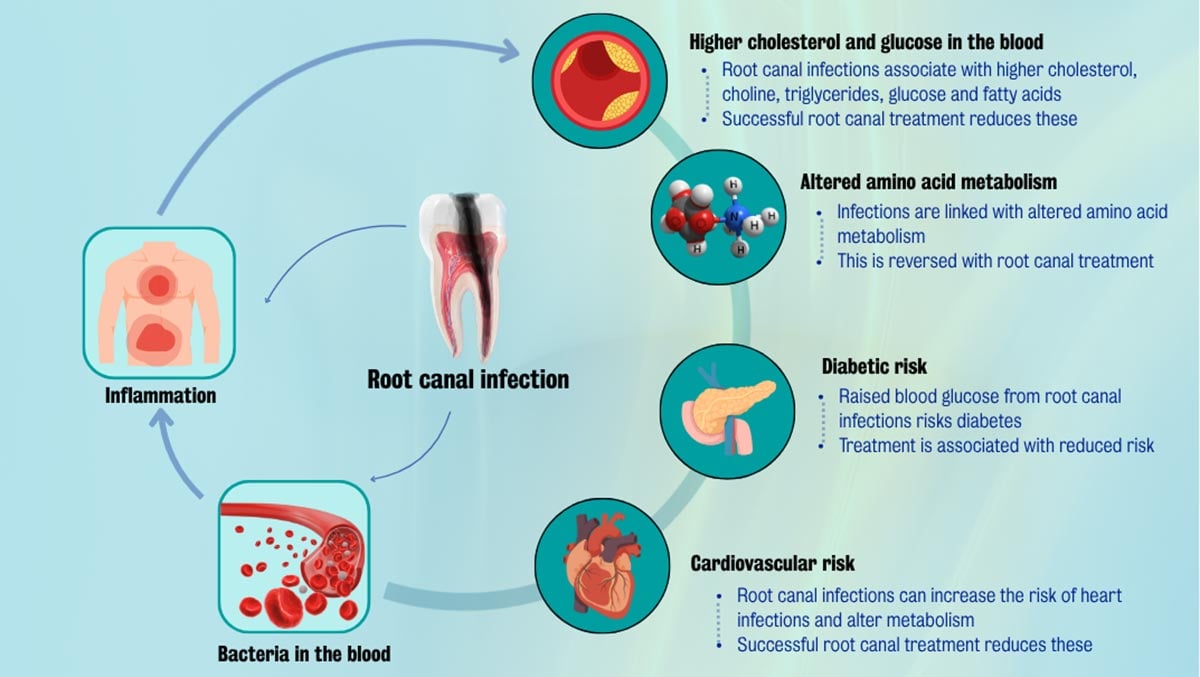
The findings suggest that monitoring blood metabolic markers, such as glucose, fats known as triglycerides, and the protein tryptophan, could help assess recovery and risk after dental treatment.
Integrated care may reduce risk
Lead Author Dr Sadia Niazi, Senior Clinical Lecturer in Endodontology, King’s College London, said: “Our findings show that root canal treatment doesn’t just improve oral health—it may also help reduce the risk of serious health conditions like diabetes and heart disease. It’s a powerful reminder that oral health is deeply connected to overall health.
“Long-standing root canal infections can allow bacteria to enter the bloodstream, trigger inflammation, and increase blood glucose and fats levels – raising the risk of serious health issues like heart disease and diabetes. It is vital that dental professionals recognize the wider impact of these root canal infections and advocate for early diagnosis and treatment.
“We also need to move towards integrated care, where dentists and general practitioners work together to monitor the risks through these blood markers and protect overall health. It’s time to move beyond the tooth and embrace a truly holistic approach to dental care.”
While more research is needed to confirm these effects in larger populations, the study opens exciting new doors for understanding how oral care can support general health and well-being.
Reference: “Successful endodontic treatment improves glucose and lipid metabolism: a longitudinal metabolomic study” by Yuchen Zhang, Adrien Le Guennec, Pirkko Pussinen, Gordon Proctor and Sadia Ambreen Niazi, 18 November 2025, Journal of Translational Medicine.
DOI: 10.1186/s12967-025-07110-0
Funded by the Faculty of Dental Surgery of the Royal College of Surgeons (RCS) England.
Never miss a breakthrough: Join the SciTechDaily newsletter.
Follow us on Google and Google News.
3 Comments
Lies Lies and more lies. Just watch Root Cause Documentary for the truth.
Tooth infections and bad oral health in cats has always resulted in diabetes. I’m surprised it took this long to make the connection in humans.
Could it be that this is long known but ignored. Why would that be? Would there be some purpose to ignoring dental infections? If there was a powerful group able to exert influence to have dental care ignored or even exacerbated? Why would local police be interested in having an individual placed in harm’s way? Having an infection would have strong negative effects like constant pain, sleeplessness, short temper, alienation from friends and known familiars. Perhaps a large inheritance was in the future, and isolation served to be able to control contacts and most likely introduce an individual who would otherwise be ignored. Some might see this as a planned murder …………untreated body infections affecting the heart…..mental instability………all to control an asset like a 60 acre farm in N Indianapolis IN.