
Close Menu
    Facebook X (Twitter) Instagram
    SciTechDaily
    • Biology
    • Chemistry
    • Earth
    • Health
    • Physics
    • Science
    • Space
    • Technology
    Facebook X (Twitter) Pinterest YouTube RSS
    SciTechDaily
    Home»Space»Tumbling in Orbit: NASA’s Test of Advanced Solar Sail Technology Encounters Early Challenges
    Space

    Tumbling in Orbit: NASA’s Test of Advanced Solar Sail Technology Encounters Early Challenges

    By NASA’s Ames Research CenterOctober 24, 2024No Comments4 Mins Read
    Facebook Twitter Pinterest Telegram LinkedIn WhatsApp Email Reddit
    Share
    Facebook Twitter LinkedIn Pinterest Telegram Email Reddit
    NASA Advanced Composite Solar Sail System Spacecraft
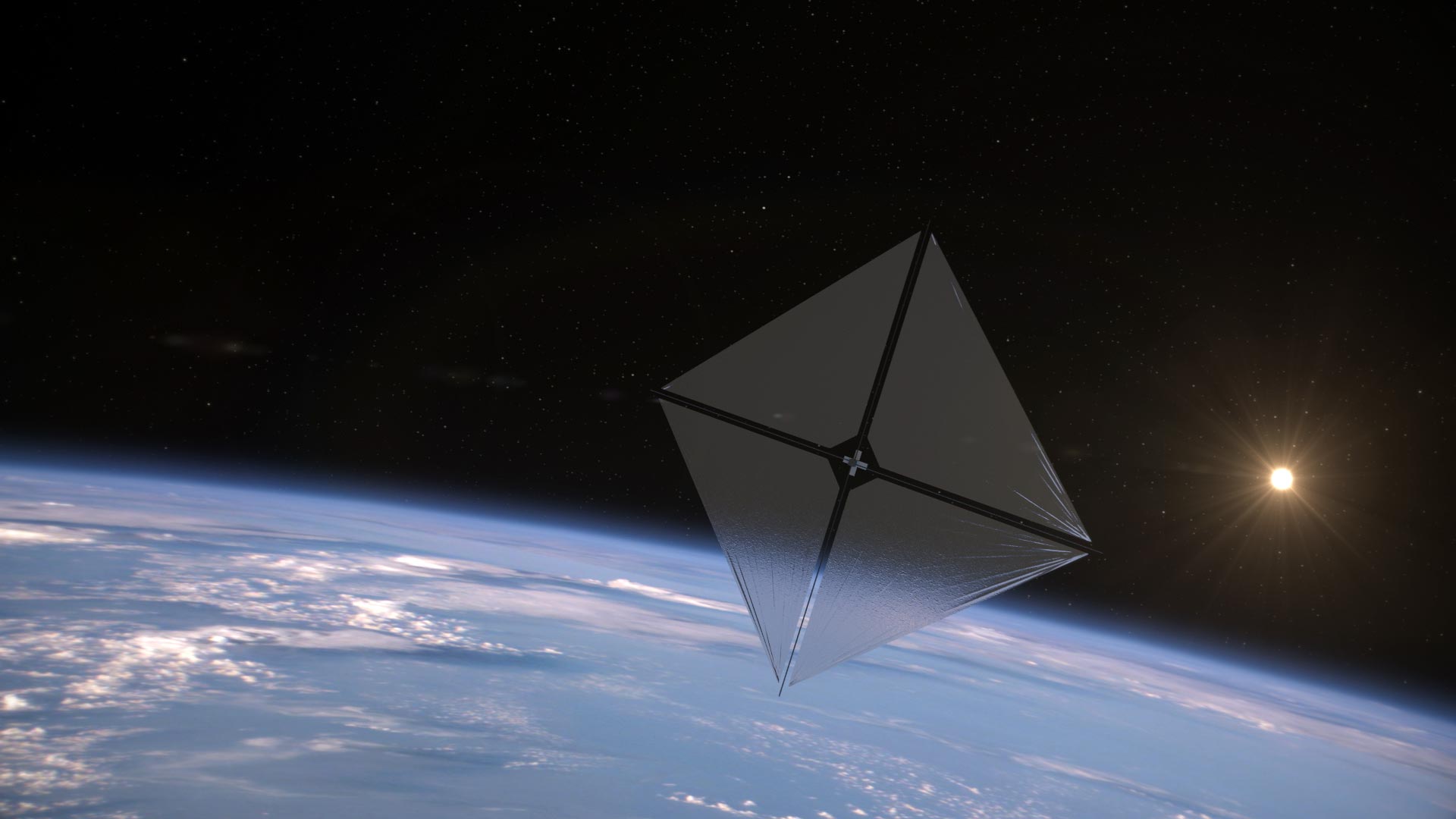
    This artist’s concept shows the Advanced Composite Solar Sail System spacecraft sailing in space using the energy of the Sun. Credit: NASA/Aero Animation/Ben Schweighart

    NASA’s mission to advance solar sail technology through the Advanced Composite Solar Sail System has shown promising signs, despite slight complications. The team is focused on collecting data to enable future solar sail missions and optimize spacecraft performance.

    NASA mission operators are continuing to study the performance of the Advanced Composite Solar Sail System and characterize the performance of its composite booms. Following the successful deployment of the booms and solar sail, the Advanced Composite Solar Sail System is still slowly tumbling in orbit because the spacecraft’s attitude control system is not yet re-engaged.

    During the deployment phase, the team turned off the attitude control system to accommodate changes in the spacecraft’s dynamics as the sail unfurled. The attitude control system is crucial for maintaining the spacecraft’s orientation, whether it’s pointing an antenna at a ground station for communication or positioning solar panels to face the Sun for battery charging.
    NASA Advanced Composite Solar Sail System Collage
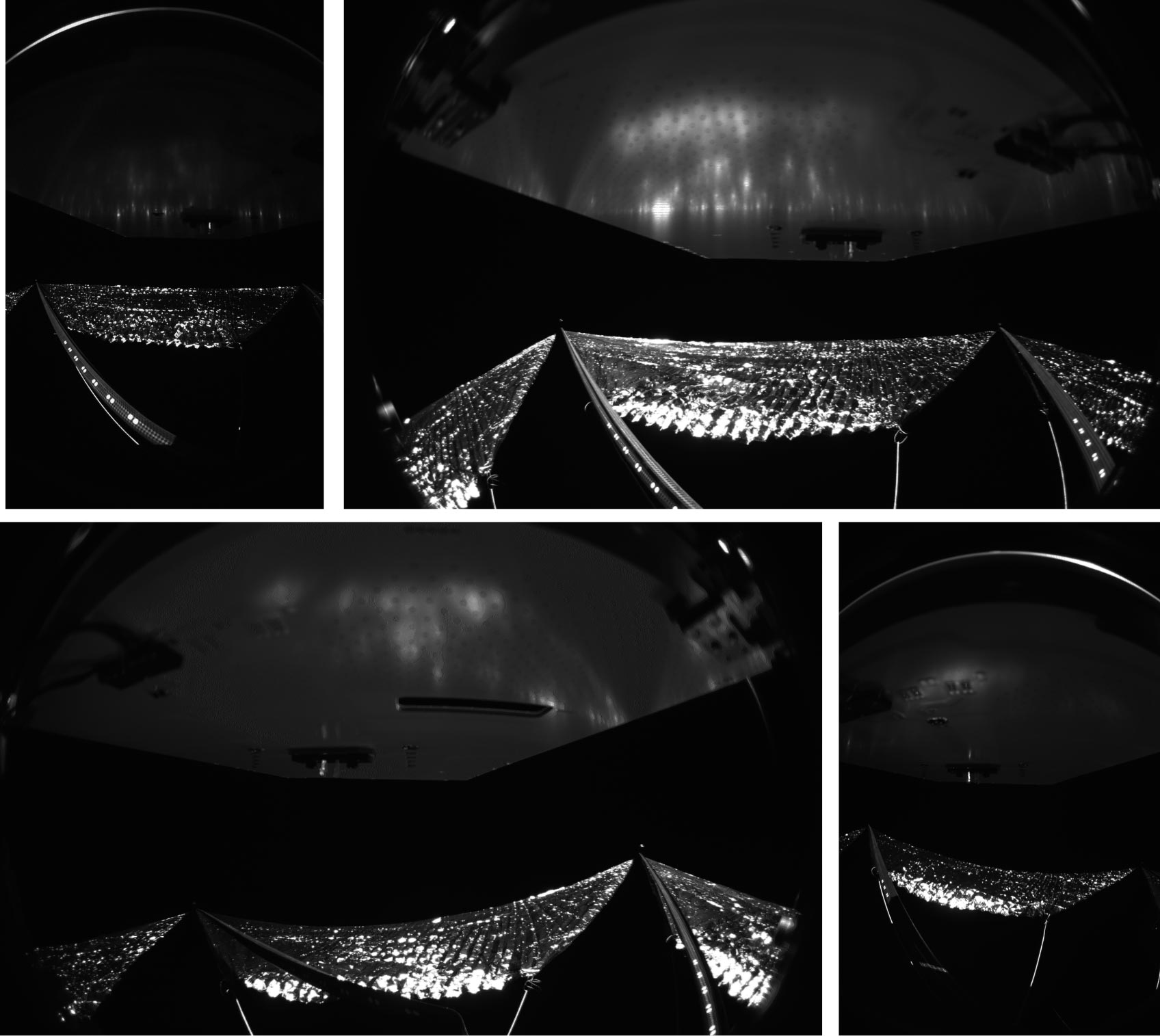
    Four cameras aboard the Advanced Composite Solar Sail System spacecraft show the four reflective sail quadrants supported by composite booms. The booms are mounted at right angles and the spacecraft’s solar panel is rectangular, but lines appear distorted because of the wide-angle camera field of view. Mission operators are currently analyzing a slight bend in the boom pictured in the left corner of the bottom left image. Credit: NASA

    Assessing Structural Integrity in Orbit

    While the solar sail has fully extended to its square shape roughly half the size of a tennis court, the mission team is assessing what appears to be a slight bend in one of the four booms. This likely occurred as the booms and sail were pulled taut to the spacecraft during deployment. Analysis indicates that the bend may have partially straightened over the weeks since boom deployment, while the spacecraft was slowly tumbling.

    The primary objective of the Advanced Composite Solar Sail System demonstration is to test deployment of the booms in space to inform future applications of the composite boom technology for large-scale solar sails and other structures. Data collected from this flight test has already proven highly valuable, and the demonstration will continue producing critical information to enable future solar sail missions.

    The mission team predicts the slight bend in one of the four booms will not inhibit the Advanced Composite Solar Sail System’s ability to execute its sailing maneuvers later in the technology demonstration.

    Energy Conservation and Mission Strategy

    Now, mission operators are working to reposition the spacecraft, keeping the Advanced Composite Solar Sail System in low power mode until its solar panels are more favorably oriented toward direct sunlight. The team is conserving the spacecraft’s energy for priority operations – such as two-way communications with mission control – until its attitude control system is reactivated.

    When the attitude control system is re-engaged, the spacecraft will be able to point its high-bandwidth radio antenna more precisely toward the ground station as it passes overhead during its brief windows of communication with the mission team. At this stage, the team will be able to gather even more data, calibrate the precise shape of the sail, and prepare to begin its sailing maneuvers.

    NASA’s Ames Research Center oversees the Advanced Composite Solar Sail System project and developed the onboard camera diagnostic system. The deployable composite booms and solar sail system were designed and built by NASA’s Langley Research Center. The mission is funded and managed by NASA’s Small Spacecraft Technology program, based at Ames and led by the Space Technology Mission Directorate. The deployable composite boom technology was developed through NASA STMD’s Game Changing Development program. Rocket Lab USA, Inc. provided the launch services, while NanoAvionics supplied the spacecraft bus.

    Never miss a breakthrough: Join the SciTechDaily newsletter.
    Follow us on Google and Google News.

    Ames Research Center NASA Popular Solar Sail
    Share. Facebook Twitter Pinterest LinkedIn Email Reddit

    Related Articles

    Look Up! Catch a Glimpse of NASA’s Giant Solar Sail Gliding Above

    Liftoff! NASA’s Next-Generation Solar Sail Boom Technology Launched

    Origin of Saturn’s Rings: Massive Collision Between Icy Moons During the Time of the Dinosaurs?

    Autonomous Invasion: NASA’s Starling Mission Sending Swarm of Satellites Into Orbit

    Swarm Intelligence in Space: NASA’s Starling CubeSats Ready To Test Critical Technology

    Moon’s Hidden Treasure: Lunar Water Map Unveiled by Pioneering Study

    Moon Mountain Named in Honor of NASA Mathematician and Computer Programmer

    After 15 Years and 1,000 Tests – Is Orion’s Heat Shield Ready To Take the Heat?

    Innovative Diffractive Solar Sail Funded by NASA Could Take Science to Exciting New Destinations

    Leave A Reply Cancel Reply

    • Facebook
    • Twitter
    • Pinterest
    • YouTube

    Don't Miss a Discovery

    Subscribe for the Latest in Science & Tech!

    Trending News

    Monster Storms on Jupiter Unleash Lightning Beyond Anything on Earth

    Scientists Create “Liquid Gears” That Spin Without Touching

    The Simple Habit That Could Help Prevent Cancer

    Millions Take These IBS Drugs, But a New Study Finds Serious Risks

    Scientists Unlock Hidden Secrets of 2,300-Year-Old Mummies Using Cutting-Edge CT Scanner

    Bread Might Be Making You Gain Weight Even Without Eating More Calories

    Scientists Discover Massive Magma Reservoir Beneath Tuscany

    Europe’s Most Active Volcano Just Got Stranger – Here’s Why Scientists Are Rethinking It

    Follow SciTechDaily
    • Facebook
    • Twitter
    • YouTube
    • Pinterest
    • Newsletter
    • RSS
    SciTech News
    • Biology News
    • Chemistry News
    • Earth News
    • Health News
    • Physics News
    • Science News
    • Space News
    • Technology News
    Recent Posts
    • Simple Blood Test May Predict Alzheimer’s Years Before Brain Scans Show Signs
    • Scientists Say Adding This Unusual Seafood to Your Diet Could Reverse Signs of Aging
    • U.S. Waste Holds $5.7 Billion Worth of Crop Nutrients
    • Scientists Say a Hidden Structure May Exist Inside Earth’s Core
    • Doctors Surprised by the Power of a Simple Drug Against Colon Cancer
    Copyright © 1998 - 2026 SciTechDaily. All Rights Reserved.
    • Science News
    • About
    • Contact
    • Editorial Board
    • Privacy Policy
    • Terms of Use

    Type above and press Enter to search. Press Esc to cancel.