

New research reveals that biological age in humans and mice can rapidly increase due to stress but is reversible upon stress recovery, challenging the traditional view of aging. Transient changes in biological age were observed during major surgery, pregnancy, and severe COVID-19, suggesting stress recovery could be a key factor in aging and longevity.
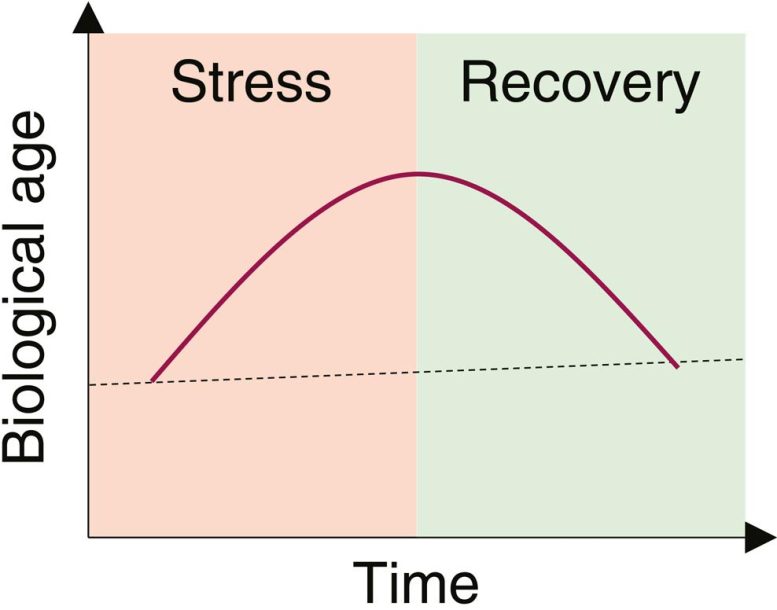
The biological age of humans and mice undergoes a rapid increase in response to diverse forms of stress, which is reversed following recovery from stress, according to a study published on April 21 in the journal Cell Metabolism. These changes occur over relatively short time periods of days or months, according to multiple independent epigenetic aging clocks.
“This finding of fluid, fluctuating, malleable age challenges the longstanding conception of a unidirectional upward trajectory of biological age over the life course,” says co-senior study author James White of Duke University School of Medicine. “Previous reports have hinted at the possibility of short-term fluctuations in biological age, but the question of whether such changes are reversible has, until now, remained unexplored. Critically, the triggers of such changes were also unknown.”
The biological age of organisms is thought to steadily increase over the life course, but it is now clear that biological age is not indelibly linked to chronological age. Individuals can be biologically older or younger than their chronological age implies. Moreover, increasing evidence in animal models and humans indicates that biological age can be influenced by disease, drug treatment, lifestyle changes, and environmental exposures, among other factors.
“Despite the widespread acknowledgment that biological age is at least somewhat malleable, the extent to which biological age undergoes reversible changes throughout life and the events that trigger such changes remain unknown,” says co-senior study author Vadim Gladyshev of Brigham and Women’s Hospital, Harvard Medical School.
DNA Methylation Clocks and Epigenetic Insights
To address this knowledge gap, the researchers leveraged the power of DNA methylation clocks, which were innovated based on the observation that methylation levels of various sites throughout the genome predictably change over the course of chronological age. They measured changes in biological age in humans and mice in response to various stressful stimuli. In one set of experiments, the researchers surgically attached pairs of mice that were 3 months old and 20 months old in a procedure known as heterochronic parabiosis.
The results revealed that biological age may increase over relatively short time periods in response to stress, but this increase is transient and trends back toward baseline following recovery from stress. At epigenetic, transcriptomic, and metabolomic levels, the biological age of young mice was increased by heterochronic parabiosis and restored following surgical detachment.
“An increase in biological age upon exposure to aged blood is consistent with previous reports of detrimental age-related changes upon heterochronic blood-exchange procedures,” says first author Jesse Poganik of Brigham and Women’s Hospital, Harvard Medical School. “However, reversibility of such changes, as we observed, has not yet been reported. From this initial insight, we hypothesized that other naturally occurring situations might also trigger reversible changes in biological age.”
As predicted, transient changes in biological age also occurred during major surgery, pregnancy, and severe COVID-19 in humans or mice. For example, trauma patients experienced a strong and rapid increase in biological age following emergency surgery. Nevertheless, this increase was reversed and biological age was restored to baseline in the days following the surgery. Similarly, pregnant subjects experienced postpartum recovery of biological age at varying rates and magnitudes, and an immunosuppressive drug called tocilizumab enhanced the biological age recovery of convalescent COVID-19 patients.
Stress, Aging, and Longevity
“The findings imply that severe stress increases mortality, at least in part, by increasing biological age,” Gladyshev says. “This notion immediately suggests that mortality may be decreased by reducing biological age and that the ability to recover from stress may be an important determinant of successful aging and longevity. Finally, biological age may be a useful parameter in assessing physiological stress and its relief.”
Additional findings showed that second-generation human DNA methylation clocks give consistent outputs, whereas first-generation clocks generally lack the sensitivity to detect transient changes in biological age. “Whatever the underlying reason, these data highlight the critical importance of judicious selection of DNA methylation clocks appropriate to the analysis at hand, especially in light of the many clocks continuously coming to the fore,” says Gladyshev.
While this study highlights a previously unappreciated aspect of the nature of biological aging, the researchers acknowledge some important limitations. Although they characterized the parabiosis model at multiple omics levels, they relied mainly on DNA methylation clocks to infer biological age in the human studies because these tools are the most powerful aging biomarkers currently available. In addition, the findings are limited in their ability to probe the connections between short-term fluctuations in biological age and lifelong biological aging trajectories.
“Our study uncovers a new layer of aging dynamics that should be considered in future studies,” White says. “A key area for further investigation is understanding how transient elevations in biological age or successful recovery from such increases may contribute to accelerated aging over the life course.”
For more on this research:
Reference: “Biological age is increased by stress and restored upon recovery” by Jesse R. Poganik, Bohan Zhang, Gurpreet S. Baht, Alexander Tyshkovskiy, Amy Deik, Csaba Kerepesi, Sun Hee Yim, Ake T. Lu, Amin Haghani, Tong Gong, Anna M. Hedman, Ellika Andolf, Göran Pershagen, Catarina Almqvist, Clary B. Clish, Steve Horvath, James P. White and Vadim N. Gladyshev, 21 April 2023, Cell Metabolism.
DOI: 10.1016/j.cmet.2023.03.015
Never miss a breakthrough: Join the SciTechDaily newsletter.
Follow us on Google and Google News.