
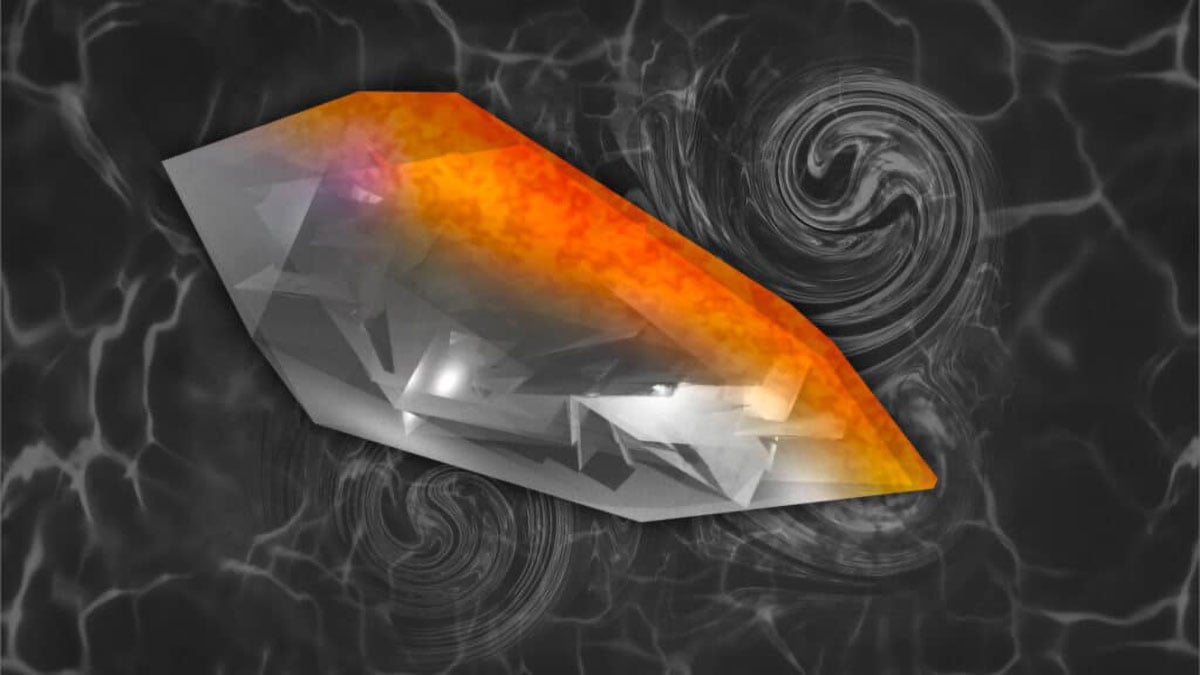
A new breakthrough in orbitronics reveals that atomic vibrations can control the orbital motion of electrons.
As demand for faster and more powerful computing continues to grow, scientists are exploring quantum physics for new ways to process and store enormous amounts of data. One emerging approach, called “orbitronics,” focuses on the motion of electrons around an atom’s nucleus. This motion, known as orbital angular momentum, can be used to encode and manipulate information with far greater efficiency than conventional electronic methods.
In most existing systems, controlling this orbital motion requires magnetic materials such as iron. These metals are heavy, costly, and not ideal for building practical orbitronic devices.
In a new study, researchers report what they describe as the simplest system yet for generating orbital angular momentum in electrons. Their advance relies on an increasingly studied phenomenon in modern physics called chiral phonons.
For the first time, the team demonstrated that chiral phonons can directly pass orbital angular momentum to electrons inside a material that is not magnetic.
“The generation of orbital currents traditionally necessitates the injection of charge current into specific transition metals, and many of these elements are now classified as critical materials,” said Dali Sun, physicist at North Carolina State University and co-author of the study. “There are other ways to generate orbital angular momentum, but this method allows for the use of cheaper, more abundant materials.”
“We don’t need a magnet. We don’t need a battery. We don’t need to use voltage. We just need a material with chiral phonons,” added Valy Vardeny, distinguished professor in the Department of Physics & Astronomy at the University of Utah and co-author of the study. “Before, it was unimaginable. Now, we’ve invented a new field, so to speak.”
The research was led by North Carolina State University, with collaborators including the University of Utah. The findings were published in Nature Physics.
The race to crack chiral phonons
The breakthrough builds on the way atoms are arranged and how they move inside solid materials. In any solid, atoms sit in tightly packed, repeating patterns called lattices. The geometry of that lattice depends on the substance.
In many metals, atoms form highly symmetrical structures. If you compare the structure with its mirror image, the two match perfectly.
Chiral materials are different. In substances such as quartz, atoms are arranged in a spiral pattern that resembles the threads of a screw. This structure can twist in a left-handed or right-handed direction. The two versions are mirror images, but they cannot be perfectly aligned on top of each other. This property is known as chirality. Human hands are a familiar example. They are mirror images, yet they cannot be superimposed.
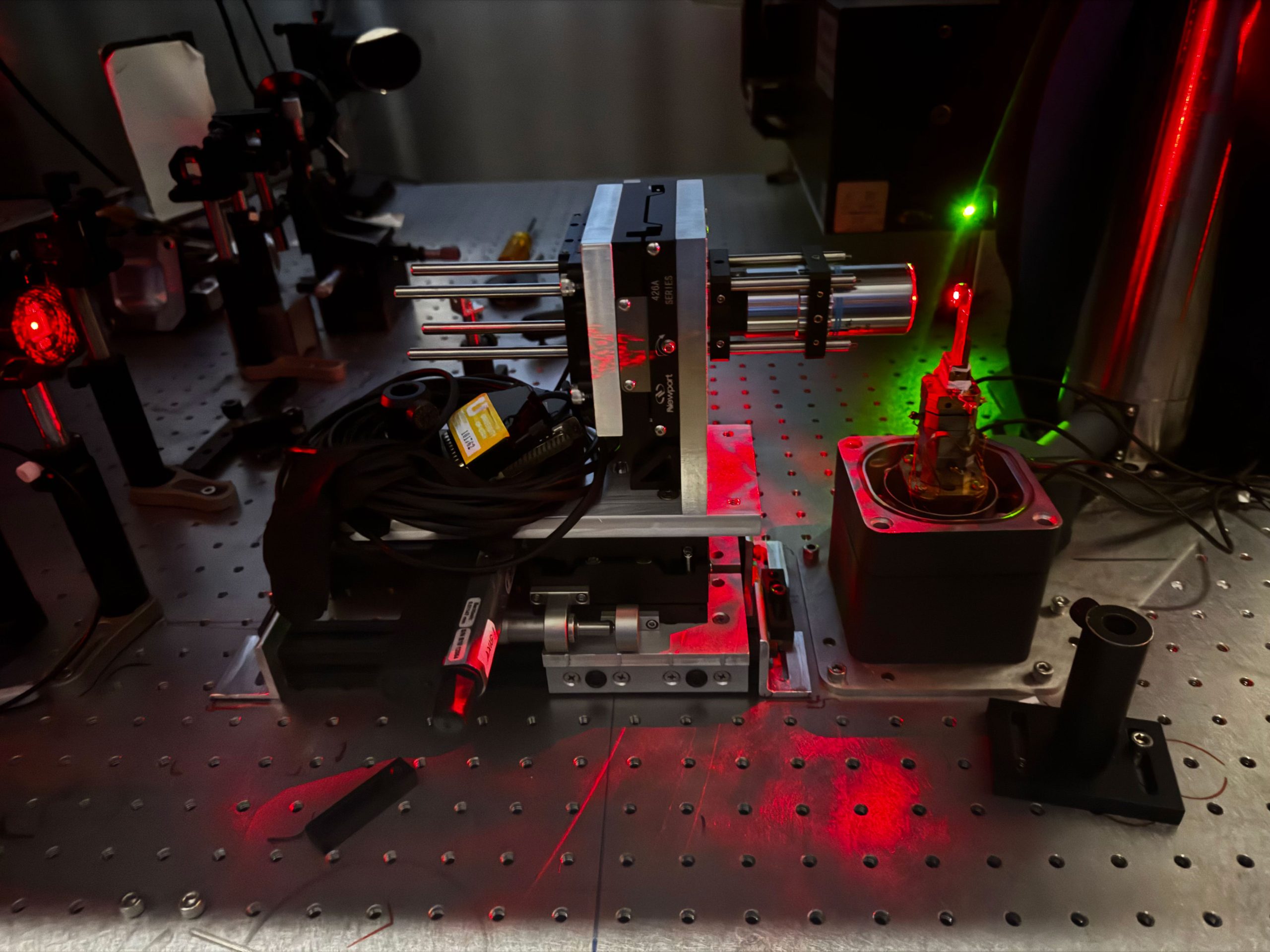
Atoms in solids are not frozen in place. They constantly vibrate around their positions. In symmetrical materials, these vibrations typically move back and forth. In chiral materials, the spiral arrangement of atoms causes the vibrations to follow circular paths with a specific handedness.
Phonons are the collective vibrations that move through a solid. They can be thought of as waves traveling across the atomic lattice. In chiral materials, these traveling vibrations inherit the material’s handedness, creating chiral phonons.
Picture a crowd at a concert. One person begins swaying, prompting the next person to sway, and soon a wave spreads through the audience. In a crystal, phonons move in a similar way, except that in chiral materials the motion traces a circular path.
Because the atoms move in circles, they naturally carry angular momentum. The researchers showed that this angular momentum can be transferred directly from chiral phonons to the orbital motion of electrons. According to the team, this is the first clear demonstration of such a direct transfer in a non magnetic material.
Aligning the atoms
Electrons carry a negative charge, and magnetic fields are usually required to influence their orbital motion. That is why conventional orbitronics has relied on magnetic metals.
Quartz offers a different approach. It is lightweight, inexpensive, and not magnetic in the usual sense. However, its chiral phonons generate their own internal magnetic fields.
Physicists at the University of Utah directly measured this effect using specialized equipment at the National High Magnetic Field Lab in Florida. They shined lasers into quartz and carefully analyzed the reflected light. Subtle changes in the light’s properties, including color and wavelength, revealed that the chiral phonons inside quartz produce a measurable magnetic field.
“Even though the material itself isn’t magnetic, the existence of chiral phonons gives us these magnetic levers to pull on,” said Rikard Bodin, doctoral candidate at the U and co-author of the paper. “When we talk about discovering things, like the orbital Seebeck effect—I can’t tell you that your TV is going to run on it, but it’s creating more levers that we can pull on to do new things. Now that it’s here, someone else can push it forward and before you know it, it’s ubiquitous. That’s how technology is.”
Under everyday conditions, chiral phonons have a random mix of right- and left-handed atoms that all have various energy levels. The researchers used α-quartz, a crystal with a chiral atomic structure, to test their theory. By applying a magnetic field to the quartz, the researchers forced the material to align the right- and left-handed phonons.
The authors showed that getting a critical mass of aligned chiral phonons was enough to transfer the effect to the electrons—without needing an external magnet. This created a flow of electron angular momentum that the authors coined the “orbital Seebeck effect,” named after a well-known process, that influences electron spin called the “spin Seebeck effect.” To directly measure the orbital Seebeck effect, the scientists put layers of metals (tungsten and titanium) on top of the α-quartz, which conferred the hidden “orbital flow” into a measurable electrical signal.
The method will work on other chiral materials, such as tellurium, selenium, and hybrid organic/inorganic perovskites. It’s more efficient because it uses less material while holding the orbital angular momentum far longer than other systems have been shown to do.
Reference: “Orbital Seebeck effect induced by chiral phonons” by Yoji Nabei, Cong Yang, Hong Sun, Hana Jones, Thuc Mai, Tian Wang, Rikard Bodin, Binod Pandey, Ziqi Wang, Yuzan Xiong, Andrew H. Comstock, Benjamin Ewing, John Bingen, Rui Sun, Dmitry Smirnov, Wei Zhang, Axel Hoffmann, Rahul Rao, Ming Hu, Z. Valy Vardeny, Binghai Yan, Xiaosong Li, Jun Zhou, Jun Liu and Dali Sun, 21 January 2026, Nature Physics.
DOI: 10.1038/s41567-025-03134-x
Never miss a breakthrough: Join the SciTechDaily newsletter.
Follow us on Google and Google News.
2 Comments
The two versions are mirror images, but they cannot be perfectly aligned on top of each other. This property is known as chirality. Human hands are a familiar example. They are mirror images, yet they cannot be superimposed.
WHY? WHY? WHY?
Symmetry Breaking (SB) has never occurred; Symmetry Changing (SC) is always ongoing. What is observed in scientific research can never represent the entirety of a phenomenon.
—— Refer to https://zhuanlan.zhihu.com/p/2010251268497638939.
Are these science?
Example 1
Two sets of cobalt-60 are manually rotated in opposite directions, and even without detection, people around the world know that they will not be symmetrical because these two objects are not mirror images of each other at all. However, a group of so-called physicists and so-called academic publications do not believe it. They conducted experiments and the results were indeed asymmetric, but they still firmly believed that these two objects were mirror images of each other, and the asymmetry was due to a violation of the previous natural laws (CP violation). In the history of science, there can never be a dirtier and uglier operation and explanation than this.
—— Excerpted from https://scitechdaily.com/what-happens-when-light-gains-extra-dimensions/#comment-947619.
Example 2
Please see how the so-called “mystery of θ – τ” is explained: θ and τ are completely identical in all measurable physical properties such as mass, lifetime, charge, spin, etc. However, experimental observations have shown that the θ meson decays into two π mesons, while the τ meson decays into three π mesons, making it difficult for physicists to explain why they are so similar. Physicist Martin Block proposed a highly challenging idea: θ and τ are the same particle, but in weak interactions, parity is not conserved. An easy to understand explanation is the following analogy:: There are two boxes of apples with identical weight, color, and taste. However, when one box is opened, there are two apples, while when the other box is opened, there are three apples. This confuses the old farmer who buys apples. He circled around the orchard and came up with a highly challenging idea: these two boxes of apples are not from the same tree, so they are the same.
—— Excerpted from https://scitechdaily.com/what-happens-when-light-gains-extra-dimensions/#comment-947686.
Everyone who has a reverence for natural laws and regulations deserves respect.