
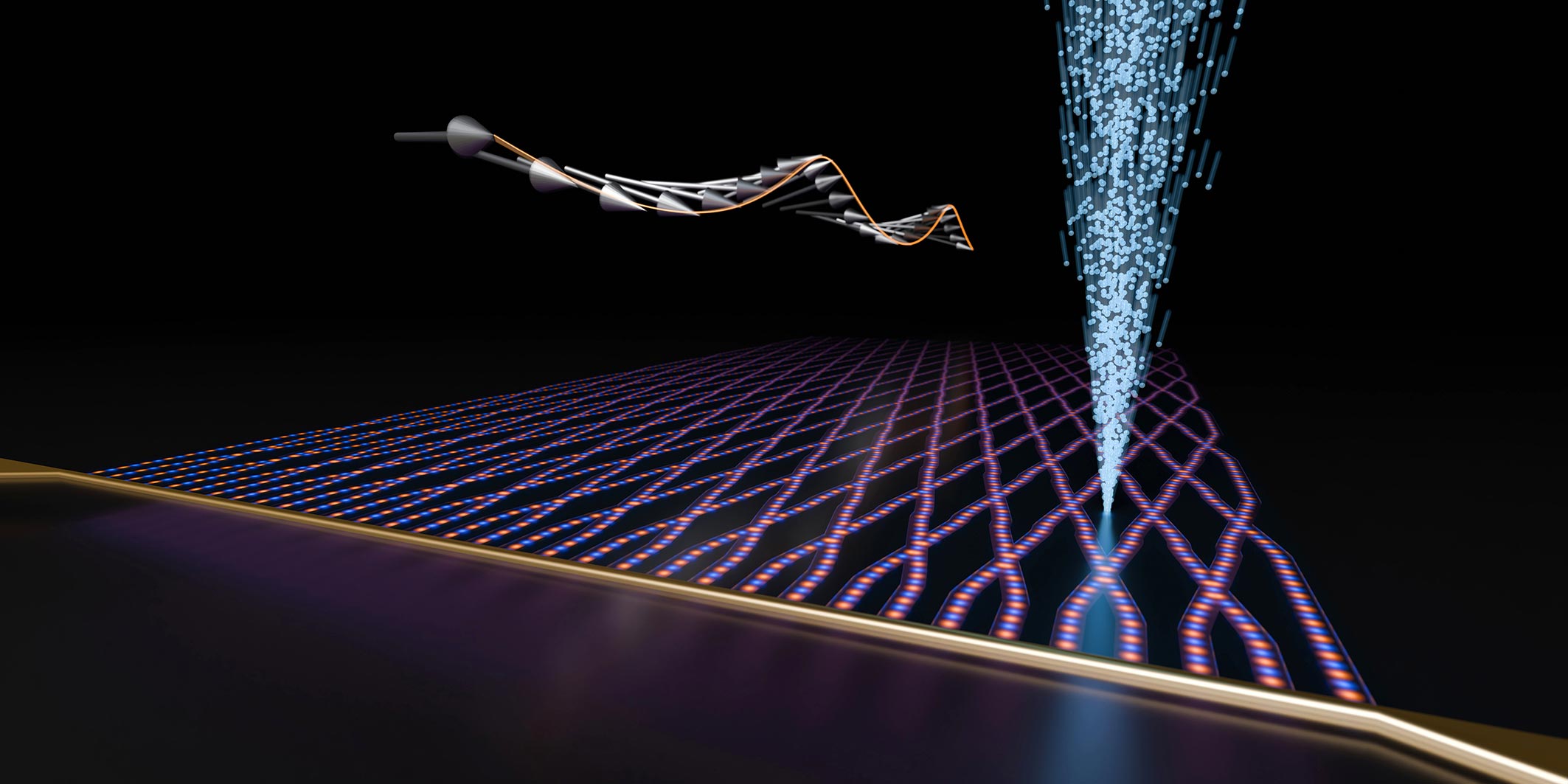
A new method has been developed that enables large networks to efficiently process the advanced information demands of the future.
The growing use of artificial intelligence is putting significant strain on global energy systems. This has intensified the search for more energy-efficient hardware to support AI technologies. One innovative approach gaining attention involves using “spin waves” to carry and process information.
Researchers from the Universities of Münster and Heidelberg (Germany), led by physicist Prof. Rudolf Bratschitsch (Münster), have developed a new technique for creating waveguides that allow spin waves to travel much farther than previously possible.
Using this method, the team successfully built the largest spin waveguide network constructed so far. In addition to its scale, the researchers demonstrated precise control over how the spin waves behave within the network. They were able to adjust characteristics such as wavelength and how the waves reflect at specific boundaries. Their findings were published in the journal Nature Materials.
Understanding Spin Waves and Magnetic Properties
The electron spin is a quantum mechanical quantity that is also described as the intrinsic angular momentum. The alignment of many spins in a material determines its magnetic properties. If an alternating current is applied to a magnetic material with an antenna, thereby generating a changing magnetic field, the spins in the material can generate a spin wave.
Spin waves have already been used to create individual components, such as logic gates that process binary input signals into binary output signals, or multiplexers that select one of various input signals. Up until now, however, the components were not connected to form a larger circuit.
“The fact that larger networks such as those used in electronics have not yet been realized is partly due to the strong attenuation of the spin waves in the waveguides that connect the individual switching elements, especially if they are narrower than a micrometer and therefore on the nanoscale,” explains Rudolf Bratschitsch.
The group used the material with the lowest attenuation currently known: yttrium iron garnet (YIG)., The researchers inscribed individual spin-wave waveguides into a 110 nanometer thin film of this magnetic material using a silicon ion beam and produced a large network with 198 nodes. The new method allows complex structures of high quality to be produced flexibly and reproducibly.
Reference: “Dispersion-tunable low-loss implanted spin-wave waveguides for large magnonic networks” by Jannis Bensmann, Robert Schmidt, Kirill O. Nikolaev, Dimitri Raskhodchikov, Shraddha Choudhary, Richa Bhardwaj, Shabnam Taheriniya, Akhil Varri, Sven Niehues, Ahmad El Kadri, Johannes Kern, Wolfram H. P. Pernice, Sergej O. Demokritov, Vladislav E. Demidov, Steffen Michaelis de Vasconcellos and Rudolf Bratschitsch, 9 July 2025, Nature Materials.
DOI: 10.1038/s41563-025-02282-y
The German Research Foundation (DFG) funded the project as part of the Collaborative Research Centre 1459 “Intelligent Matter.”
Never miss a breakthrough: Join the SciTechDaily newsletter.
Follow us on Google and Google News.
1 Comment
AI Hardware Revolution: Scientists Create Largest Spin Waveguide Network.
VERY GOOD!!!
Keep trying! Spin creates all things. Spin Shaping World.