
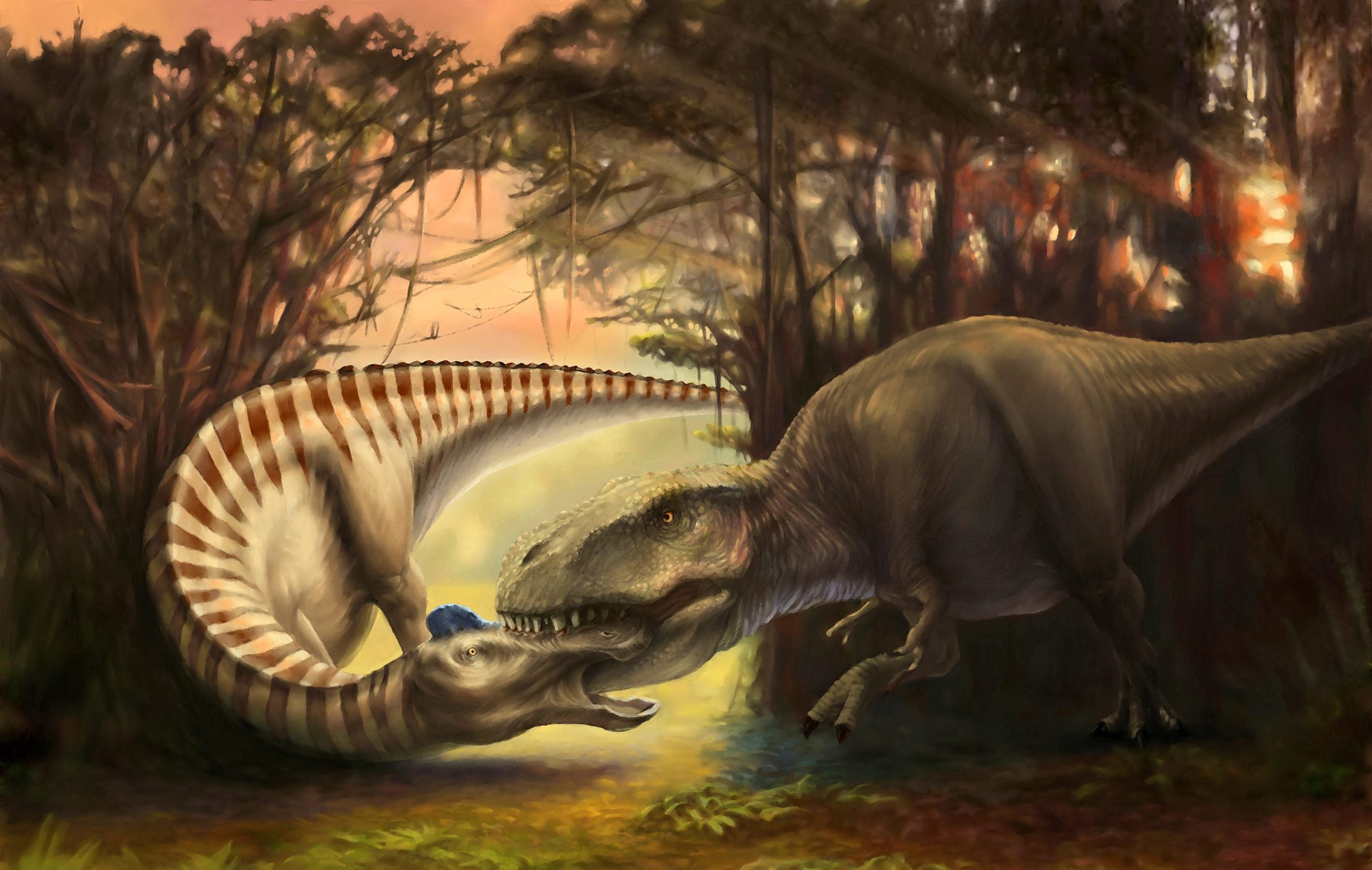
A fossil skull with a Tyrannosaurus tooth embedded shows evidence of a forceful attack, helping scientists better understand how the predator hunted or fed.
A rare fossil at Montana State University’s Museum of the Rockies is shedding light on how Tyrannosaurus may have attacked its prey, capturing what appears to be a violent moment frozen in time.
The specimen, a nearly complete Edmontosaurus skull discovered in 2005 in Montana’s Hell Creek Formation, contains an extraordinary feature: a broken tyrannosaur tooth lodged deep in its face. Finds like this are exceptionally uncommon and give researchers a direct link between predator and prey, rather than relying on isolated bite marks.
At the end of the Age of Dinosaurs, about 66 million years ago, Tyrannosaurus was one of the dominant predators in this region. It lived alongside large herbivores such as Triceratops and Edmontosaurus, forming part of a complex ecosystem just before the mass extinction event that wiped out non-avian dinosaurs.
Embedded Tooth Evidence and Research Collaboration
The fossil is now on display in the museum’s Hall of Horns and Teeth and has become the focus of a study by Taia Wyenberg-Henzler of the University of Alberta and John Scannella, curator of paleontology at the Museum of the Rockies. Their findings were published in PeerJ.
“Although bite marks on bones are relatively common, finding an embedded tooth is extremely rare,” said Wyenberg-Henzler. “The great thing about an embedded tooth, particularly in a skull, is it gives you the identity of not only who was bitten but also who did the biting. This allowed us to paint a picture of what happened to this Edmontosaurus, kind of like Cretaceous crime scene investigators.”
Researchers compared the tooth with those of all known carnivores from the Hell Creek Formation and found it most closely matched those of Tyrannosaurus. CT scans conducted at Advanced Medical Imaging at Bozeman Health Deaconess Hospital provided additional detail about how the tooth was lodged in the bone.
Predator Behavior and Fatal Encounter Analysis
“A fossil like this is extra exciting because it captures a behavior: a tyrannosaur biting into this duckbill’s face,” said Scannella. “The skull shows no signs of healing around the tyrannosaur tooth, so it may have already been dead when it was bitten, or it may be dead because it was bitten.”
“Looking at the way the tooth is embedded in the nose of the Edmontosaurus suggests that it met its attacker face-to-face, something that usually happens to an animal that was killed by a predator,” said Wyenberg-Henzler. “The amount of force necessary for a tooth to have become broken off in bone also points to the use of deadly force. For me, this paints a terrifying picture of the last moments of this Edmontosaurus.”
For decades, scientists have debated how Tyrannosaurus fed and hunted. This fossil, with its embedded tooth, provides new evidence that helps clarify the behavior of one of the largest predators to ever walk the Earth, Scannella said.
Reference: “Behavioral implications of an embedded tyrannosaurid tooth and associated tooth marks on an articulated skull of Edmontosaurus from the Hell Creek Formation, Montana” by Taia C.A. Wyenberg-Henzler and John B. Scannella, 17 February 2026, PeerJ.
DOI: 10.7717/peerj.20796
Never miss a breakthrough: Join the SciTechDaily newsletter.
Follow us on Google and Google News.
4 Comments
Amazing
Was it common for the T Rex to lose teeth when biting? Future dinosaur films might be more realistic if a few gap-toothed predators were shown chomping on CG actors.
Honestly, a lot really happened MILLIONS of YEARS ago which we have only been able to dig out and research just a FRACTION of the WHOLE DINASUARIC ERA/AGE..!
This could be the result of a kill, or could it be the result of two or more predators violently claiming the kill?