
Close Menu
    Facebook X (Twitter) Instagram
    SciTechDaily
    • Biology
    • Chemistry
    • Earth
    • Health
    • Physics
    • Science
    • Space
    • Technology
    Facebook X (Twitter) Pinterest YouTube RSS
    SciTechDaily
    Home»Physics»Ultra-Cold Mini Twisters: Quantum Vortices Are a Strong Indication of Superfluidity
    Physics

    Ultra-Cold Mini Twisters: Quantum Vortices Are a Strong Indication of Superfluidity

    By University of InnsbruckOctober 31, 20222 Comments3 Mins Read
    Facebook Twitter Pinterest Telegram LinkedIn WhatsApp Email Reddit
    Share
    Facebook Twitter LinkedIn Pinterest Telegram Email Reddit
    Ultra-Cold Mini Twisters
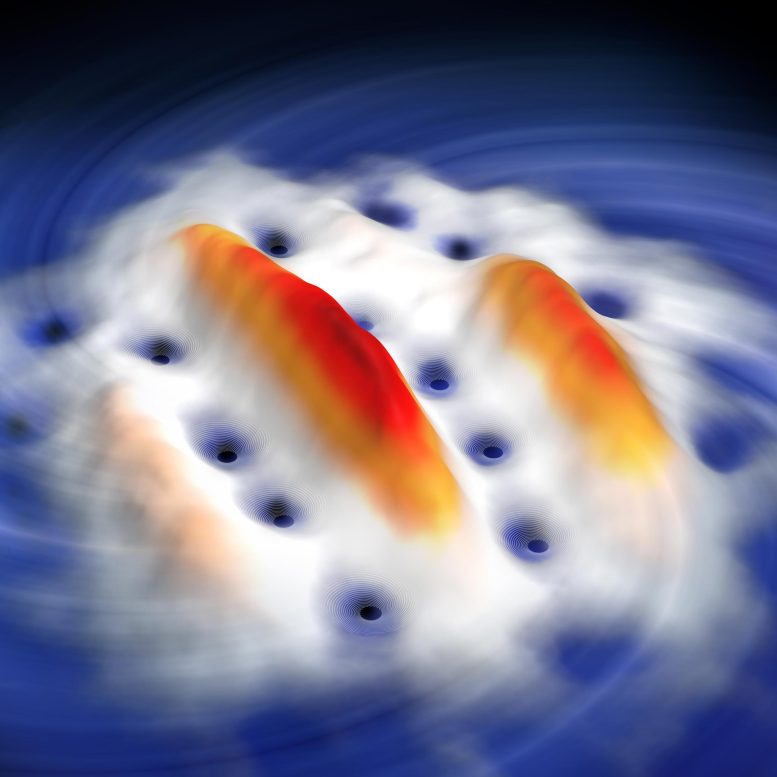
    Illustration of the density distribution of a rotating dipolar Bose-Einstein-Condensate (dBEC) exhibiting quantized vortices based on simulation data from the paper. The vortices, visible via their density dips in the dBEC, arrange in stripes due to the anisotropic and long-range character of the dipolar interactions between the atoms. Credit: Ella Maru Studio

    Scientists have induced quantum vortices in dipolar gases for the first time, using magnetic fields to create vortex patterns in dysprosium. This breakthrough allows new research on supersolid states in quantum matter.

    In nature, vortices can be found everywhere: Whirling up water can produce swirls. When the atmosphere is stirred up, huge tornadoes can form. This is also the case in the quantum world, except that many identical vortices are being formed simultaneously — the vortex is quantized. In many quantum gases, such quantized vortices have already been demonstrated.

    “This is interesting because such vortices are a clear indication of the frictionless flow of a quantum gas — the so-called superfluidity,” says Francesca Ferlaino from the Department of Experimental Physics at the University of Innsbruck and the Institute of Quantum Optics and Quantum Information at the Austrian Academy of Sciences.

    Ferlaino and her team are researching quantum gases made of strongly magnetic elements. For such dipolar quantum gases, in which atoms are highly connected to each other, quantum vortices could not be demonstrated so far. Scientists have developed a new method: “We use the directionality of our quantum gas of dysprosium, whose atoms behave like many small magnets, to stir the gas,” explains Manfred Mark from Francesca Ferlaino’s team.

    To do this, the scientists apply a magnetic field to their quantum gas in such a way that this initially round, pancake-shaped gas becomes elliptically deformed due to magnetostriction. This idea, as simple as it is powerful, originated from a theoretical proposal a few years ago by the Newcastle University theoretical team, led by Nick Parker and of which Thomas Bland, the paper’s second author, was a member.

    “By rotating the magnetic field, we can rotate the quantum gas,” explains Lauritz Klaus, first author of the current paper. “If it spins fast enough, then small vortices form in the quantum gas. This is how the gas tries to balance the angular momentum.”

    At sufficiently high rotational speeds, peculiar stripes of vortices form along the magnetic field. These are a special characteristic of dipolar quantum gases and have now been observed for the first time at the University of Innsbruck, Austria.

    The new method, now presented in Nature Physics, will be used to study superfluidity in supersolid states in which quantum matter is simultaneously solid and liquid. “It is indeed still a major open question the degree of superfluid character in the newly discovered supersolid states, and this question remains still very little studied today.”

    Reference: “Observation of vortices and vortex stripes in a dipolar condensate” by Lauritz Klaus, Thomas Bland, Elena Poli, Claudia Politi, Giacomo Lamporesi, Eva Casotti, Russell N. Bisset, Manfred J. Mark and Francesca Ferlaino, 31 October 2022, Nature Physics.
    DOI: 10.1038/s41567-022-01793-8

    The work was done in cooperation with Giacomo Lamporesi from the University of Trento, Italy, and the theorist Russell Bisset from the University of Innsbruck, and was financially supported by the European Research Council ERC, the Austrian Science Fund FWF and the Austrian Academy of Sciences ÖAW, among others.

    Never miss a breakthrough: Join the SciTechDaily newsletter.
    Follow us on Google and Google News.

    Bose-Einstein Condensates Quantum Physics University of Innsbruck
    Share. Facebook Twitter Pinterest LinkedIn Email Reddit

    Related Articles

    Quantum Simulation: Measurement of Entanglement Made Much Easier

    Quantum Magic Squares Cannot Be As Easily Characterized As Their “Classical” Cousins

    New Protocol Identifies Fascinating Topological Quantum States

    Atoms Don’t Like Jumping Rope: Breakthrough in Using Nanooptical Traps for Quantum Technologies

    Physicists Develop Data Bus for Quantum Computers

    Physicists Demonstrate Probing Topology by “Heating”

    Physicists Encode One Qubit in Entangled States Distributed Over Several Particles

    Physicists Realize New Quasiparticle in Ultracold Quantum Gas

    Physicists Create a Condensate of Erbium

    2 Comments

    1. Bao-hua ZHANG on October 31, 2022 4:32 pm

      Science and technology are transcending the vortex storm, I can see the approaching steps of the spring for human scientific and technological revolution.

      Reply
    2. xABBAAA on November 1, 2022 10:40 am

      … if there are some points like … I will not tell you this!!!

      Reply
    Leave A Reply Cancel Reply

    • Facebook
    • Twitter
    • Pinterest
    • YouTube

    Don't Miss a Discovery

    Subscribe for the Latest in Science & Tech!

    Trending News

    Bone-Strengthening Discovery Could Reverse Osteoporosis

    Scientists Uncover Hidden Trigger Behind Stem Cell Aging

    Scientists Find Way to Reverse Fatty Liver Disease Without Changing Diet

    Could Humans Regrow Limbs? New Study Reveals Promising Genetic Pathway

    Scientists Reveal Eating Fruits and Vegetables May Increase Your Risk of Lung Cancer

    Scientists Reverse Brain Aging With Simple Nasal Spray

    Scientists Uncover Potential Brain Risks of Popular Fish Oil Supplements

    Scientists Discover a Surprising Way To Make Bread Healthier and More Nutritious

    Follow SciTechDaily
    • Facebook
    • Twitter
    • YouTube
    • Pinterest
    • Newsletter
    • RSS
    SciTech News
    • Biology News
    • Chemistry News
    • Earth News
    • Health News
    • Physics News
    • Science News
    • Space News
    • Technology News
    Recent Posts
    • Europe’s Most Active Volcano Just Got Stranger – Here’s Why Scientists Are Rethinking It
    • Why Are Giant Ants Letting Tiny Ants Crawl All Over Them?
    • Revolutionary Technique Sends Healthy Mitochondria Exactly Where They’re Needed
    • This Student Recreated the Universe in a Bottle. What She Discovered Could Help Reveal How Life Started on Earth
    • Alzheimer’s Symptoms May Start Outside the Brain, Study Finds
    Copyright © 1998 - 2026 SciTechDaily. All Rights Reserved.
    • Science News
    • About
    • Contact
    • Editorial Board
    • Privacy Policy
    • Terms of Use

    Type above and press Enter to search. Press Esc to cancel.