
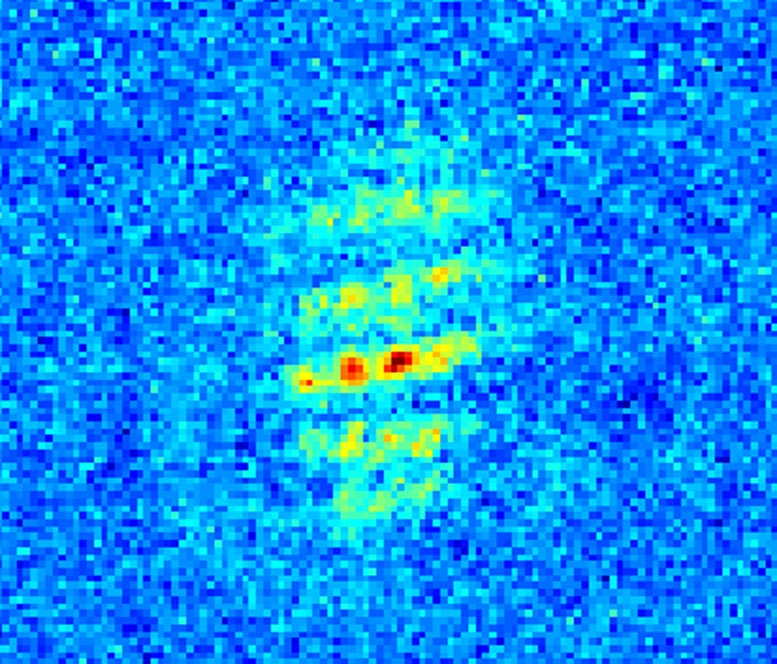
Researchers present results of experiments with atom interferometry on a sounding rocket. Further rocket missions set to follow.
Extremely precise measurements are possible using atom interferometers that employ the wave character of atoms for this purpose. They can thus be used, for example, to measure the gravitational field of the Earth or to detect gravitational waves. A team of scientists from Germany has now managed to successfully perform atom interferometry in space for the first time – onboard a sounding rocket. “We have established the technological basis for atom interferometry on board of a sounding rocket and demonstrated that such experiments are not only possible on Earth, but also in space,” said Professor Patrick Windpassinger of the Institute of Physics at Johannes Gutenberg University Mainz (JGU), whose team was involved in the investigation. The results of their analyses have been published in Nature Communications.
A team of researchers from various universities and research centers led by Leibniz University Hannover launched the MAIUS-1 mission in January 2017. This has since become the first rocket mission on which a Bose-Einstein condensate has been generated in space. This special state of matter occurs when atoms – in this case atoms of rubidium – are cooled to a temperature close to absolute zero, or minus 273 degrees Celsius. “For us, this ultracold ensemble represented a very promising starting point for atom interferometry,” explained Windpassinger. Temperature is one of the determining factors, because measurements can be carried out more accurately and for longer periods at lower temperatures.

Atom Interferometry: Generating Atomic Interference by Spatial Separation and Subsequent Superposition of Atoms
During the experiments, the gas of rubidium atoms was separated using laser light irradiation and then subsequently superpositioned. Depending on the forces acting on the atoms on their different paths, several interference patterns can be produced, which in turn can be used to measure the forces that are influencing them, such as gravity.
Laying the Groundwork for Precision Measurements
The study first demonstrated the coherence, or interference capability, of the Bose-Einstein condensate as a fundamentally required property of the atomic ensemble. To this end, the atoms in the interferometer were only partially superimposed by means of varying the light sequence, which, in the case of coherence, led to the generation of a spatial intensity modulation. The research team has thus demonstrated the viability of the concept, which may lead to further experiments targeting the measurement of the Earth’s gravitational field, the detection of gravitational waves, and a test of Einstein’s equivalence principle.
Even More Measurements Will Be Possible When MAIUS-2 and MAIUS-3 Are Launched
In the near future, the team wants to go further and investigate the feasibility of high-precision atom interferometry to test Einstein’s principle of equivalence. Two more rocket launches, MAIUS-2 and MAIUS-3, are planned for 2022 and 2023, and on these missions the team also intends to use potassium atoms, in addition to rubidium atoms, to produce interference patterns. By comparing the free fall acceleration of the two types of atoms, a test of the equivalence principle with previously unattainable precision can be facilitated. “Undertaking this kind of experiment would be a future objective on satellites or the International Space Station ISS, possibly within BECCAL, the Bose Einstein Condensate and Cold Atom Laboratory, which is currently in the planning phase. In this case, the achievable accuracy would not be constrained by the limited free-fall time aboard a rocket,” explained Dr. André Wenzlawski, a member of Windpassinger’s research group at JGU, who is directly involved in the launch missions.
The experiment is one example of the highly active research field of quantum technologies, which also includes developments in the fields of quantum communication, quantum sensors, and quantum computing.
Reference: “Ultracold atom interferometry in space” by Maike D. Lachmann, Holger Ahlers, Dennis Becker, Aline N. Dinkelaker, Jens Grosse, Ortwin Hellmig, Hauke Müntinga, Vladimir Schkolnik, Stephan T. Seidel, Thijs Wendrich, André Wenzlawski, Benjamin Carrick, Naceur Gaaloul, Daniel Lüdtke, Claus Braxmaier, Wolfgang Ertmer, Markus Krutzik, Claus Lämmerzahl, Achim Peters, Wolfgang P. Schleich, Klaus Sengstock, Andreas Wicht, Patrick Windpassinger and Ernst M. Rasel, 26 February 2021, Nature Communications.
DOI: 10.1038/s41467-021-21628-z
The MAIUS-1 sounding rocket mission was implemented as a joint project involving Leibniz University Hannover, the University of Bremen, Johannes Gutenberg University Mainz, Universität Hamburg, Humboldt-Universität zu Berlin, the Ferdinand-Braun-Institut in Berlin, and the German Aerospace Center (DLR). Financing for the project was arranged by the Space Administration of the German Aerospace Center and funds were provided by the German Federal Ministry for Economic Affairs and Energy on the basis of a resolution of the German Bundestag.
Never miss a breakthrough: Join the SciTechDaily newsletter.
Follow us on Google and Google News.