

Close Menu
    Facebook X (Twitter) Instagram
    SciTechDaily
    • Biology
    • Chemistry
    • Earth
    • Health
    • Physics
    • Science
    • Space
    • Technology
    Facebook X (Twitter) Pinterest YouTube RSS
    SciTechDaily
    Home»Physics»Understanding Hot-Spot Conditions in National Ignition Facility Implosion Experiments
    Physics

    Understanding Hot-Spot Conditions in National Ignition Facility Implosion Experiments

    By Lawrence Livermore National LaboratoryMarch 8, 20222 Comments3 Mins Read
    Facebook Twitter Pinterest Telegram LinkedIn WhatsApp Email Reddit
    Share
    Facebook Twitter LinkedIn Pinterest Telegram Email Reddit
    Energy Plasma Concept
    Research at Lawrence Livermore National Laboratory (LLNL) validated simple models for understanding hot-spot conditions in implosions, finding good agreement with a set of simulations.

    Researchers validated simple models used to infer critical hot-spot conditions in ignition experiments. These models, tested against thousands of 2D simulations, are essential for understanding implosion physics and advancing ignition research at National Ignition Facility (NIF).

    Research conducted at Lawrence Livermore National Laboratory (LLNL) describes a validation exercise for simple models used to understand hot-spot conditions reached in an implosion, which find good agreement when compared to a set of simulations.

    Progress toward ignition requires accurately diagnosing current conditions and assessing proximity metrics for implosion experiments at LLNL’s National Ignition Facility (NIF). Hot-spot conditions are not directly measured, but rather inferred, often using simple 0- and 1-dimensional (1D) models.

    Challenges in Measuring Hot-Spot Conditions

    “When we do ignition experiments on NIF, we have a phenomenal array of diagnostics that can measure many aspects of the shot and its performance,” LLNL physicist Alex Zylstra explained. “Unfortunately, some things that we really care about for the burn physics are not directly measurable, like the pressure or amount of energy in the hot spot.”
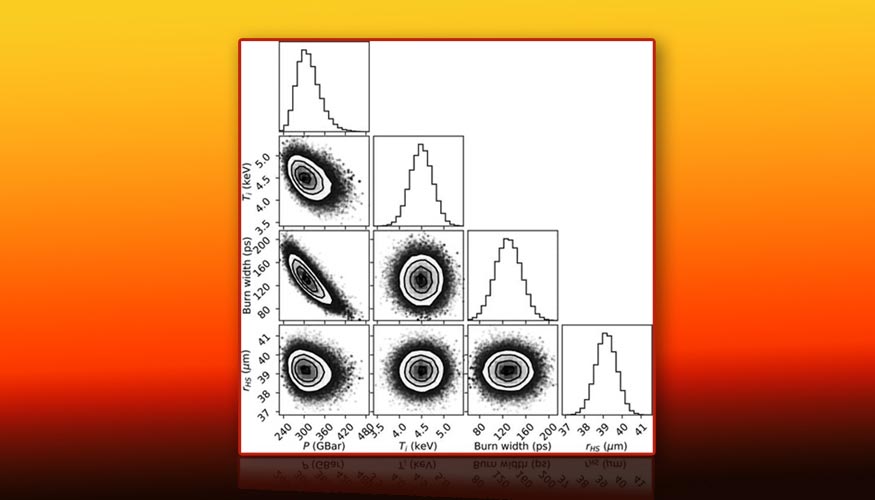
    Plasma Distribution Plots
    This image shows the distribution plots for the model parameters pressure, ion temperature, burn width and radius. Credit: LLNL

    Researchers therefore rely on simple models to infer these quantities from the data. But in order for findings derived from inferences to be credible, researchers then need to benchmark those models.

    The findings are featured in Physics of Plasmas, with LLNL physicists Zylstra, Ryan Nora, Prav Patel, and Omar Hurricane serving as authors of the paper.

    Validation Exercise Using 2D Simulations

    The research also is a much more extensive validation exercise for these simple models, using more than 20,000 2D simulations varying performance as well as various things that can go “wrong” in an experiment.

    “We find that the simple models still do quite a good job over a reasonable range of parameters,” Zylstra said. “We also have started to use a new Markov Chain Monte Carlo algorithm to produce probabilistic distributions for the inferred quantities based on the measurement uncertainties of the inputs.”

    Hurricane said these simple models were important for evaluating some of the burning-plasma criteria in LLNL’s recently published Nature paper, as well as upcoming papers.

    “These simple models have been used in the literature for some time,” Hurricane said. “What’s new here is that the development of ‘ensembles’ by the cognitive simulation group within the ICF program has now produced simulation sets large enough to support these sorts of studies, testing our model against a known truth using the simulation’s synthetic data.”

    Reference: “Model validation for inferred hot-spot conditions in National Ignition Facility experiments” by A. B. Zylstra, R. Nora, P. Patel and O. Hurricane, 1 December 2021, Physics of Plasmas.
    DOI: 10.1063/5.0069366

    Never miss a breakthrough: Join the SciTechDaily newsletter.
    Follow us on Google and Google News.

    DOE Lawrence Livermore National Laboratory National Ignition Facility Plasma Physics
    Share. Facebook Twitter Pinterest LinkedIn Email Reddit

    Related Articles

    World’s Most Powerful Laser Reveals Secrets of Pressure-Driven Ionization in Stars and Nuclear Fusion

    Key Discovery for Future Design of Laser–Fusion Energy Reactors

    Thermonuclear Fusion in a Sheared-Flow Z-Pinch: Advancing Another Viable Pathway to Fusion Energy

    How Scientists Achieved Burning Plasma State – After Decades of Fusion Research

    Laser-Driven Ion Acceleration With Deep Learning Neural Networks

    Experiments Probe Carbon’s Crystal Structure at Record Pressures – Five Times the Pressure in Earth’s Core

    Igniting Shock Waves Using Some of the World’s Most Powerful Lasers to Mimic Stars Exploding As Supernovas

    New Understanding of Collision-Less Plasma Shock Waves, Earth’s Interaction With the Solar Wind

    A Star Is Born: Using World’s Biggest Laser to Study Nucleosynthesis

    2 Comments

    1. Eric M. Jones on March 9, 2022 8:33 am

      This Job fare for physicists is so far from anything usable…I am constantly flummoxed by why it continues.

      Reply
    2. BibhutibhusanPatel on March 10, 2022 11:25 pm

      To achive one useful model,can follow solar plasma in direct
      way ;which also links with stars.

      Reply
    Leave A Reply Cancel Reply

    • Facebook
    • Twitter
    • Pinterest
    • YouTube

    Don't Miss a Discovery

    Subscribe for the Latest in Science & Tech!

    Trending News

    Scientists Warn That This Common Pet Fish Can Wreck Entire Ecosystems

    Scientists Make Breakthrough in Turning Plastic Trash Into Clean Fuel Using Sunlight

    This Popular Supplement May Interfere With Cancer Treatment, Scientists Warn

    Scientists Finally Solved One of Water’s Biggest Mysteries

    Could This New Weight-Loss Pill Disrupt the Entire Market? Here’s What You Should Know About Orforglipron

    Earth’s Crust Is Tearing Open in Africa, and It Could Form a New Ocean

    Breakthrough Bowel Cancer Trial Leaves Patients Cancer-Free for Nearly 3 Years

    Natural Compound Shows Powerful Potential Against Rheumatoid Arthritis

    Follow SciTechDaily
    • Facebook
    • Twitter
    • YouTube
    • Pinterest
    • Newsletter
    • RSS
    SciTech News
    • Biology News
    • Chemistry News
    • Earth News
    • Health News
    • Physics News
    • Science News
    • Space News
    • Technology News
    Recent Posts
    • The Most Effective Knee Arthritis Treatments Aren’t What You Expect
    • Scientists Develop Bioengineered Chewing Gum That Could Help Fight Oral Cancer
    • Popular Weight-Loss Drugs Found To Cut Heart Attack and Stroke Risk
    • After 37 Years, the World’s Longest-Running Soil Warming Experiment Uncovers a Startling Climate Secret
    • NASA Satellite Captures First-Ever High-Res View of Massive Pacific Tsunami
    Copyright © 1998 - 2026 SciTechDaily. All Rights Reserved.
    • Science News
    • About
    • Contact
    • Editorial Board
    • Privacy Policy
    • Terms of Use

    Type above and press Enter to search. Press Esc to cancel.