
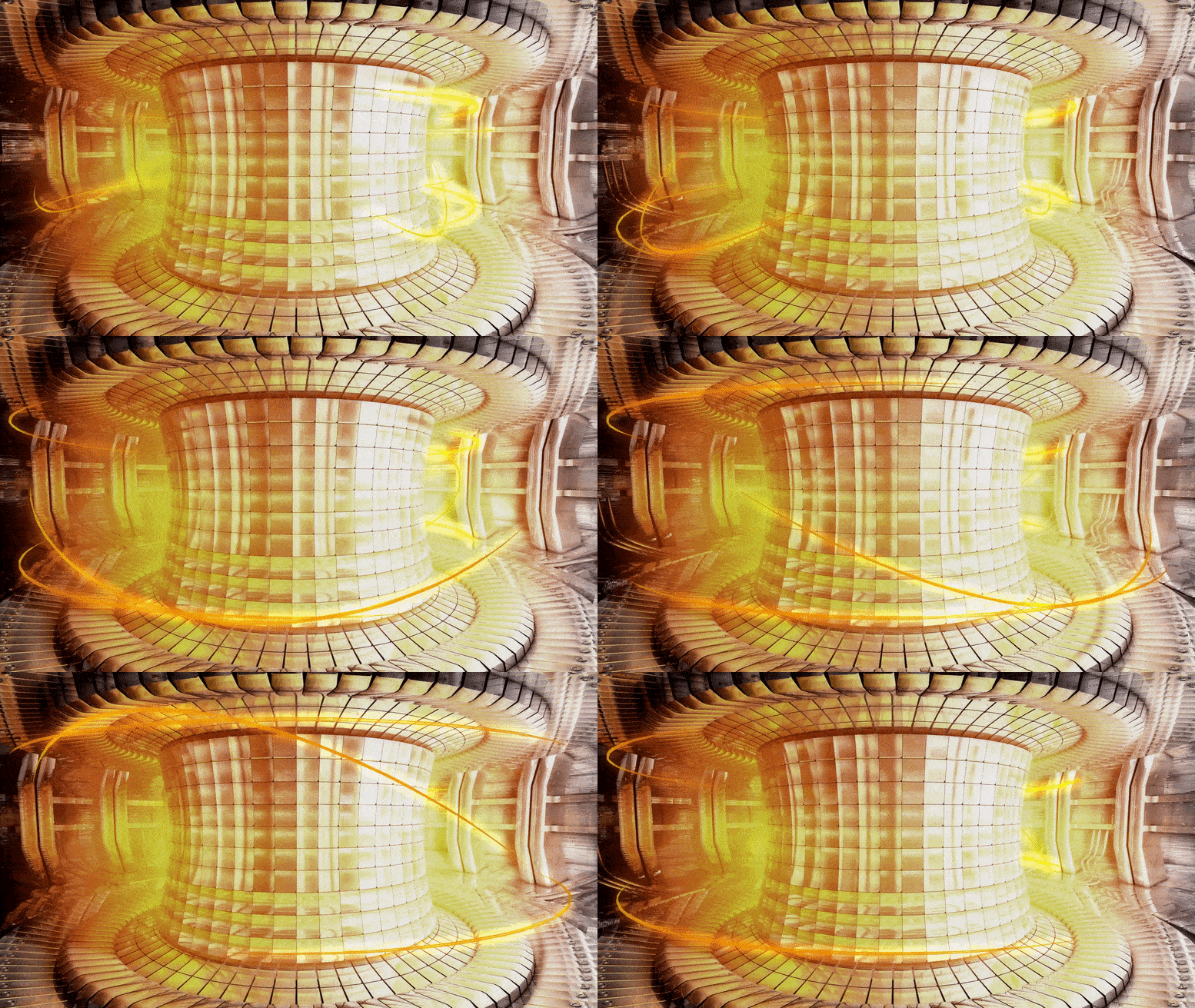
Nature paper chronicles how researchers achieved burning plasma regime for the first time in a laboratory experiment.
After decades of fusion research, a burning plasma state was achieved on November 2020 and February 2021 at Lawrence Livermore National Laboratory’s National Ignition Facility (NIF), the world’s most energetic laser.
Obtaining a burning plasma is a critical step toward self-sustaining fusion energy. A burning plasma is one in which the fusion reactions themselves are the primary source of heating in the plasma, which is necessary to sustain and propagate the burn to enable high-energy gain.
The work is detailed in the journal Nature in a paper titled “Burning plasma achieved in inertial fusion,” with LLNL physicists Alex Zylstra and Omar Hurricane serving as lead authors.
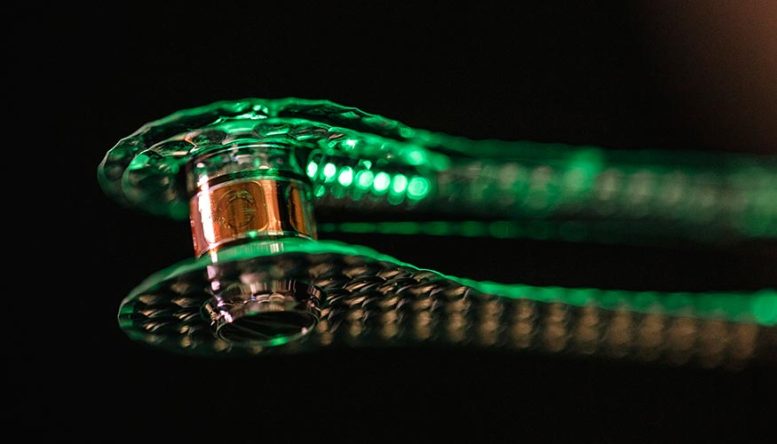
“In this paper, we show that those experiments entered into what we call the burning plasma regime for the first time in the laboratory,” Zylstra said. “A burning plasma is one in which the fusion reactions provide most of the plasma heating.”
LLNL uses NIF to generate X-rays in a radiation cavity to indirectly drive a fuel-containing capsule via the X-ray ablation pressure. The implosion process compresses and heats the deuterium-tritium fuel via mechanical work.
“Fusion experiments over decades have produced fusion reactions using large amounts of ‘external’ heating to get the plasma hot. Now, for the first time, we have a system where the fusion itself is providing most of the heating,” Zylstra said. “This is a key milestone on the way to even higher levels of fusion performance.”
Getting fusion to work requires getting the power balance in the fuel right — there are always mechanisms that cause the plasma to lose energy, while fusion and the implosion’s compression heat the plasma.
Fusion is a highly non-linear process and, in this regime, researchers now have the opportunity to rapidly increase performance — in fact, this burning plasma work was a key stepping stone to the 1.3 MJ yield produced in August 2021. Generating these burning plasmas on NIF enables novel stewardship science experiments on both the burn physics and stockpile applications using the higher yield.
Designing and conducting these experiments was the work of a huge multidisciplinary team, with more than 150 coauthors on this publication from the Lab and partner institutions. Confirming that researchers had actually entered the burning plasma regime required using some inferred metrics, where a combination of measured quantities was used from several key diagnostics on NIF and models to infer the energy balance in the fusion fuel. This work was largely done in a working group that looks at analysis of the ‘hot spot,’ with conclusions validated by another working group of scientists at the Lab.
Reflecting the team effort, additional papers are coming soon on these burning plasma experiments. A paper describing the computational design work that led to these results has been published in Nature Physics, with lead authors Annie Kritcher and Chris Young. Further analysis of the experiments in the new burning plasma regime is submitted for publication in a paper led by authors Steven Ross, Joe Ralph and Alex Zylstra.
Reference: “Burning plasma achieved in inertial fusion” by A. B. Zylstra, O. A. Hurricane, D. A. Callahan, A. L. Kritcher, J. E. Ralph, H. F. Robey, J. S. Ross, C. V. Young, K. L. Baker, D. T. Casey, T. Döppner, L. Divol, M. Hohenberger, S. Le Pape, A. Pak, P. K. Patel, R. Tommasini, S. J. Ali, P. A. Amendt, L. J. Atherton, B. Bachmann, D. Bailey, L. R. Benedetti, L. Berzak Hopkins, R. Betti, S. D. Bhandarkar, J. Biener, R. M. Bionta, N. W. Birge, E. J. Bond, D. K. Bradley, T. Braun, T. M. Briggs, M. W. Bruhn, P. M. Celliers, B. Chang, T. Chapman, H. Chen, C. Choate, A. R. Christopherson, D. S. Clark, J. W. Crippen, E. L. Dewald, T. R. Dittrich, M. J. Edwards, W. A. Farmer, J. E. Field, D. Fittinghoff, J. Frenje, J. Gaffney, M. Gatu Johnson, S. H. Glenzer, G. P. Grim, S. Haan, K. D. Hahn, G. N. Hall, B. A. Hammel, J. Harte, E. Hartouni, J. E. Heebner, V. J. Hernandez, H. Herrmann, M. C. Herrmann, D. E. Hinkel, D. D. Ho, J. P. Holder, W. W. Hsing, H. Huang, K. D. Humbird, N. Izumi, L. C. Jarrott, J. Jeet, O. Jones, G. D. Kerbel, S. M. Kerr, S. F. Khan, J. Kilkenny, Y. Kim, H. Geppert Kleinrath, V. Geppert Kleinrath, C. Kong, J. M. Koning, J. J. Kroll, M. K. G. Kruse, B. Kustowski, O. L. Landen, S. Langer, D. Larson, N. C. Lemos, J. D. Lindl, T. Ma, M. J. MacDonald, B. J. MacGowan, A. J. Mackinnon, S. A. MacLaren, A. G. MacPhee, M. M. Marinak, D. A. Mariscal, E. V. Marley, L. Masse, K. Meaney, N. B. Meezan, P. A. Michel, M. Millot, J. L. Milovich, J. D. Moody, A. S. Moore, J. W. Morton, T. Murphy, K. Newman, J.-M. G. Di Nicola, A. Nikroo, R. Nora, M. V. Patel, L. J. Pelz, J. L. Peterson, Y. Ping, B. B. Pollock, M. Ratledge, N. G. Rice, H. Rinderknecht, M. Rosen, M. S. Rubery, J. D. Salmonson, J. Sater, S. Schiaffino, D. J. Schlossberg, M. B. Schneider, C. R. Schroeder, H. A. Scott, S. M. Sepke, K. Sequoia, M. W. Sherlock, S. Shin, V. A. Smalyuk, B. K. Spears, P. T. Springer, M. Stadermann, S. Stoupin, D. J. Strozzi, L. J. Suter, C. A. Thomas, R. P. J. Town, E. R. Tubman, P. L. Volegov, C. R. Weber, K. Widmann, C. Wild, C. H. Wilde, B. M. Van Wonterghem, D. T. Woods, B. N. Woodworth, M. Yamaguchi, S. T. Yang and G. B. Zimmerman, 26 January 2022, Nature.
DOI: 10.1038/s41586-021-04281-w
Never miss a breakthrough: Join the SciTechDaily newsletter.
Follow us on Google and Google News.
1 Comment
…