
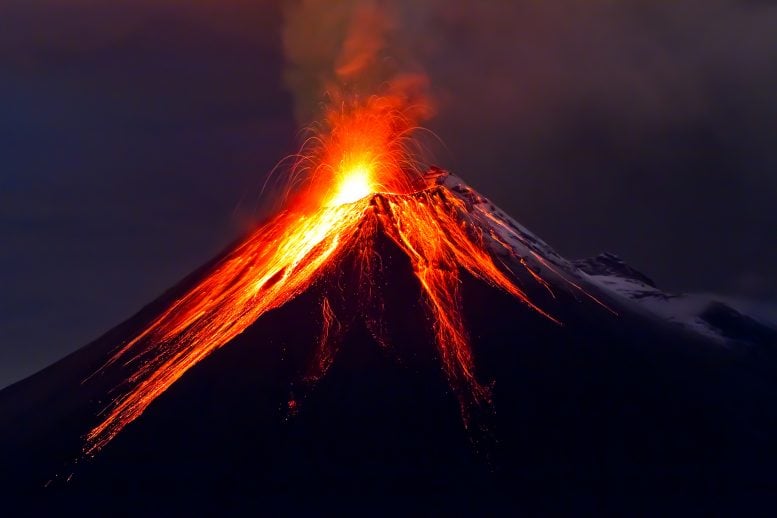
An international team, led by the University of Geneva (UNIGE), has successfully dated some of the largest eruptions in history by analyzing medieval texts.
While studying the night sky, medieval monks inadvertently documented some of the most significant volcanic eruptions in history. A global team of scientists, spearheaded by the University of Geneva (UNIGE), utilized information from 12th and 13th-century European and Middle Eastern chronicles, as well as ice core and tree ring data, to precisely determine the timing of some of the largest volcanic eruptions ever witnessed. Published in the journal Nature, their findings reveal fresh insights about an exceptionally volcanic era in Earth’s past, which some believe contributed to the onset of the Little Ice Age— a long interval of cooling that saw the advance of European glaciers.
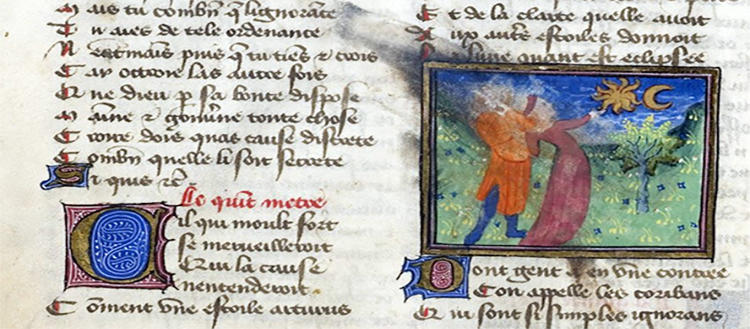
The research team spent nearly five years scrutinizing hundreds of annals and chronicles from various regions in Europe and the Middle East, searching for mentions of total lunar eclipses and their hues. Total lunar eclipses transpire when the moon moves into Earth’s shadow. Ordinarily, the moon stays visible as a reddish sphere due to sunlight bending around Earth through its atmosphere. However, following a massive volcanic eruption, the stratosphere— the central portion of the atmosphere commencing at approximately the altitude of commercial aircraft—may contain so much dust that the eclipsed moon becomes nearly invisible.
Medieval chroniclers recorded and described all kinds of historical events, including the deeds of kings and popes, important battles, and natural disasters and famines. Just as noteworthy were the celestial phenomena that might foretell such calamities. Mindful of the Book of Revelation, a vision of the end times that speaks of a blood-red moon, the monks were especially careful to take note of the moon’s coloration. Of the 64 total lunar eclipses that occurred in Europe between 1100 and 1300, the chroniclers had faithfully documented 51. In five of these cases, they also reported that the moon was exceptionally dark.
The Contribution of Japanese Scribes
Asked what made him connect the monks’ records of the brightness and color of the eclipsed moon with volcanic gloom, the lead author of the work, Sébastien Guillet, senior research associate at the Institute for environmental sciences at the UNIGE, said: “I was listening to Pink Floyd’s Dark Side of the Moon album when I realized that the darkest lunar eclipses all occurred within a year or so of major volcanic eruptions. Since we know the exact days of the eclipses, it opened the possibility of using the sightings to narrow down when the eruptions must have happened.”
The researchers found that scribes in Japan took equal note of lunar eclipses. One of the best known, Fujiwara no Teika, wrote of an unprecedented dark eclipse observed on 2 December 1229: ‘the old folk had never seen it like this time, with the location of the disk of the Moon not visible, just as if it had disappeared during the eclipse… It was truly something to fear.’ The stratospheric dust from large volcanic eruptions was not only responsible for the vanishing moon. It also cooled summer temperatures by limiting the sunlight reaching the Earth’s surface. This in turn could bring ruin to agricultural crops.
Cross-Checking Text and Data
“We know from previous work that strong tropical eruptions can induce global cooling on the order of roughly 1°C over a few years,” said Markus Stoffel, full professor at the Institute for environmental sciences at the UNIGE and last author of the study, a specialist in converting measurements of tree rings into climate data, who co-designed the study. “They can also lead to rainfall anomalies with droughts in one place and floods in another.”
Despite these effects, people at the time could not have imagined that the poor harvests or the unusual lunar eclipses had anything to do with volcanoes – the eruptions themselves were all but one undocumented. “We only knew about these eruptions because they left traces in the ice of Antarctica and Greenland,” said co-author Clive Oppenheimer, professor at the Department of Geography at the University of Cambridge. “By putting together the information from ice cores and the descriptions from medieval texts we can now make better estimates of when and where some of the biggest eruptions of this period occurred.”
Climate and Society Affected
To make the most of this integration, Sébastien Guillet worked with climate modelers to compute the most likely timing of the eruptions. “Knowing the season when the volcanoes erupted is essential, as it influences the spread of the volcanic dust and the cooling and other climate anomalies associated with these eruptions,” he said.
As well as helping to narrow down the timing and intensity of these events, what makes the findings significant is that the interval from 1100 to 1300 is known from ice core evidence to be one of the most volcanically active periods in history. Of the 15 eruptions considered in the new study, one in the mid-13th century rivals the famous 1815 eruption of Tambora that brought on ‘the year without a summer’ of 1816. The collective effect of the medieval eruptions on Earth’s climate may have led to the Little Ice Age, when winter ice fairs were held on the frozen rivers of Europe. “Improving our knowledge of these otherwise mysterious eruptions, is crucial to understanding whether and how past volcanism affected not only climate but also society during the Middle Ages,” concludes the researcher.
Reference: “Lunar eclipses illuminate timing and climate impact of medieval volcanism” by Sébastien Guillet, Christophe Corona, Clive Oppenheimer, Franck Lavigne, Myriam Khodri, Francis Ludlow, Michael Sigl, Matthew Toohey, Paul S. Atkins, Zhen Yang, Tomoko Muranaka, Nobuko Horikawa, and Markus Stoffel, 5 April 2023, Nature.
DOI: 10.1038/s41586-023-05751-z
Never miss a breakthrough: Join the SciTechDaily newsletter.
Follow us on Google and Google News.