

Brain Space Provides New Insights Into Ancient Lungfish
The evolution of the brain and nervous system in animals has been wound back more than 400 million years, due to the discovery of fossilized remnants of ancient lungfish that provided a missing link in the origin of land-dwelling, four-legged creatures on Earth.
To better understand lungfish brain development, an international team led by Flinders University in Australia compared comprehensive 3D models of cranial endocasts from six Paleozoic lungfish (Dipnoi) fossils to the brain spaces of the surviving sister group of terrestrial vertebrates.
According to lead scientist Dr. Alice Clement of Flinders University, this could help interpret the earliest tetrapods, which eventually went from water to land on four legs.
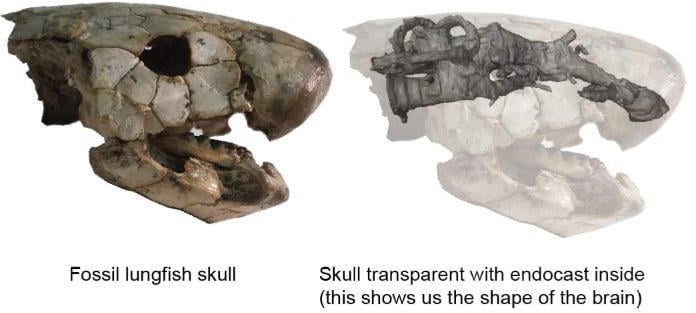
The finding, published in the international journal eLife, sheds light on the evolutionary history of these lobe-finned fish (Sarcopterygii), revealing how the olfactory area seems to be more plastic than the hindbrain and experiences dramatic elongation in several taxa.
Insights into Lungfish Brain Evolution and Sensory Development
“Our discovery shows that the brains of lungfish have been evolving constantly throughout their 400-million-year history, but it suggests they have likely always relied on their sense of smell rather than vision to navigate their environments. This is quite unlike other fish which use sight much more powerfully,” says Dr. Clement from the Flinders University Ecology and Evolution (Palaeontology) research lab.
“She says that understanding how lungfish brains have changed throughout their evolutionary history helps an understand of what the brains of the first tetrapods (our land-based ancestors) might have looked like too – this can give us an idea of which senses were more important than others (such as vision vs olfaction).”
For this study, the researchers from Australia, with co-authors in the UK, Canada, and Sweden, used powerful imaging methods to reconstruct these brain models virtually.

Broader Implications for Evolutionary Science
Senior author Dr. Tom Challands, from the University of Edinburgh in Scotland, says the ongoing work is significant in broad evolutionary and palaeontological science.
“This paper effectively doubles the number of lungfish endocasts known, as their preservation quality is often damaged by a fossil being crushed or broken, and the brain itself has very poor preservation potential and is not currently known in any fossil lungfish,” he says.
“Lungfish have persisted for more than 400 million years from the Devonian Period to the present day and provide unique insights into the condition of the earliest tetrapods as well as their own evolutionary history.”
With the use of X-ray tomography as a palaeontological tool, the cranial endocasts of six Palaeozoic lungfish (Iowadipterus halli, Gogodipterus paddyensis, Pillararhynchus longi, Griphognathus whitei, Orlovichthys limnatis, and Rhinodipterus ulrichi) could be studied non-destructively. The fossils come from Australia, the US, Russia, and Germany.
The six fossils and two extant taxa were subject to a 12-taxon data set for multivariate morphometric analysis using 17 variables.
“Studying our ‘fishy cousins’ lungfish continues to help us understand how fish first left the water some 350 million years ago and started to become land animals (tetrapods), and later humans. Perhaps some of their nervous system traits remain in us still,” Dr. Clements says.
Reference: “Morphometric analysis of lungfish endocasts elucidates early dipnoan palaeoneurological evolution” by Alice M Clement Is a corresponding author, Tom J Challands, Richard Cloutier, Laurent Houle, Per E Ahlberg, Shaun P Collin and John A Long, 12 July 2022, eLife.
DOI: 10.7554/eLife.73461
Never miss a breakthrough: Join the SciTechDaily newsletter.
Follow us on Google and Google News.
1 Comment
“Unlike Other Fish: Lungfish Brains Have Been Constantly Evolving for 400 Million Years”
What an ignorant headline, especially for a site that supposed to be about science!
Nor is there anything in the article indicting that claim. All animals, including all fish species, are continually evolving.