
- Mass Eye and Ear physician-researchers show that retinal imaging can help predict a person’s risk of developing ocular, neuropsychiatric, cardiac, metabolic, and pulmonary diseases.
- The team also identified genetic loci associated with retinal thinning, which could help develop personalized treatment plans and future therapies for eye diseases such as glaucoma and macular degeneration.
The retina is said to provide a window into a person’s systemic health. In a new study published on January 24th in Science Translational Medicine, physician-researchers from Mass Eye and Ear, a member of Mass General Brigham, and the Broad Institute of MIT and Harvard combined retinal imaging, genetics, and big data to estimate how likely a person is to develop eye and systemic diseases in the future. They found significant associations between the thinning of different retinal layers and increased risk of developing ocular, neuropsychiatric, cardiac, metabolic, and pulmonary diseases and identified genes that are associated with retinal layer thickness.
Predictive Power of Retinal Images
“We showed that retinal images could be used to predict the future risk of both ocular disease and systemic disease,” says first author Seyedeh Maryam Zekavat, MD, PhD, a Harvard Ophthalmology resident at Mass Eye and Ear and graduate student at Broad. “This could potentially help with disease prevention—if we know from someone’s retinal image that they are at high risk of developing glaucoma or cardiovascular disease in the future, we could refer them for follow-up screening or preventative treatment.”
Because of its position behind the transparent structures of the eye, the retina is easy to visualize and image non-invasively, and retinal imaging is already a routine procedure in ophthalmology. The new study uncovers possibilities for preventative medicine and crosstalk between ophthalmologists and other areas of medicine.
Linking Retinal Health With Systemic Conditions
Previous studies have shown that there are links between retinal health and health conditions including aging, cardiometabolic diseases such as diabetes and hypertension, and neurological diseases such as dementia, stroke, and multiple sclerosis.
“We’ve come to realize recently that there is a lot more information that we can get from our retina images than we thought was possible,” says senior author Nazlee Zebardast, MD, MSc, director of Glaucoma Imaging at Mass Eye and Ear and an assistant professor of ophthalmology at Harvard Medical School. “It’s really exciting to be able to see that these images, which are obtained without having to do any sort of invasive procedure, are associated with so many systemic conditions, both at a genetic level as well as an epidemiologic level.”
To identify associations between retinal health and disease risk, and to identify genes associated with retinal health, the researchers analyzed data from 44,823 UK Biobank participants who underwent optical coherence tomography (OCT) imaging of the retina, genotyping, and baseline measurements of health in 2010 and were then followed for disease development for an average of ten years.
Insights Into Retinal Layers and Genetic Associations
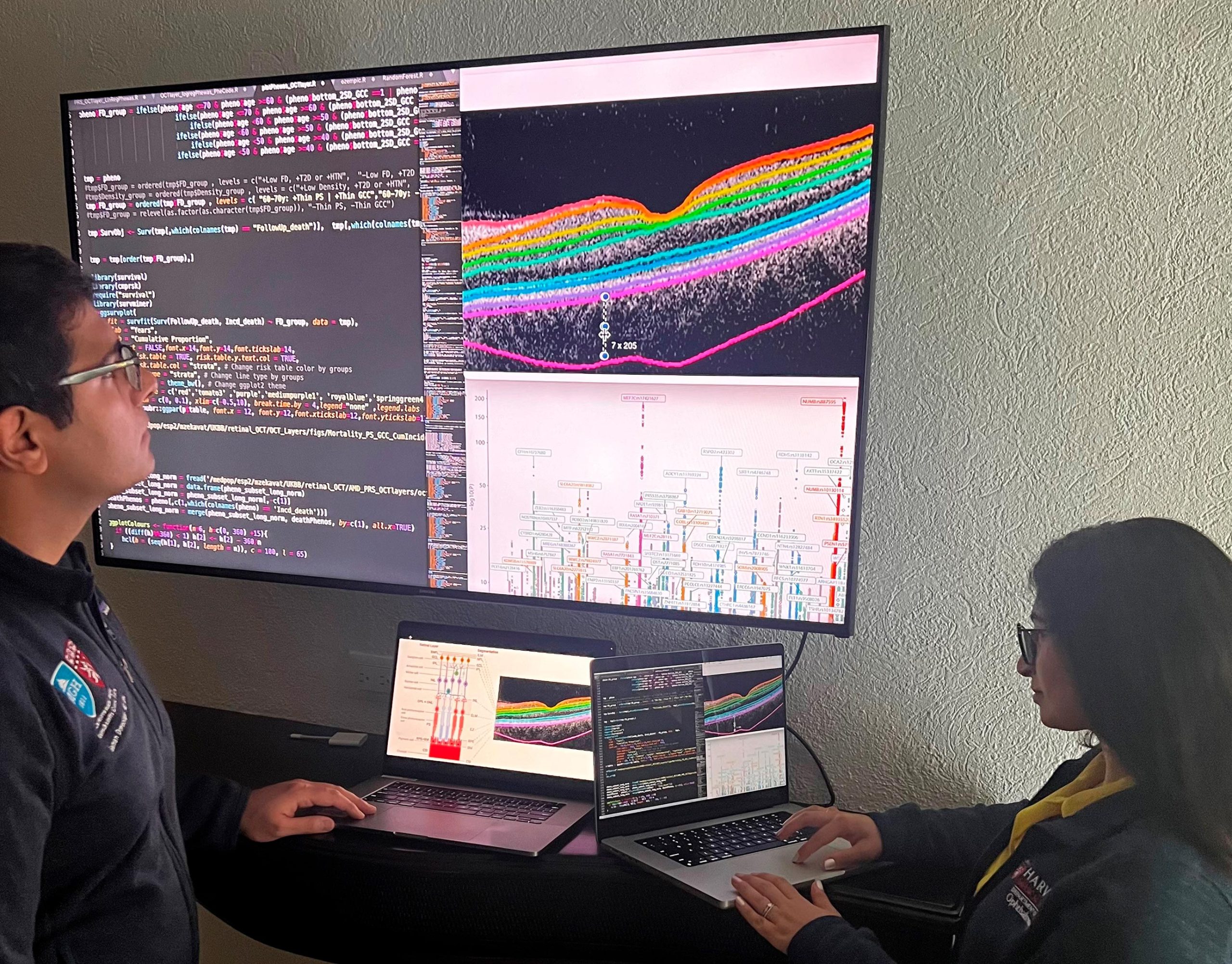
Unlike previous studies that searched for genes associated with overall retina health, this study delved deeper into the role of the different cell layers that make up the retina.
“Each layer of the retina is made up of different types of cells with diverse structures and functions, and we show that the thicknesses of these different layers are associated with different conditions,” says Zebardast, who is also an associated scientist at Broad.
The study also provides insight into the genes and biological pathways that determine retinal health, which could be leveraged to develop future therapies, the researchers say. Altogether, the team identified 259 genetic loci that were associated with retinal thickness.
One particular insight from this work was that multiple systemic health conditions including poor cardiac, metabolic, pulmonary, and renal function are linked to thinning of the photoreceptor segment of the retina, though further research would be needed to confirm causality. Future studies should also aim to replicate the study’s methods in more diverse populations and different age groups, since participants in the UK BioBank were predominantly white and aged 40-70 years old at baseline.
Expanding Clinical Applications and Future Directions
The study is part of an ongoing effort at Mass Eye and Ear to identify genetic markers of glaucoma and other ocular diseases that might help to develop personalized risk scores and treatment plans for patients. Retinal OCT imaging is already a standard clinical procedure in ophthalmology at Mass Eye and Ear and elsewhere, but the authors say that their results suggest that its use could be widened. Further work on the connection between ocular and cardiometabolic health will enable understanding of its clinical utility, and the researchers are extending this line of research along with co-author Pradeep Natarajan, MD, director of preventive cardiology at Massachusetts General Hospital, and an associate member in the Cardiovascular Disease Initiative at Broad.
Conclusion: The Potential of Retinal Imaging in Health Prediction
“Patients come to us for their eye health, but what if we could tell them more than that?” says Zebardast. “What if we could use someone’s retinal images to tell them, ‘You seem to have a high risk of having high blood pressure, maybe you should get screened, or maybe your primary care doctor should know about that.’”
The authors have developed an online user-interface for all of their findings on the Ocular Knowledge Portal, to enable researchers to explore associations between retinal layer thickness, disease, and genetics.
Reference: “Phenome- and genome-wide analyses of retinal optical coherence tomography images identify links between ocular and systemic health” by Seyedeh Maryam Zekavat, Saman Doroodgar Jorshery, Franziska G. Rauscher, Katrin Horn, Sayuri Sekimitsu, Satoshi Koyama, Trang T. Nguyen, Maria C. Costanzo, Dongkeun Jang, Noël P. Burtt, Andreas Kühnapfel, Yusrah Shweikh, Yixuan Ye, Vineet Raghu, Hongyu Zhao, Marzyeh Ghassemi, Tobias Elze, Ayellet V. Segrè, Janey L. Wiggs, Lucian Del Priore, Markus Scholz, Jay C. Wang, Pradeep Natarajan and Nazlee Zebardast, 24 January 2024, Science Translational Medicine.
DOI: 10.1126/scitranslmed.adg4517
Authorship: Seyedeh Maryam Zekavat (MEE, MGH, Broad) Saman Doroodgar Jorshery (Broad) Franziska G. Rauscher (Lepzig), Katrin Horn (Leipzig), Sayuri Sekimitsu (Tufts) Satoshi Koyama (MGH, Broad) Trang T. Nguyen (Broad) Maria C. Costanzo (Broad), Dongkeun Jang (Broad), Noël P. Burtt (Broad), Andreas Kühnapfel (Leipzig) Yusrah Shweikh (MEE), Yixuan Ye (Yale), Vineet Raghu (MGH, Broad), Hongyu Zhao (Yale), Marzyeh Ghassemi (Toronto), Tobias Elze (MEE), Ayellet V. Segrè (MEE) , Janey L. Wiggs (MEE), Lucian Del Priore (Yale), Markus Scholz (Leipzig), Jay C. Wang (Yale) Pradeep Natarajan (MGH, Broad) Nazlee Zebardast (MEE, Broad).
Disclosures: Natarajan reports research grants from Allelica, Apple, Amgen, Boston Scientific, Genentech / Roche, and Novartis; personal fees from Allelica, Apple, AstraZeneca, Blackstone Life Sciences, Creative Education Concepts, CRISPR Therapeutics, Eli Lilly & Co, Foresite Labs, Genentech / Roche, GV, HeartFlow, Magnet Biomedicine, Merck, and Novartis; scientific advisory board membership of Esperion Therapeutics, Preciseli, and TenSixteen Bio; scientific cofounder of TenSixteen Bio; equity in MyOme, Preciseli, and TenSixteen Bio; and spousal employment at Vertex Pharmaceuticals, all unrelated to the present work. Wiggs has received grant support from Aerpio and served as a consultant for Allergan, Avellino, Editas, Maze, and Regenxbio outside of the present work, has served as a consultant for Zeiss. No conflicting relationship exists for other authors.
Funding: This study was supported by the National Eye Institute with additional support from the Hassenfeld Scholar Award from the Massachusetts General Hospital, grants from the National Heart, Lung, and Blood Institute and analysis support from the LIFE Leipzig Research Center for Civilization Diseases. A full list of funders can be found in the paper.
Never miss a breakthrough: Join the SciTechDaily newsletter.
Follow us on Google and Google News.