
Engineers could gain better control over the behavior of vortices in power generation and other applications with a mathematical model linking these vortices with more pedestrian types, like smoke rings.
Gaining deeper insight into the formation of vortex rings, which are swirling, ring-shaped disturbances, could assist nuclear fusion scientists in more effectively compressing fuel. This would potentially bring us a step closer to harnessing nuclear fusion as a viable energy source.
The model developed by researchers at the University of Michigan could aid in the design of the fuel capsule, minimizing the energy lost while trying to ignite the reaction that makes stars shine. In addition, the model could help other engineers who must manage the mixing of fluids after a shock wave passes through, such as those designing supersonic jet engines, as well as physicists trying to understand supernovae.
“These vortex rings move outward from the collapsing star, populating the universe with the materials that will eventually become nebulae, planets, and even new stars—and inward during fusion implosions, disrupting the stability of the burning fusion fuel and reducing the efficiency of the reaction,” said Michael Wadas, a doctoral candidate in mechanical engineering at U-M and corresponding author of the study.
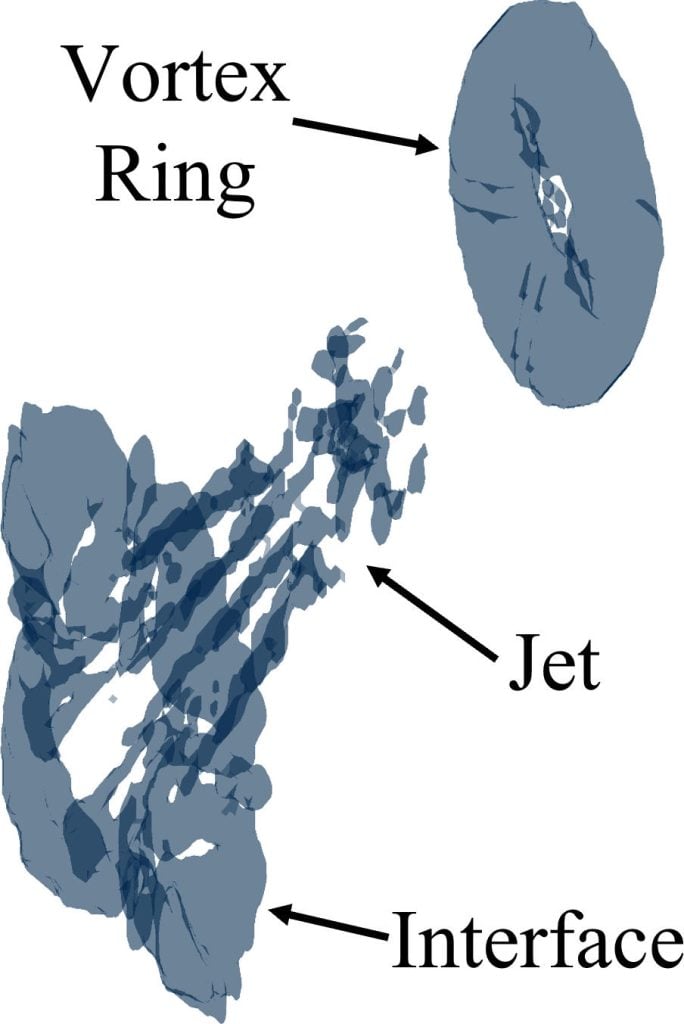
“Our research, which elucidates how such vortex rings form, can help scientists understand some of the most extreme events in the universe and bring humanity one step closer to capturing the power of nuclear fusion as an energy source,” he said.
Nuclear fusion pushes atoms together until they merge. This process releases several times more energy than breaking atoms apart, or fission, which powers today’s nuclear plants. Researchers can create this reaction, merging forms of hydrogen into helium, but at present, much of the energy used in the process is wasted.
Part of the problem is that the fuel can’t be neatly compressed. Instabilities cause the formation of jets that penetrate into the hotspot, and the fuel spurts out between them—Wadas compared it to trying to squish an orange with your hands, how juice would leak out between your fingers.
Connecting Fusion Science to Supernovae and Jellyfish Eddies
Vortex rings that form at the leading edge of these jets, the researchers have shown, are mathematically similar to smoke rings, the eddies behind jellyfish and the plasma rings that fly off the surface of a supernova.
Perhaps the most famous approach to fusion is a spherical array of lasers all pointing toward a spherical capsule of fuel. This is how experiments are set up at the National Ignition Facility, which has repeatedly broken records for energy output in recent years.
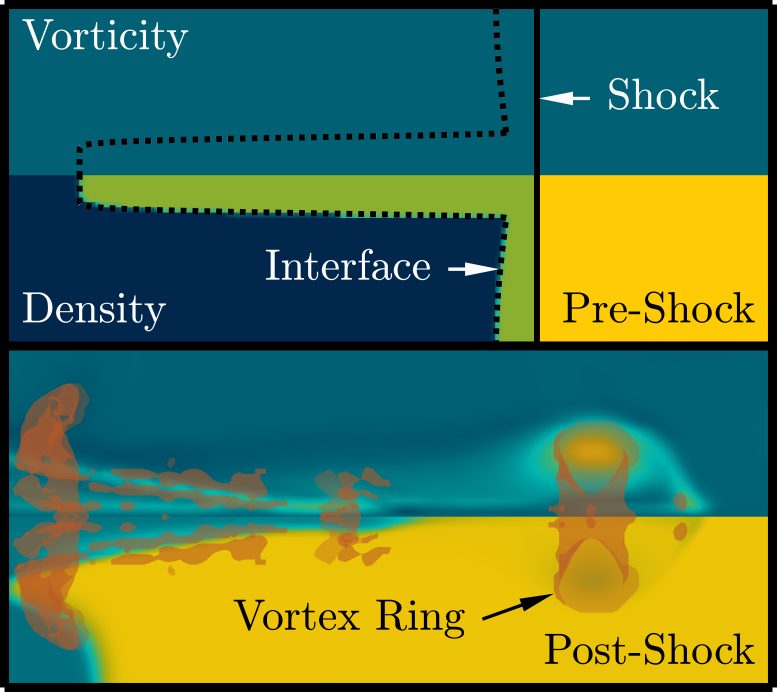
The energy from the lasers vaporizes the layer of material around the fuel—a nearly perfect, lab-grown shell of diamond in the latest record-setter in December 2022. When that shell vaporizes, it drives the fuel inward as the carbon atoms fly outward. This generates a shockwave, which pushes the fuel so hard that the hydrogen fuses.
While the spherical fuel pellets are some of the most perfectly round objects humans have ever made, each has a deliberate flaw: a fill tube, where the fuel enters. Like a straw stuck in that crushed orange, this is the most likely place for a vortex-ring-led jet to form when the compression starts, the researchers explained.
“Fusion experiments happen so fast that we really only have to delay the formation of the jet for a few nanoseconds,” said Eric Johnsen, an associate professor of mechanical engineering at U-M, who supervised the study.
Bridging Fluid Mechanics and Plasma Physics
The study brought together the fluid mechanics expertise of Wadas and Johnsen as well as the nuclear and plasma physics knowledge in the lab of Carolyn Kuranz, an associate professor of nuclear engineering and radiological sciences.
“In high-energy-density physics, many studies point out these structures, but haven’t clearly identified them as vortex rings,” said Wadas.
Knowing about the deep body of research into the structures seen in fusion experiments and astrophysical observations, Wadas and Johnsen were able to draw on and extend that existing knowledge rather than trying to describe them as completely new features.
Johnsen is particularly interested in the possibility that vortex rings could help drive the mixing between heavy elements and lighter elements when stars explode, as some mixing process must have occurred to produce the composition of planets like Earth.
The model can also help researchers understand the limits of the energy that a vortex ring can carry, and how much fluid can be pushed before the flow becomes turbulent and harder to model as a result. In ongoing work, the team is validating the vortex ring model with experiments.
Reference: “Saturation of Vortex Rings Ejected from Shock-Accelerated Interfaces” by Michael J. Wadas, Loc H. Khieu, Griffin S. Cearley, Heath J. LeFevre, Carolyn C. Kuranz and Eric Johnsen, 12 May 2023, Physical Review Letters.
DOI: 10.1103/PhysRevLett.130.194001
The research is funded by Lawrence Livermore National Laboratory and the Department of Energy, with computational resources provided by the Extreme Science and Engineering Discovery Environment through the National Science Foundation and the Oak Ridge Leadership Computing Facility.
Never miss a breakthrough: Join the SciTechDaily newsletter.
Follow us on Google and Google News.
2 Comments
Fusion Now!
Vortex storm is approaching. This is the pace of the spring of human scientific and technological revolution.