
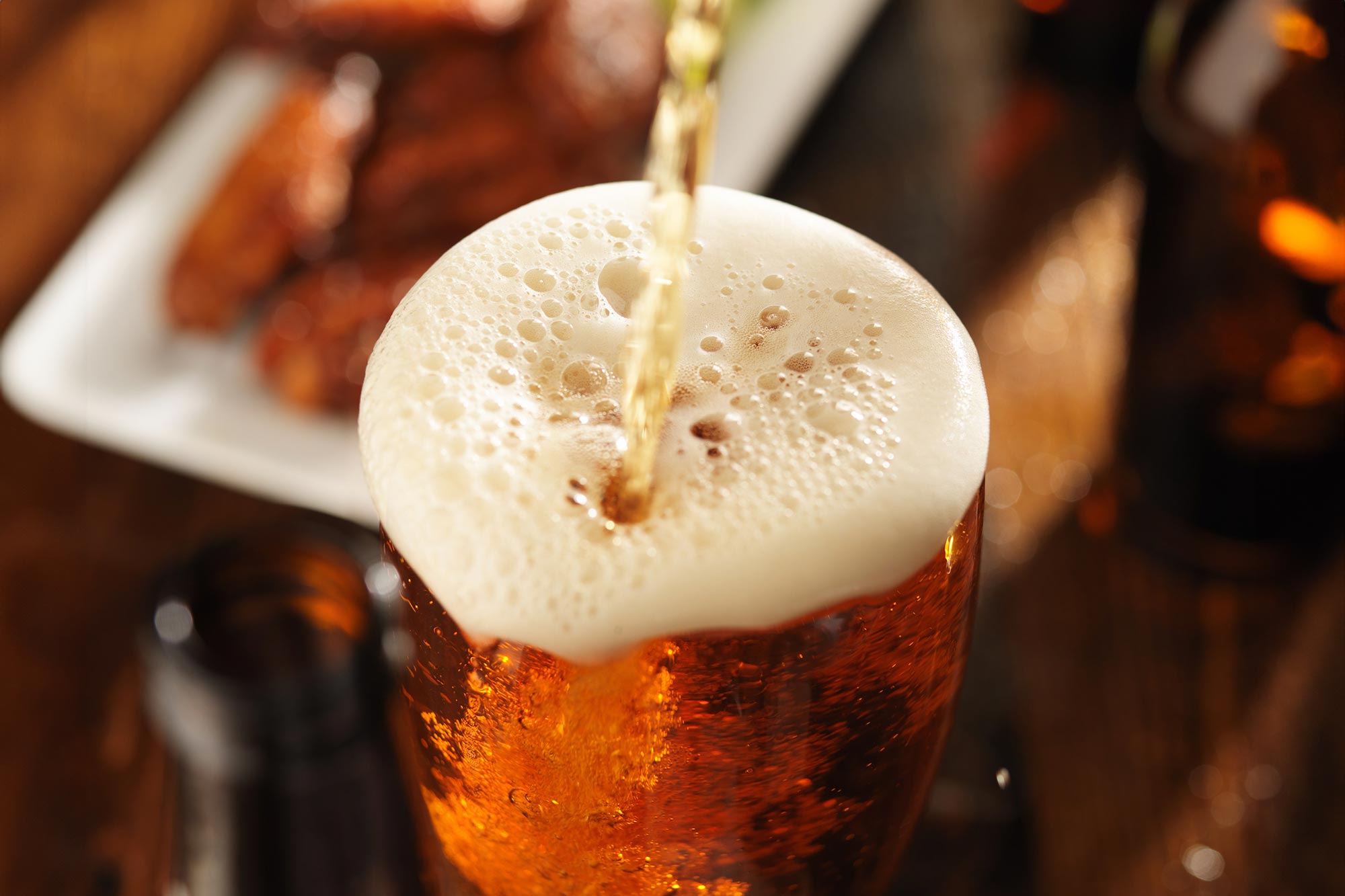
Killer toxins produced by Saccharomyces strains have been found to inhibit beer-spoiling diastatic yeasts, offering an economical solution for managing beer contamination in craft breweries.
- Diastatic yeasts can spoil craft beer through hyperattenuation, which boosts the alcohol content and causes bottles to explode.
- Killer toxins, which are produced by other yeast strains, hint at a remedy.
- In a proof-of-concept study, researchers found that killer toxins inhibited up to 95% of diastatic yeasts.
- More work is needed to fine tune the recipe, but killer yeasts may help brewers remedy potentially contaminated beers.
Brewer’s Yeast Challenges
When diastatic strains of Saccharomyces cerevisiae, or brewer’s yeast, land in the wrong place, they can become a craft beer brewer’s nightmare. Diastatic yeasts are variant strains of yeasts that secrete glucoamylase, an enzyme that can break down dextrins into simple sugars, which can spoil fresh beer by augmenting the alcohol content, changing the flavor and in worst-case scenarios, making bottles explode.
One way to remedy the problem before bottles start to break might be hiding in plain sight. This week in Applied and Environmental Microbiology, a group of brewers and microbiologists report the solution to this yeast problem may be other yeasts. The researchers found that proteins called killer toxins, which are produced naturally by many strains of S. cerevisiae, suppress diastatic strains and may help curb the issue.
Effective Remediation Procedures Using Killer Yeasts
“If you’ve got a diastatic contamination, most of the time you just throw away the beer, and that’s expensive,” said microbiologist and senior author Paul Rowley, Ph.D., at the University of Idaho. “What we show in the paper is that we can add the killer yeast at the point of contamination. It’s a remediation procedure to prevent the diastatic strains from taking off.”
Diastatic strains of S. cerevisiae play an important role in brewing Belgian-style saison beers, which typically have a higher alcohol content than other styles. The problem arises, Rowley said, when those strains end up in the mix for pale ales and other types and set off a secondary fermentation. Although many breweries have robust surveillance methods to prevent contamination, the strains can slip by.
Challenges in Identifying and Controlling Diastatic Yeasts
“If you were to look at these strains on an agar plate, you couldn’t morphologically tell the difference,” he said. The only difference, he said, is that diastatic yeasts have a genetic change that gives them an extra ability to degrade residual starches. “Yeast looks like yeast.”
Large breweries avoid the problem by pasteurizing beer, but the process is expensive, and some small brewers worry that pasteurization changes the taste, said Nicholas Ketchum, a microbiologist who works at the Rhinegeist brewery in Cincinnati, Ohio and co-author on the new study. One of his responsibilities at Rhinegeist is to keep an eye out for diastatic contamination.
Exploratory Research and Future Directions
The research began a few years ago when Ketchum was teaching an applied microbiology and brewing class at a community college in Cincinnati. As he prepared a lecture on wild yeasts and killer toxins, he realized that those proteins might offer an inexpensive way to remedy diastatic contamination. He ran a few experiments, presented preliminary findings at the World Brewing Congress in 2020, and discussed the work on a beer brewer’s podcast—where the mention of killer yeasts caught Rowley’s attention.
Researchers in Rowley’s lab—including then-undergraduates Victor Zhong and Ximena Garcia—subjected 34 diastatic strains of yeast to Saccharomyces strains producing 8 known killer toxins. The most effective toxin, K1, prevented the growth of more than 91% of diastatic strains tested.
The next step is to better understand the mechanism, said Ketchum, and find a way to make it broadly useful to craft brewers. “There are more unknowns than there are knowns” about the process, he said. The efficacy of the toxins, for example, seems to depend on the amount of total yeast in the mix, and not just diastatic strains. Rowley is also currently investigating how widespread the problem is among small brewers.
Rowley continues to investigate killer toxins, which haven’t been well studied. “Yeasts are a lot more complicated than we might think,” he said.
Reference: “Inhibition of diastatic yeasts by Saccharomyces killer toxins to prevent hyperattenuation during brewing” by Victor Zhong, Nicholas Ketchum, James K. Mackenzie, Ximena Garcia and Paul A. Rowley, 12 September 2024, Applied and Environmental Microbiology.
DOI: 10.1128/aem.01072-24
Never miss a breakthrough: Join the SciTechDaily newsletter.
Follow us on Google and Google News.