
Close Menu
    Facebook X (Twitter) Instagram
    SciTechDaily
    • Biology
    • Chemistry
    • Earth
    • Health
    • Physics
    • Science
    • Space
    • Technology
    Facebook X (Twitter) Pinterest YouTube RSS
    SciTechDaily
    Home»Chemistry»“Unprecedented” Control – Scientists Twist Chemical Bonds Beyond Their Limits
    Chemistry

    “Unprecedented” Control – Scientists Twist Chemical Bonds Beyond Their Limits

    By Durham UniversityMarch 29, 2023No Comments3 Mins Read
    Facebook Twitter Pinterest Telegram LinkedIn WhatsApp Email Reddit
    Share
    Facebook Twitter LinkedIn Pinterest Telegram Email Reddit
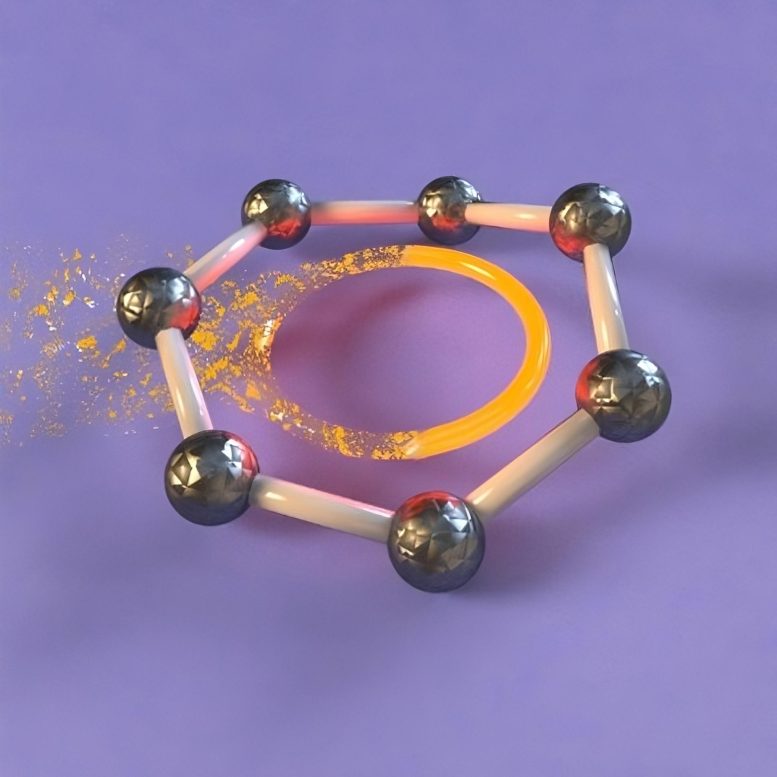
    Scientists Twist Chemical Bonds Beyond Their Limits
    Credit: Durham University

    Researchers manipulated tropylium rings to uncover how strain impacts aromatic bonding, discovering dynamic transitions between intact and pinched forms. This reveals new possibilities for controlling chemical properties in materials.

    A team of researchers from Durham University and the University of York has twisted molecules to their limits in order to challenge understanding of chemical bonds.

    The scientists examined how much twisting the chemical bonding in an aromatic ring could endure before it broke. They accomplished this by creating overcrowded aromatic rings, utilizing tropylium instead of benzene, which shares electrons around a ring of seven carbon atoms.

    Each of these carbon atoms can be functionalized and having seven attachment points in the ring, rather than the six carbon atoms of benzene, allowed the researchers to cram more groups around the edge of the aromatic ring, causing more strain. The researchers found that low levels of overcrowding made the ring twist, but without breaking its aromatic bonding.
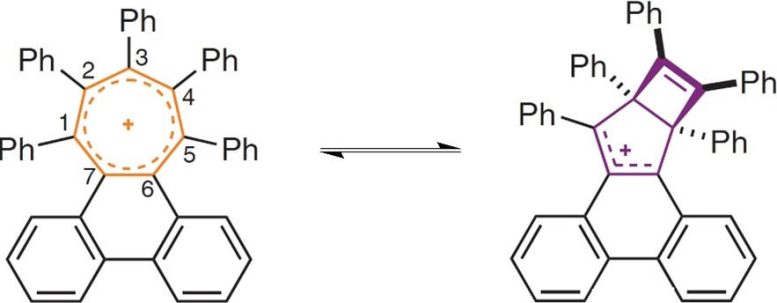
    Dynamic Rearrangement of a Crowded Ring Structure
    The 7-membered ring (left) becomes so crowded around its periphery that it rearranges by pinching across the middle (right), with the molecule alternating between the two structures. Credit: Durham University

    By adding progressively larger groups around the edge of the ring, the team twisted the ring further, eventually causing the aromatic bonding to break.

    The electrons no longer circle the seven carbon atoms and instead, the ring pinches across its middle to form two smaller flat rings. Surprisingly, the researchers found there is a balance point, where the ring jumps back and forth between the aromatic structure and the two smaller rings. One molecule made in this study spends 90% of its time as the pinched structure and 10% of its time as a larger aromatic ring.

    Full study results have been published in the journal Nature Chemistry.

    Surprising Dynamics of Aromatic Bonds

    Reflecting on the study results, Dr. Paul McGonigal of the University of York, said: “In these overcrowded molecules, strain and aromatic bonding are delicately balanced. The structure, properties, and potential applications of a material are ultimately determined by this balance. The precise control over the twisting of our molecules is unprecedented. We were not only able to twist an aromatic molecule up to the maximum amount of strain it can tolerate but also to discover what happens when we push beyond that limit. We hope this investigation is a step towards us being able to more routinely turn aromatic bonding ‘off’ and ‘on’ in a controlled manner.”

    Project lead investigator, Promeet Saha of Durham University, said: “The reversible pinching and reopening of an aromatic ring are truly remarkable. Aromatic bonding is such a powerful stabilizing force that we usually think of it being a constant presence. However, our findings demonstrate that it can be surprisingly dynamic.”

    Chemical bonding in aromatic molecules is key to the structure, stability, and function of chemicals such as drugs and plastics.

    Reference: “Rupturing aromaticity by periphery overcrowding” by Promeet K. Saha, Abhijit Mallick, Andrew T. Turley, Aisha N. Bismillah, Andrew Danos, Andrew P. Monkman, Alyssa-Jennifer Avestro, Dmitry S. Yufit, and Paul R. McGonigal, 6 March 2023, Nature Chemistry.
    DOI: 10.1038/s41557-023-01149-6

    The study was funded by the Engineering and Physical Sciences Research Council (EPSRC).

    Never miss a breakthrough: Join the SciTechDaily newsletter.
    Follow us on Google and Google News.

    Durham University Materials Science Popular University of York
    Share. Facebook Twitter Pinterest LinkedIn Email Reddit

    Related Articles

    Incredible New Polymer Fibers Are Ultra Light and Super Strong

    Scientists Turn Plastic Waste Into Valuable Chemicals With Sunlight

    Forget ‘Super’ Glue, Scientists Develop New ‘Hyper’ Glue

    New Way to Split and Sum Photons With Silicon Is Breakthrough for Quantum Computing, Solar Energy

    New Technology Can Instantly Identify Airborne Chemicals – Down to Parts-Per-Billion

    Unique Particles – With Stickiness of Gecko Feet – Formed by Harnessing Chaos

    Powerful New Electronics Could Be Created at the Edge of Chaos

    New Discovery Makes Valuable Chemicals Using Excess Carbon Dioxide in the Atmosphere

    Scientists Synthesize an Entirely New Form of Silicon

    Leave A Reply Cancel Reply

    • Facebook
    • Twitter
    • Pinterest
    • YouTube

    Don't Miss a Discovery

    Subscribe for the Latest in Science & Tech!

    Trending News

    One of the Universe’s Largest Stars May Be Getting Ready To Explode

    Scientists Discover Enzyme That Could Supercharge Ozempic-Like Weight Loss Drugs

    Popular Sweetener Linked to DNA Damage – “It’s Something You Should Not Be Eating”

    Ancient “Rock” Microbes May Reveal How Complex Life Began

    Researchers Capture Quantum Interference in One of Nature’s Rarest Atoms

    “A Plague Is Upon Us”: The Mass Death That Changed an Ancient City Forever

    Scientists Discover Game-Changing New Way To Treat High Cholesterol

    This Small Change to Your Exercise Routine Could Be the Secret to Living Longer

    Follow SciTechDaily
    • Facebook
    • Twitter
    • YouTube
    • Pinterest
    • Newsletter
    • RSS
    SciTech News
    • Biology News
    • Chemistry News
    • Earth News
    • Health News
    • Physics News
    • Science News
    • Space News
    • Technology News
    Recent Posts
    • New Research Uncovers Hidden Side Effects of Popular Weight-Loss Drugs
    • Scientists Rethink Extreme Warming After Surprising Ocean Discovery
    • The Surprising Role of Asteroids in the Origin of Life
    • Scientists Raise Concerns Over Newly Recognized Pollutant Found Everywhere in the Air
    • New Study Challenges 40-Year Puzzle About Childhood Body Fat
    Copyright © 1998 - 2026 SciTechDaily. All Rights Reserved.
    • Science News
    • About
    • Contact
    • Editorial Board
    • Privacy Policy
    • Terms of Use

    Type above and press Enter to search. Press Esc to cancel.