
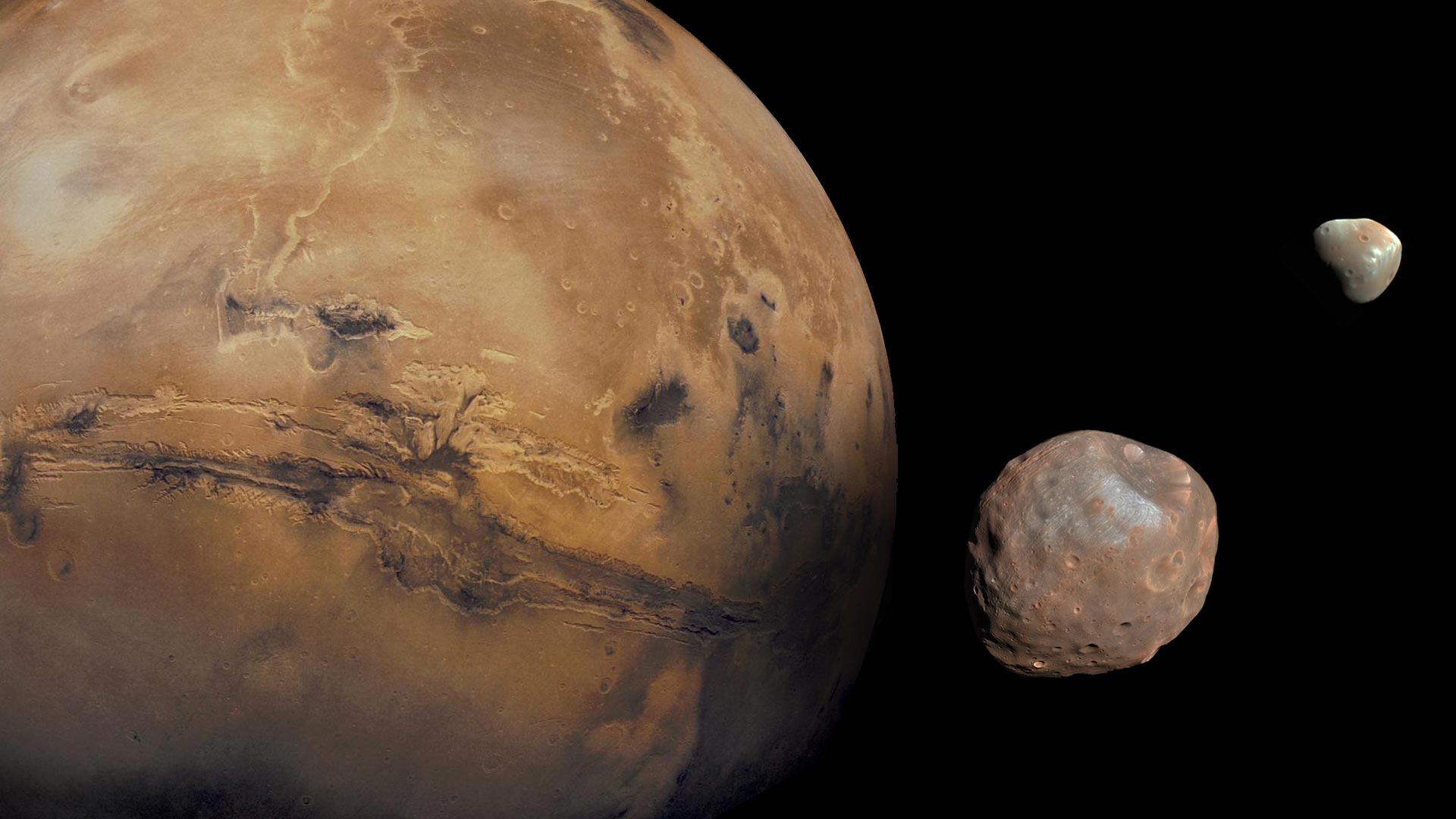
What causes the weathering of the Mars moon Phobos? Results from the Vienna University of Technology give new insights, soon a spacecraft will retrieve soil samples.
Of course, there is no weather in our sense of the word in space — nevertheless, soil can also “weather” in the vacuum of space if it is constantly bombarded by high-energy particles, such as those emitted by the sun. The Martian moon Phobos is affected by a special situation: it is so close to Mars that not only the solar wind but also the irradiation by particles from Mars plays a decisive role there. A research team from TU Wien has now been able to measure this in laboratory experiments. In just a few years, a Japanese space mission will take soil samples from Phobos and bring them back to Earth.
Billions of years of particle irradiation
“There are different theories of how the Mars moon Phobos could have formed,” says Paul Szabo, who is working on his PhD thesis in the research group of Prof. Friedrich Aumayr at the Institute of Applied Physics at TU Wien. “It is possible that Phobos was originally an asteroid that was then captured by Mars, but it could also have been created by a collision of Mars with another large object.”
When investigating such celestial bodies, one must always bear in mind that their surfaces have been completely changed over billions of years by cosmic particle bombardment. The surface of the Earth remains unaffected by this, because our atmosphere shields the particles. However, the geology of celestial bodies without atmospheres, such as our Moon or Phobos, can only be understood if it is possible to correctly assess “space weathering.”

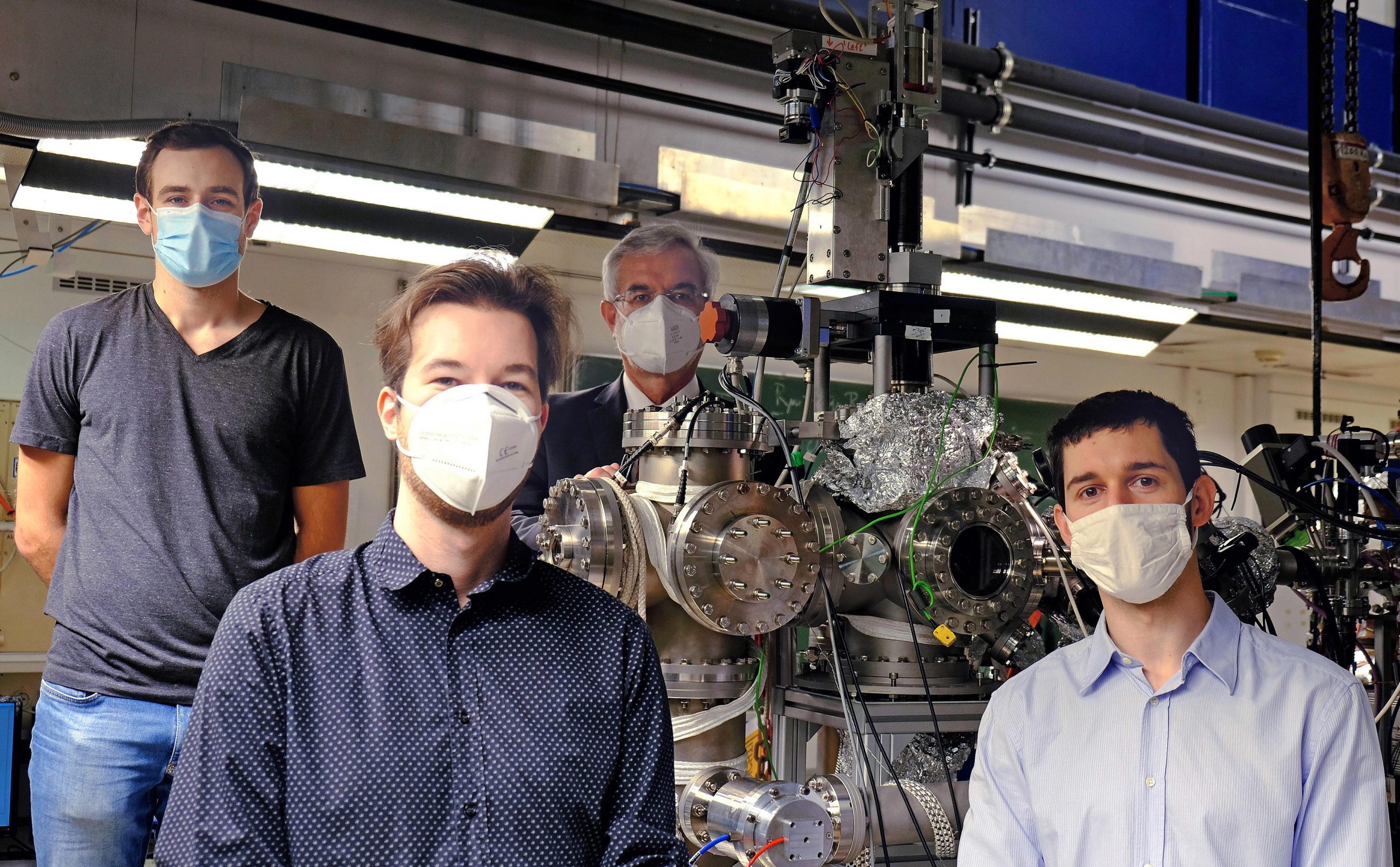
Therefore, elaborate experiments were conducted at TU Wien: “We used a mineral like it is found on Phobos and bombarded it in vacuum chambers with different charged particles,” explains Paul Szabo. “Using an extremely precise balance, we can measure how much material is removed in the process and how much each particle affects the surface.
The special properties of the moon Phobos must be taken into account: Its distance from the surface of Mars is less than 6000 km — not even two percent of the distance between our Moon and the Earth. Just like our Moon, it is in a tidally locked rotation around its planet: The same side always faces Mars.
“Because of the extremely small distance between Mars and Phobos, not only particles emitted from the Sun play a role on the surface of Phobos, but also particles from Mars,” says Paul Szabo. The Martian atmosphere consists mainly of carbon dioxide. But in the outer regions of the atmosphere there are also larger amounts of oxygen. When particles from the solar wind penetrate there, oxygen ions can be created, which then hit Phobos at high speed and change the surface material.
Data for 2024 space mission
“With our measuring methods we were able to estimate the erosion of Phobos much more accurately than was previously possible,” says Friedrich Aumayr. “Our results show that the effect of oxygen ions from the Martian atmosphere cannot be neglected. It is also important to distinguish between the two sides of Phobos: While the solar wind causes the weathering on the side facing away from Mars, the bombardment from the Martian atmosphere dominates on the other side, when the Sun is shielded from Mars.
These considerations could soon play an important role in the evaluation of real Phobos samples: As early as 2024, a spacecraft is meant to reach Phobos as part of the Japanese space mission MMX (Martian Moon eXploration) and bring soil samples back to Earth.
Reference: “Experimental Insights into Space Weathering of Phobos: Laboratory Investigation of Sputtering by Atomic and Molecular Planetary Ions” by P. S. Szabo, H. Biber, N. Jäggi, M. Wappl, R. Stadlmayr, D. Primetzhofer, A. Nenning, A. Mutzke, J. Fleig, K. Mezger, H. Lammer, A. Galli, P. Wurz and F. Aumayr, 1 November 2020, JGR Planets.
DOI: 10.1029/2020JE006583
Never miss a breakthrough: Join the SciTechDaily newsletter.
Follow us on Google and Google News.
3 Comments
Interesting.
However there are afew Questions we need to keep in mind and ask
1. How do we know and can assume that neither Mars or its Moon Phobos Never had a Atmosphere for Billions of years? Dont think we haveen around that long!
2.Every assumption we make and experiment we carry out to try and replicate the conditions on Phobos needs to be carried out under various assumpptions of time snd Space (Read Materials) to see the effect of the same on the Samples the Japanese Space Craft will pick up in 2024 and bring it back ( Dont know why these need tobe brouht back at all . If we can Build a Lab on a Chip I wonder what is stopping us from Building a Lab on Chip fr Space Materials and Space Rocks?). These Samples shouuld be picked up from both faces of Phobos , so that the assumption which fits best with the experiments carried out on earth and alogorithms wriiten to map the likely impct of bombrdment is mapped and information database built so that the comparisions can also occur as soon as the samples are picked up and analysis completed and Information Relayed back to Earth! Then the spacecraft can be used and available to explore other unsolved mysteries of other objects in space.Make such Space Expedition produce more band for the buck as far as Knwledge and information is concerned.
Views expressed are Personal.
@Sekar:
1. Mars has an atmosphere presently, but it’s not nearly as dense as it was billions of years ago. We know this, in part, from evidence of liquid water on the Mars surface billions of years ago, which requires much higher atmospheric pressure than Mars has presently.
Phobos is too low-mass to hold much of any atmosphere. It’s tiny.
What radiological dating system are we using to determine billions of years on Mars? I believe it’s much more logical to assume that Mars had a human breathable atmosphere much more recent than that. I also think Phobos is a fragment of the planet.