
Oligomers are released from polyester textiles.
Plastic household items and clothing made of synthetic fibers release microplastics: particles less than five millimetres in size that can enter the environment unnoticed. A small proportion of these particles are so small that they are measured in nanometers. Such nanoplastics are the subject of intensive research, as nanoplastic particles can be absorbed into the human body due to their small size – but, as of today, little is known about their potential toxicity.
Empa researchers from Bernd Nowack’s group in the Technology and Society laboratory have now joined forces with colleagues from China to take a closer look at nanoparticles released from textiles. Tong Yang, first author of the study, carried out the investigations during his doctorate at Empa. In earlier studies, Empa researchers were already able to demonstrate that both micro- and nanoplastics are released when polyester is washed. A detailed examination of the released nanoparticles has now shown that not everything that appears to be nanoplastic at first glance actually is nanoplastic.
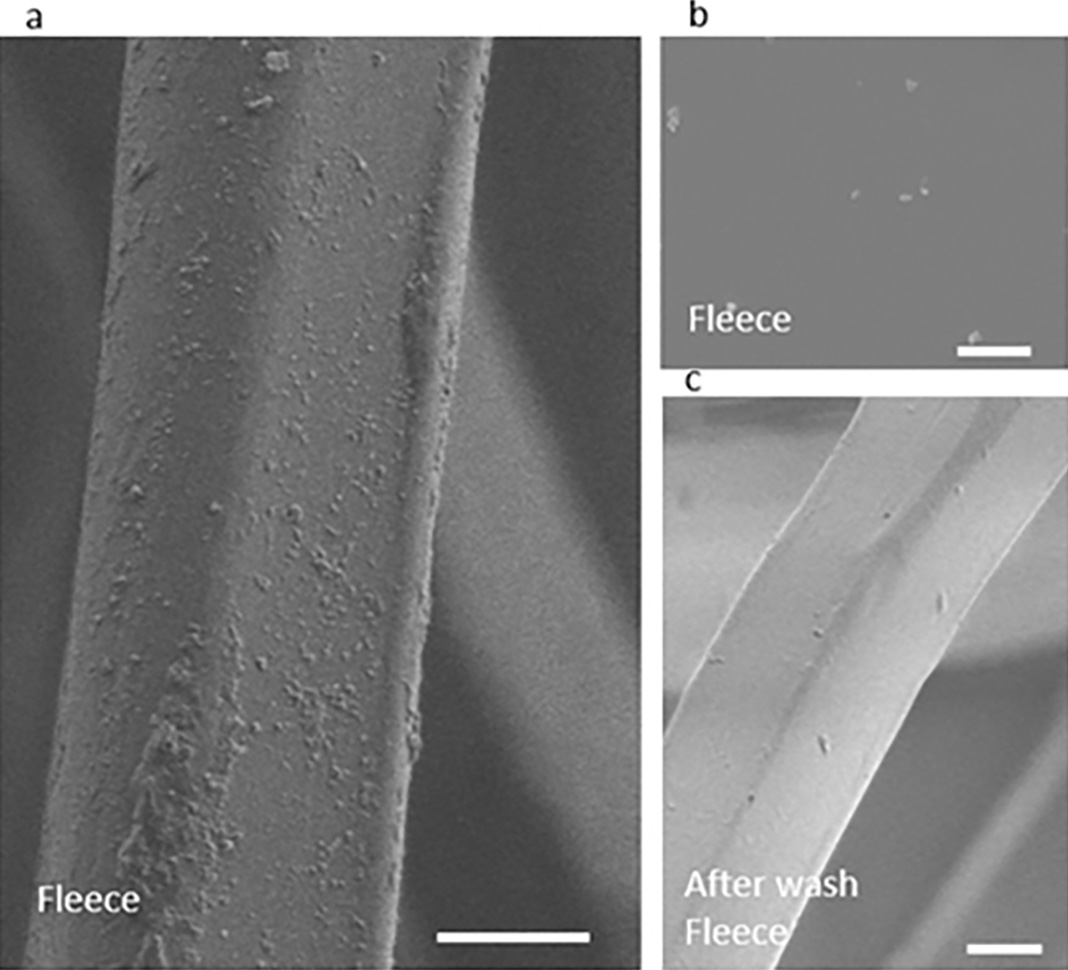
To a considerable extent, the released particles were in fact not nanoplastics, but clumps of so-called oligomers, i.e. small to medium-sized molecules that represent an intermediate stage between the long-chained polymers and their individual building blocks, the monomers. These molecules are even smaller than nanoplastic particles, and hardly anything is known about their toxicity either. The researchers published their findings in the journal Nature Water.
For the study, the researchers examined twelve different polyester fabrics, including microfiber, satin, and jersey. The fabric samples were washed up to four times and the nanoparticles released in the process were analyzed and characterized. Not an easy task, says Bernd Nowack. “Plastic, especially nanoplastics, is everywhere, including on our devices and utensils,” says the scientist. “When measuring nanoplastics, we have to take this ‘background noise’ into account.”
Large proportion of soluble particles
The researchers used an ethanol bath to distinguish nanoplastics from clumps of oligomers. Plastic pieces, no matter how small, do not dissolve in ethanol, but aggregations of oligomers do. The result: Around a third to almost 90 percent of the nanoparticles released during washing could be dissolved in ethanol. “This allowed us to show that not everything that looks like nanoplastics at first glance is in fact nanoplastics,” says Nowack.
It is not yet clear whether the release of so-called nanoparticulate oligomers during the washing of textiles has negative effects on humans and the environment. “With other plastics, studies have already shown that nanoparticulate oligomers are more toxic than nanoplastics,” says Nowack. “This is an indication that this should be investigated more closely.” However, the researchers were able to establish that the nature of the textile and the cutting method – scissors or laser – have no major influence on the quantity of particles released.
The mechanism of release has not been clarified yet either – neither for nanoplastics nor for the oligomer particles. The good news is that the amount of particles released decreases significantly with repeated washes. It is conceivable that the oligomer particles are created during the manufacturing of the textile or split off from the fibers through chemical processes during storage. Further studies are also required in this area.
Nowack and his team are focusing on larger particles for the time being: In their next project, they want to investigate which fibers are released during washing of textiles made from renewable raw materials and whether these could be harmful to the environment and health. “Semi-synthetic textiles such as viscose or lyocell are being touted as a replacement for polyester,” says Nowack. “But we don’t yet know whether they are really better when it comes to releasing fibers.
Reference: “Oligomers are a major fraction of the submicrometre particles released during washing of polyester textiles” by Tong Yang, Yanghui Xu, Gang Liu and Bernd Nowack, 8 February 2024, Nature Water.
DOI: 10.1038/s44221-023-00191-5
Never miss a breakthrough: Join the SciTechDaily newsletter.
Follow us on Google and Google News.