
Close Menu
    Facebook X (Twitter) Instagram
    SciTechDaily
    • Biology
    • Chemistry
    • Earth
    • Health
    • Physics
    • Science
    • Space
    • Technology
    Facebook X (Twitter) Pinterest YouTube RSS
    SciTechDaily
    Home»Space»USGS Map Details Volcanos on the Surface of Io
    Space

    USGS Map Details Volcanos on the Surface of Io

    By SciTechDailyMarch 21, 2012No Comments2 Mins Read
    Facebook Twitter Pinterest Telegram LinkedIn WhatsApp Email Reddit
    Share
    Facebook Twitter LinkedIn Pinterest Telegram Email Reddit
    io-surface-jupiter
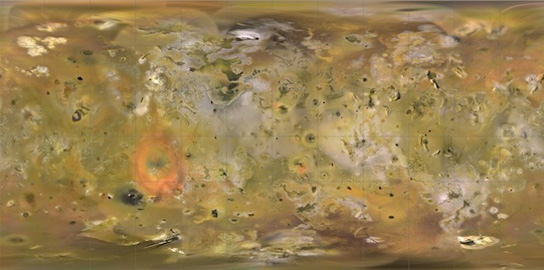
    Surface map of Jupiter’s moon Io

    This new map was published last Monday by the United States Geological Survey (USGS) and it showcases the hellish surface of Jupiter’s moon Io, the most volcanically active object in the Solar System. The creation of the map took over six years, and the map itself identifies 425 volcanoes as well as lava flow fields, squat mountains, deposits left by volcanic plumes, and plains rich in sulfur dioxide.

    This will allow researchers to test models about Io’s interior and to better understand the formation of volcanoes and mountains on its surface.

    io-map-surface-jupiter-usgs

    The massive geological activity is due to Io’s interactions with Jupiter and its sister moons, Europa, and Ganymede. The gravitational forces stretch and flex Io’s thin crust, generating roughly 25 times the volcanic activity found on Earth, on an object half the size of Earth.

    The maps were created by combining images from NASA’s two Voyager flybys in the 1970s, as well as images from the Galileo Orbiter, which circled Jupiter from 1995 to 2003. Io’s surface changes constantly, so astronomers will have to rely on telescopes to note any new volcanic eruptions. Io’s surface also lacks craters, since as soon as meteorites hit its surface, the craters themselves are wiped clean by lava flows.

    Io also doesn’t have high mountains because it doesn’t have enough silica to produce steep cinder cones. Io is like a mirror of ancient Earth, the way that Earth’s surface was billions of years ago.

    Never miss a breakthrough: Join the SciTechDaily newsletter.
    Follow us on Google and Google News.

    Eruptions Geological Survey Geology Io Jupiter Map Solar System USGS Volcano
    Share. Facebook Twitter Pinterest LinkedIn Email Reddit

    Related Articles

    Jupiter’s Innermost Moon – Io – Has Spectacular Dunes

    Juno Data Indicate Another Possible Volcano on Jupiter Moon Io

    Color-Enhanced Juno Image of Jupiter, Io and Europa

    LBT Reveals Lava Lake on Jupiter’s Moon Io

    Astronomers View Three Massive Volcanic Eruptions on Jupiter’s Moon Io

    Scientists Produce Geologic Map of Jupiter’s Moon Ganymede

    Io’s Volcanoes Are Not Located Where Scientists Expected

    Study Finds a Mixture of Both Deep and Shallow Heating on Io

    California Volcano Observatory is USGS’s Newest

    Leave A Reply Cancel Reply

    • Facebook
    • Twitter
    • Pinterest
    • YouTube

    Don't Miss a Discovery

    Subscribe for the Latest in Science & Tech!

    Trending News

    Sitting Up Straight Could Actually Help You Make Better Decisions

    Never-Before-Seen Vortices Are Swirling Across the Sun

    This Common Amino Acid May Help the Body Fight Cancer and Viruses

    Low-Protein “Longevity Diet” Linked to Fat Loss, Muscle Preservation, and Healthy Aging

    How Prehistoric Poop Changed Earth’s Ecosystems Forever

    This Fossil Upends a Decades-Old Debate About Snake Evolution

    A Blood Test Years Before Cancer May Reveal a Hidden Warning Sign

    Starlink Satellites Reveal a Hidden Atmosphere 300 Miles Above Earth

    Follow SciTechDaily
    • Facebook
    • Twitter
    • YouTube
    • Pinterest
    • Newsletter
    • RSS
    SciTech News
    • Biology News
    • Chemistry News
    • Earth News
    • Health News
    • Physics News
    • Science News
    • Space News
    • Technology News
    Recent Posts
    • Tiny Fossil Overlooked for Decades Reveals a New Ice Age Species
    • Melting Sea Ice Could Be Changing the Clouds Above the Arctic
    • Ancient Neanderthal DNA May Give Some People More Muscle
    • These Overlooked Immune Cells Supercharge the Fight Against Cancer
    • The Surprising Reason a UTI Hurts So Much – and Why That Might Be a Good Thing
    Copyright © 1998 - 2026 SciTechDaily. All Rights Reserved.
    • Science News
    • About
    • Contact
    • Editorial Board
    • Privacy Policy
    • Terms of Use

    Type above and press Enter to search. Press Esc to cancel.