
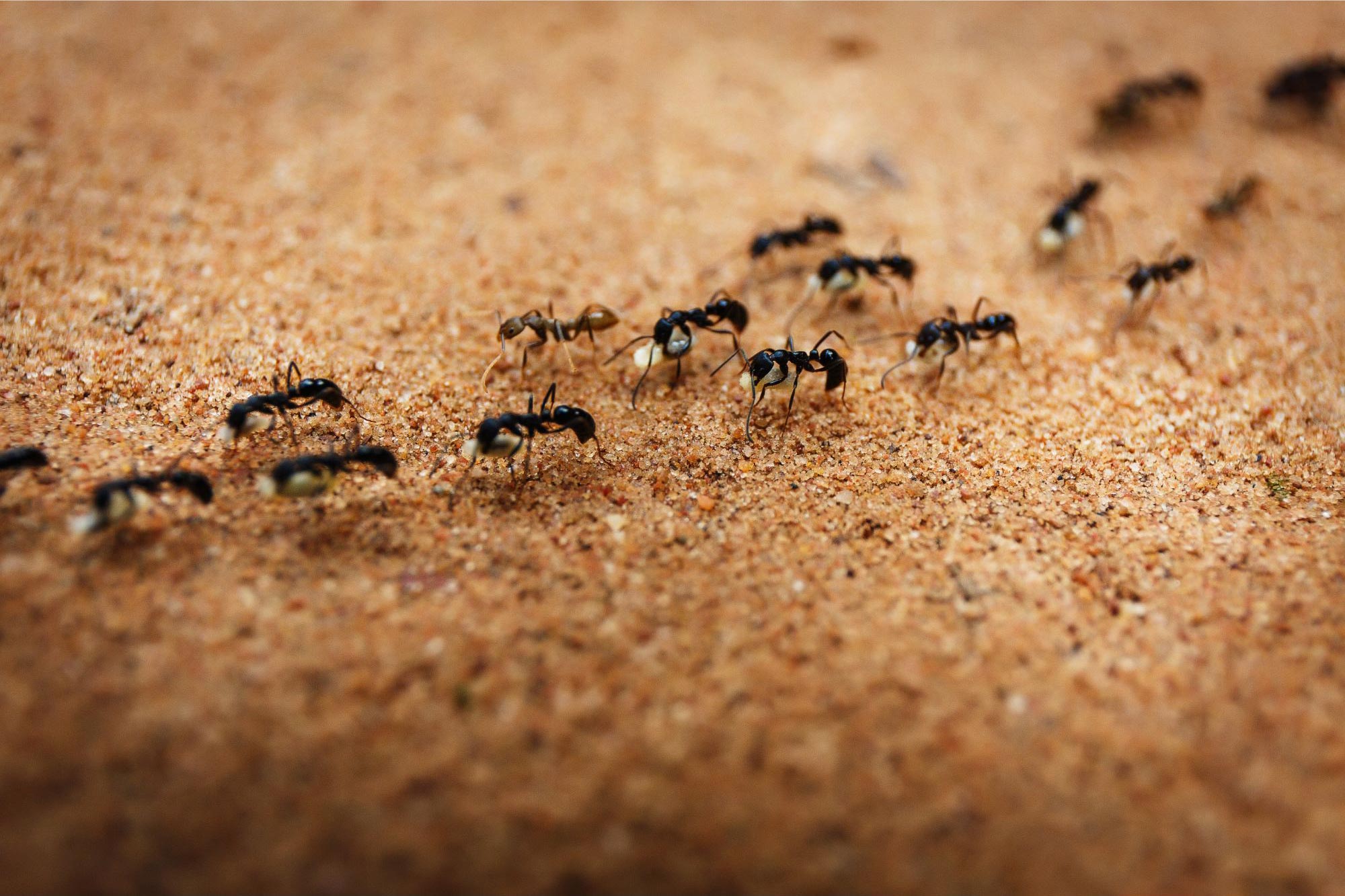
A Weizmann Institute experiment found that cooperation proved more effective for ants than for humans.
Anyone who has dealt with ants in the kitchen knows that they are highly social creatures; it’s rare to see one on its own. Similarly, humans are social beings, even though some of us enjoy solitude. Ants and humans are also unique in nature as the only creatures that consistently cooperate to transport large loads that far exceed their own size.
This shared trait inspired Prof. Ofer Feinerman and his team at the Weizmann Institute of Science to design a fascinating evolutionary competition. Their experiment posed a compelling question: Who navigates a large load through a maze more effectively—ants or humans?
The results, recently published in the Proceedings of the National Academy of Sciences (PNAS), offer surprising insights into group decision-making dynamics and highlight the advantages and drawbacks of cooperation versus individual effort.
Setting the Stage: The “Piano Movers Puzzle”
To enable a comparison between two such disparate species, the research team led by Tabea Dreyer created a real-life version of the “piano movers puzzle,” a classical computational problem from the fields of motion planning and robotics that deals with possible ways of moving an unusually shaped object – say, a piano – from point A to point B in a complex environment. Instead of a piano, the participants were given a large T-shaped object that they had to maneuver across a rectangular space divided into three chambers connected by two narrow slits.
The researchers created two sets of mazes that differed only in size, to match the dimensions of ants and humans, as well as groups of different size. Recruiting study participants was easier in the case of humans, who volunteered simply because they were asked to participate, and probably because they liked the idea of a competition. Ants, on the other hand, are far from competitive. They joined because they were misled into thinking that the heavy load was a juicy edible morsel that they were transporting into their nest.
The ants chosen to compete against Homo sapiens were Paratrechina longicornis. They are called this because of their long antennae, though they are sometimes referred to as “crazy ants” for their tendency to dash around. This familiar species of black ant, about 3 mm long, is common around the world. In Israel, they are particularly prevalent along the coast and in the south of the country.
Ants and Humans Face Off
The ants tackled the maze challenge in three combinations: a single ant, a small group of about seven ants, and a large group of about 80. Humans handled the task in three parallel combinations: a single person, a small group of six to nine individuals, and a large group of 26. To make the comparison as meaningful as possible, groups of humans were in some cases instructed to avoid communicating through speaking or gestures, even wearing surgical masks and sunglasses to conceal their mouths and eyes.
In addition, human participants were told to hold the load only by the handles that simulated the way in which it is held by ants. The handles contained meters that measured the pulling force applied by each person throughout the attempt. The researchers repeated the experiment numerous times for each combination, then meticulously analyzed the videos and all the advanced tracking data while using computer simulations and various physics models.
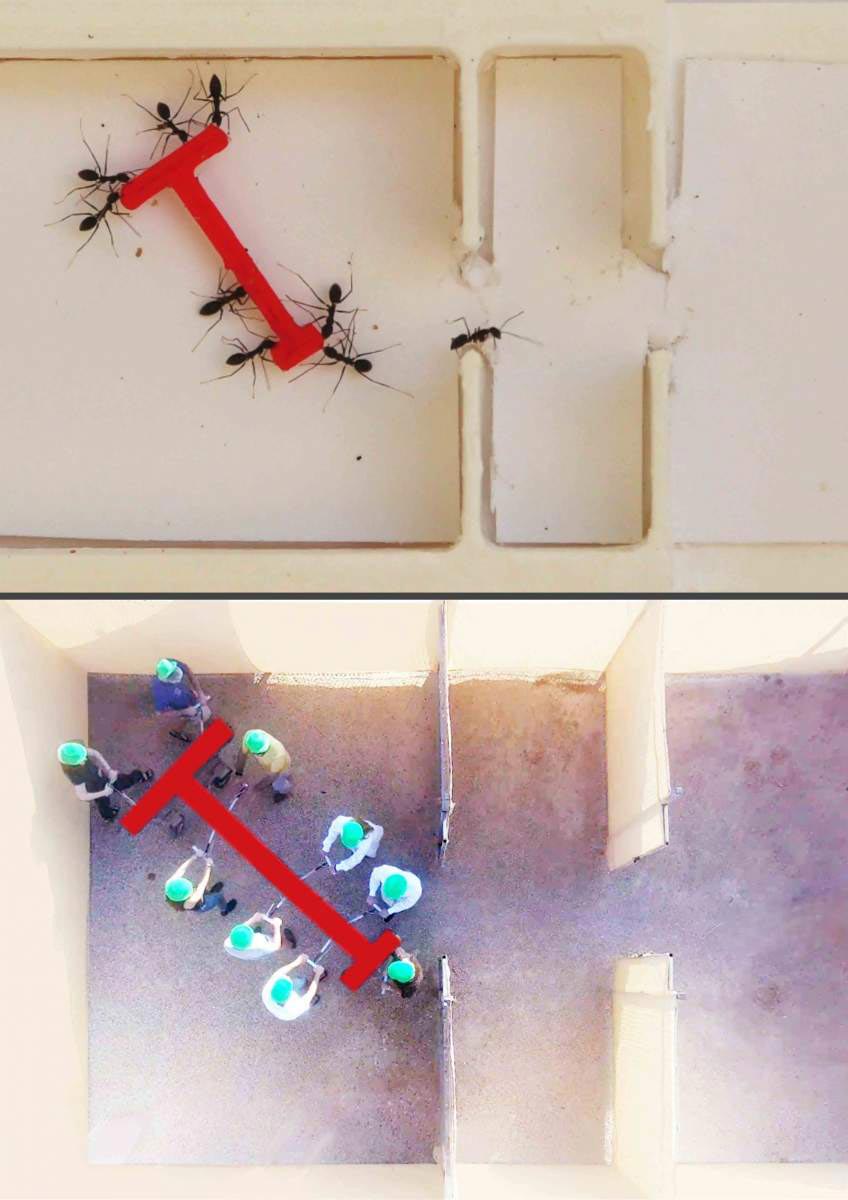
Unsurprisingly, the cognitive abilities of humans gave them an edge in the individual challenge, in which they resorted to calculated, strategic planning, easily outperforming the ants. In the group challenge, however, the picture was completely different, especially for the larger groups. Not only did groups of ants perform better than individual ants, but in some cases they did better than humans.
Groups of ants acted together in a calculated and strategic manner, exhibiting collective memory that helped them persist in a particular direction of motion and avoid repeated mistakes. Humans, on the contrary, failed to significantly improve their performance when acting in groups. When communication between group members was restricted to resemble that of ants, their performance even dropped compared to that of individuals. They tended to opt for “greedy” solutions – which seemed attractive in the short term but were not beneficial in the long term – and, according to the researchers, opted for the lowest common denominator.
There are about 15,000 ant species on Earth, all living in large colonies. About 1 percent of these species cooperate in transporting heavy loads.
“An ant colony is actually a family,” Feinerman says. “All the ants in the nest are sisters, and they have common interests. It’s a tightly knit society in which cooperation greatly outweighs competition. That’s why an ant colony is sometimes referred to as a super-organism, sort of a living body composed of multiple ‘cells’ that cooperate with one another. Our findings validate this vision. We’ve shown that ants acting as a group are smarter, that for them the whole is greater than the sum of its parts. In contrast, forming groups did not expand the cognitive abilities of humans. The famous ‘wisdom of the crowd’ that’s become so popular in the age of social networks didn’t come to the fore in our experiments.”
Reference: “Comparing cooperative geometric puzzle solving in ants versus humans” by Tabea Dreyer, Amir Haluts, Amos Korman, Nir Gov, Ehud Fonio and Ofer Feinerman, 23 December 2024, Proceedings of the National Academy of Sciences.
DOI: 10.1073/pnas.2414274121
Never miss a breakthrough: Join the SciTechDaily newsletter.
Follow us on Google and Google News.
2 Comments
Hard to say this would ever be equal as ants may be communicating through methods that humans can’t mimic such as smells.
The long-running TV show Survivor often has a maze puzzle each season, where humans wear blindfolds and a leader tries to direct them through a maze or obstacle course to be the winning team.
I see the moderators are having trouble pulling Anna’s ‘comment’ out of the maze.