
Close Menu
    Facebook X (Twitter) Instagram
    SciTechDaily
    • Biology
    • Chemistry
    • Earth
    • Health
    • Physics
    • Science
    • Space
    • Technology
    Facebook X (Twitter) Pinterest YouTube RSS
    SciTechDaily
    Home»Technology»Virtual Reality System for Small Animals Based on Raspberry Pi
    Technology

    Virtual Reality System for Small Animals Based on Raspberry Pi

    By PLOSJuly 14, 2020No Comments3 Mins Read
    Facebook Twitter Pinterest Telegram LinkedIn WhatsApp Email Reddit
    Share
    Facebook Twitter LinkedIn Pinterest Telegram Email Reddit
    PiVR Raspberry Pi VR Small Animals
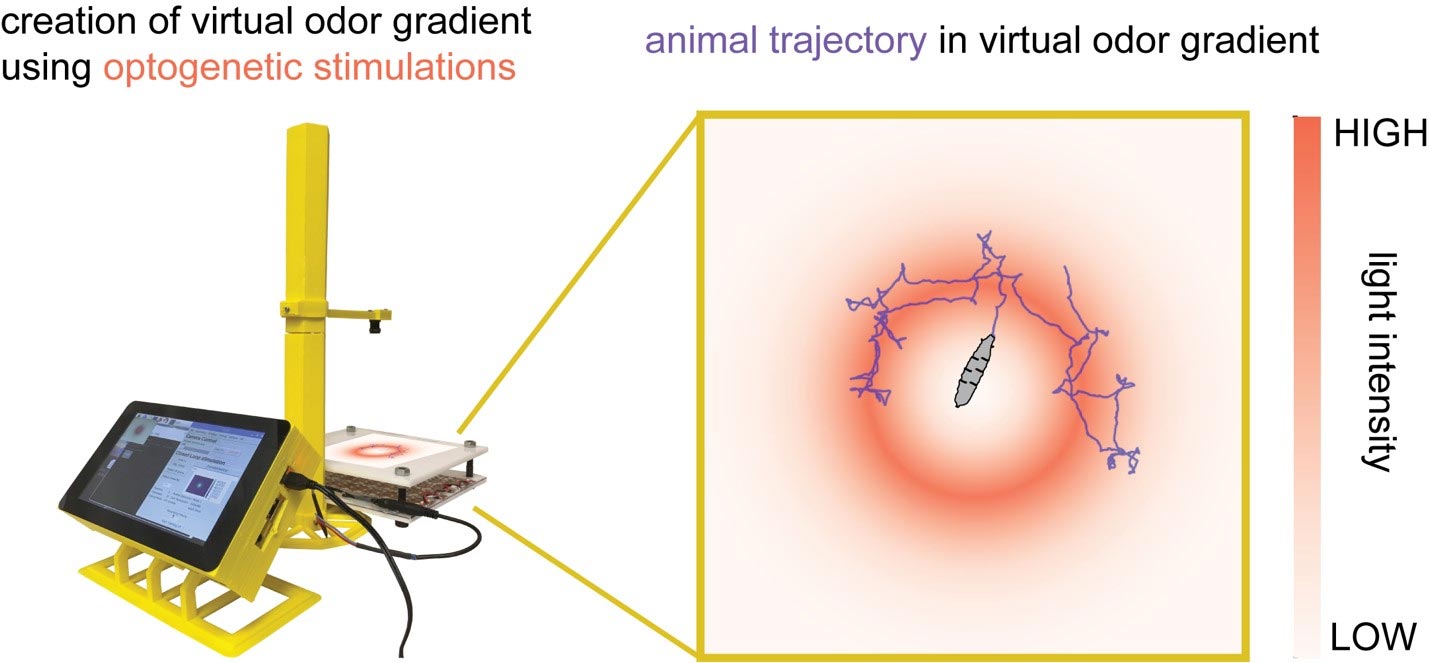
    PiVR is a do-it-yourself tool that enables scientists to create virtual realities with optogenetics in small animals. (Right) Trajectory (blue line) of a fruit fly larva in a virtual odor gradient with a ‘volcano’ shape (red background). Credit: David Tadres

    The Raspberry Pi Virtual Reality system (PiVR) is a versatile tool for presenting virtual reality environments to small, freely moving animals (such as flies and fish larvae), according to a study published today (July 14, 2020) in the open-access journal PLOS Biology by David Tadres and Matthieu Louis of the University of California, Santa Barbara. The use of PiVR, together with techniques like optogenetics, will facilitate the mapping and characterization of neural circuits involved in behavior.

    PiVR consists of a behavioral arena, a camera, a Raspberry Pi microcomputer, an LED controller, and a touchscreen. This system can implement a feedback loop between real-time behavioral tracking and delivery of a stimulus. PiVR is a versatile, customizable system that costs less than $500, takes less than six hours to build (using a 3D printer), and was designed to be accessible to a wide range of neuroscience researchers.

    In the new study, Tadres and Louis used their PiVR system to present virtual realities to small, freely moving animals during optogenetic experiments. Optogenetics is a technique that enables researchers to use light to control the activity of neurons in living animals, allowing them to examine causal relationships between the activity of genetically-labeled neurons and specific behaviors.

    As a proof-of-concept, Tadres and Louis used PiVR to study sensory navigation in response to gradients of chemicals and light in a range of animals. They showed how fruit fly larvae change their movements in response to real and virtual odor gradients. They then demonstrated how adult flies adapt their speed of movement to avoid locations associated with bitter tastes evoked by optogenetic activation of their bitter-sensing neurons. In addition, they showed that zebrafish larvae modify their turning maneuvers in response to changes in the intensity of light mimicking spatial gradients. According to the authors, PiVR represents a low-barrier technology that should empower many labs to characterize animal behavior and study the functions of neural circuits.

    “More than ever,” the authors note, “neuroscience is technology-driven. In recent years, we have witnessed a boom in the use of closed-loop tracking and optogenetics to create virtual sensory realities. Integrating new interdisciplinary methodology in the lab can be daunting. With PiVR, our goal has been to make virtual reality paradigms accessible to everyone, from professional scientists to high-school students. PiVR should help democratize cutting-edge technology to study behavior and brain functions.”

    Reference: “PiVR: An affordable and versatile closed-loop platform to study unrestrained sensorimotor behavior” by David Tadres and Matthieu Louis, 14 July 2020, PLoS Biology.
    DOI: 10.1371/journal.pbio.3000712

    This work was funded by the National Institute for Health (RO1-NS113048-01) and by the University of California, Santa Barbara (startup funds). This work was also supported by the National Science Foundation under Grant No. NSF PHY-1748958, Grant No. IOS-1523125, IH Grant No. R25GM067110, and the Gordon and Betty Moore Foundation Grant No. 2919.01. The funders had no role in study design, data collection, and analysis, decision to publish, or preparation of the manuscript.

    Never miss a breakthrough: Join the SciTechDaily newsletter.
    Follow us on Google and Google News.

    Biotechnology Neuroscience PLOS Virtual Reality
    Share. Facebook Twitter Pinterest LinkedIn Email Reddit

    Related Articles

    Advanced Computer Model Enables Improvements to “Bionic Eye” Technology

    Powerful Algorithms Used by Netflix, Amazon and Facebook Could “Crack the Language of Cancer and Alzheimer’s”

    Blind Spots Uncovered at the Intersection of AI and Neuroscience – Dozens of Scientific Papers Debunked

    Growing Artificial Organs With Help From Machine Learning

    Fast, Flexible, Powerful Bioelectronic Devices Are Two Steps Closer With Columbia’s Soft Transistors

    New Electronics Devised That Mimic the Human Brain in Efficient Learning

    MIT Develops Soft, Flexible Neural Implants That Can Be 3D Printed on Demand

    Human Brain-Like Functions Emerge in Neuromorphic Metallic Nanowire Network

    New Technique Enlarges Tissue Samples, Making Them Easier to Image

    Leave A Reply Cancel Reply

    • Facebook
    • Twitter
    • Pinterest
    • YouTube

    Don't Miss a Discovery

    Subscribe for the Latest in Science & Tech!

    Trending News

    Why Popular Diabetes Drugs Like Ozempic Don’t Work for Everyone: The “Genetic Glitch”

    Scientists Stunned After Finding Plant Thought Extinct for 60 Years

    Scientists Discover Tiny New Spider That Hunts Prey 6x Its Size

    Natural Component From Licorice Shows Promise for Treating Inflammatory Bowel Disease

    Scientists Warn: Popular Sweetener Linked to Dangerous Metabolic Effects

    Monster Storms on Jupiter Unleash Lightning Beyond Anything on Earth

    Scientists Create “Liquid Gears” That Spin Without Touching

    The Simple Habit That Could Help Prevent Cancer

    Follow SciTechDaily
    • Facebook
    • Twitter
    • YouTube
    • Pinterest
    • Newsletter
    • RSS
    SciTech News
    • Biology News
    • Chemistry News
    • Earth News
    • Health News
    • Physics News
    • Science News
    • Space News
    • Technology News
    Recent Posts
    • Scientists Uncover How Serotonin May Trigger Tinnitus
    • Common Food Compound Shows Surprising Power Against Superbugs
    • Ancient DNA Study Reveals Human Evolution Is Happening Faster Than We Thought
    • 5 Simple Ways To Remember More and Forget Less
    • This Common Habit Could Signal Serious Health Problems in Later Life
    Copyright © 1998 - 2026 SciTechDaily. All Rights Reserved.
    • Science News
    • About
    • Contact
    • Editorial Board
    • Privacy Policy
    • Terms of Use

    Type above and press Enter to search. Press Esc to cancel.