
Close Menu
    Facebook X (Twitter) Instagram
    SciTechDaily
    • Biology
    • Chemistry
    • Earth
    • Health
    • Physics
    • Science
    • Space
    • Technology
    Facebook X (Twitter) Pinterest YouTube RSS
    SciTechDaily
    Home»Space»VISTA Views the Trifid Nebula and Reveals Previously Hidden Objects
    Space

    VISTA Views the Trifid Nebula and Reveals Previously Hidden Objects

    By European Southern ObservatoryFebruary 4, 2015No Comments4 Mins Read
    Facebook Twitter Pinterest Telegram LinkedIn WhatsApp Email Reddit
    Share
    Facebook Twitter LinkedIn Pinterest Telegram Email Reddit
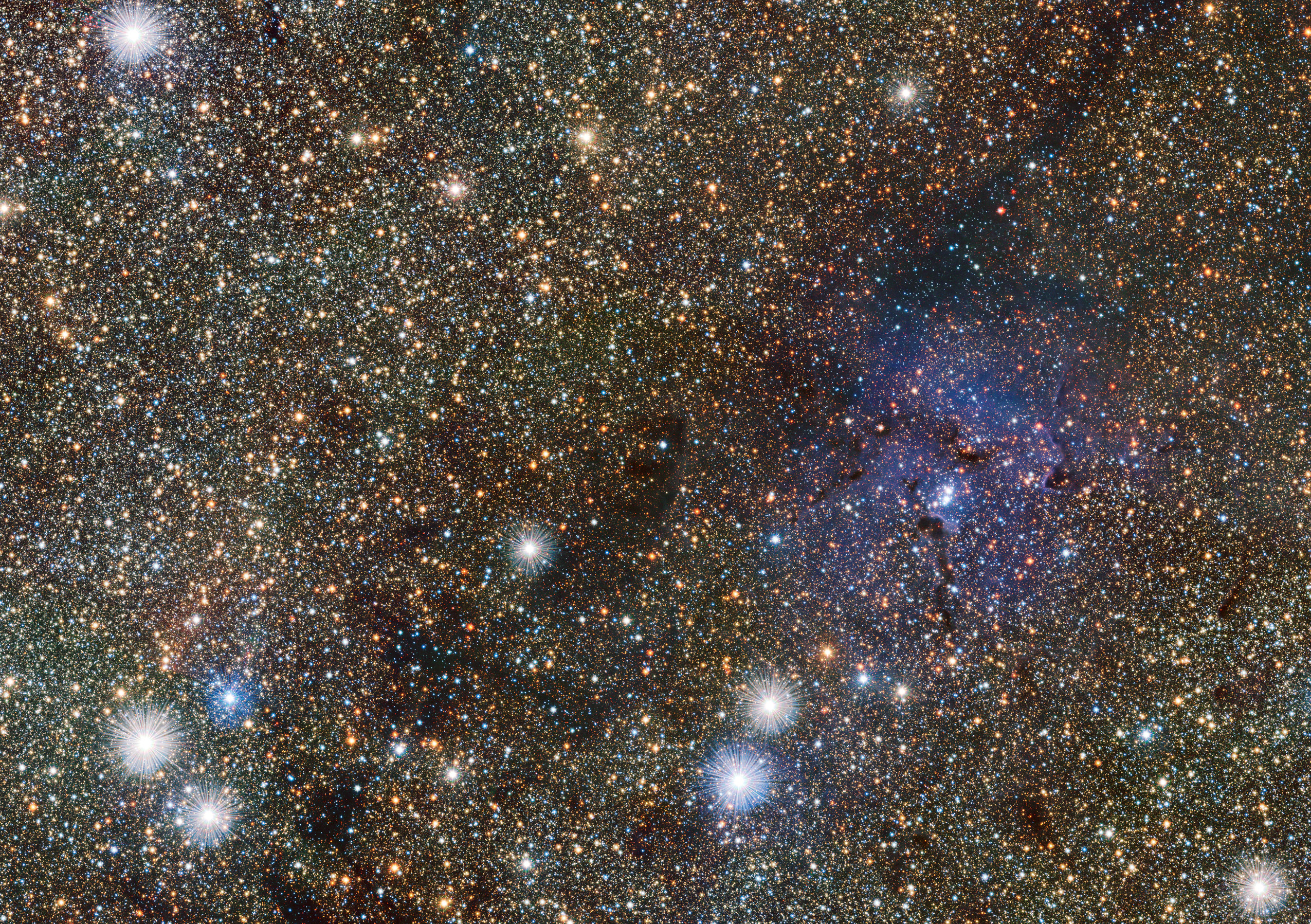
    VISTA Views the Trifid Nebula
    This small extract from the VISTA VVV survey of the central parts of the Milky Way shows the famous Trifid Nebula to the right of the center. It appears faint and ghostly at these infrared wavelengths when compared to the familiar view at visible wavelengths. This transparency has brought its own benefits — many previously hidden background objects can now be seen clearly. Among these are two newly discovered Cepheid variable stars, the first ever spotted on the far side of the galaxy near its central plane. Credit: ESO/VVV consortium/D. Minniti; ESO/Gábor Tóth

    A newly released image taken from ESO’s VISTA survey telescope shows the Trifid Nebula and reveals hidden variable stars.

    By observing in infrared light, astronomers can see right through the dust-filled central parts of the Milky Way and spot many previously hidden objects. In just this tiny part of one of the VISTA surveys, astronomers have discovered two unknown and very distant Cepheid variable stars that lie almost directly behind the Trifid. They are the first such stars found that lie in the central plane of the Milky Way beyond its central bulge.

    As one of its major surveys of the southern sky, the VISTA telescope at ESO’s Paranal Observatory in Chile is mapping the central regions of the Milky Way in infrared light to search for new and hidden objects. This VVV survey (standing for VISTA Variables in the Via Lactea) is also returning to the same parts of the sky again and again to spot objects that vary in brightness as time passes.

    A tiny fraction of this huge VVV dataset has been used to create this striking new picture of a famous object, the star formation region Messier 20, usually called the Trifid Nebula, because of the ghostly dark lanes that divide it into three parts when seen through a telescope.

    The familiar pictures of the Trifid show it in visible light, where it glows brightly in both the pink emission from ionized hydrogen and the blue haze of scattered light from hot young stars. Huge clouds of light-absorbing dust are also prominent. But the view in the VISTA infrared picture is very different. The nebula is just a ghost of its usual visible-light self. The dust clouds are far less prominent and the bright glow from the hydrogen clouds is barely visible at all. The three-part structure is almost invisible.

    Trifid Nebula in Visible Light
    This picture shows a familiar visible-light view of the Trifid Nebula from a small telescope on the ground. Credit: ESO/VVV consortium/D. Minniti; ESO/Gábor Tóth

    In the new image, as if to compensate for the fading of the nebula, a spectacular new panorama comes into view. The thick dust clouds in the disc of our galaxy that absorb visible light allow through most of the infrared light that VISTA can see. Rather than the view being blocked, VISTA can see far beyond the Trifid and detect objects on the other side of the galaxy that have never been seen before.

    By chance this picture shows a perfect example of the surprises that can be revealed when imaging in the infrared. Apparently close to the Trifid in the sky, but in reality about seven times more distant [1], a newly discovered pair of variable stars has been found in the VISTA data. These are Cepheid variables, a type of bright star that is unstable and slowly brightens and then fades with time. This pair of stars, which the astronomers think are the brightest members of a cluster of stars, are the only Cepheid variables detected so far that are close to the central plane, but on the far side of the galaxy. They brighten and fade over a period of eleven days.

    Notes

    [1] The Trifid Nebula lies about 5,200 light-years from Earth, the center of the Milky Way is about 27,000 light-years away, in almost the same direction, and the newly discovered Cepheids are at a distance of about 37,000 light-years.

    Reference: “Discovery of a Pair of Classical Cepheids in an Invisible Cluster Beyond the Galactic Bulge” by I. Dékány, D. Minniti, G. Hajdu, J. Alonso-García, M. Hempel, T. Palma, M. Catelan, W. Gieren and D. Majaess, 19 January 2015, The Astrophysical Journal.
    DOI: 10.1088/2041-8205/799/1/L11
    arXiv: 1412.8658


    Never miss a breakthrough: Join the SciTechDaily newsletter.
    Follow us on Google and Google News.

    Astronomy Astrophysics European Southern Observatory
    Share. Facebook Twitter Pinterest LinkedIn Email Reddit

    Related Articles

    Stunning Galactic Fireworks: New ESO Images Reveal Spectacular Features of Nearby Galaxies

    Astronomers Were Puzzled by “Great Dimming” of Betelgeuse – Now the Mystery Is Solved

    “Big Surprise!” – Heavy Metal Vapors Unexpectedly Found in Comets Throughout Our Solar System – and Beyond

    Mysterious Interstellar Visitor May Be the Most Pristine Comet Ever Found

    Event Horizon Telescope Images Magnetic Fields at the Edge of M87’s Supermassive Black Hole

    “Meteorological Beast in Our Solar System” – Powerful Stratospheric Winds Measured on Jupiter for the First Time

    Astronomers Have Discovered the Most Distant Source of Radio Emission Ever Known – 13 Billion Light-Years Away

    Distant Colliding Galaxy Dying Out As It Loses the Ability to Form Stars – Ejecting 10,000 Suns-Worth of Gas a Year

    Puzzling Six-Exoplanet System Discovered With Resonant Rhythmic Movement

    Leave A Reply Cancel Reply

    • Facebook
    • Twitter
    • Pinterest
    • YouTube

    Don't Miss a Discovery

    Subscribe for the Latest in Science & Tech!

    Trending News

    Popular Supplement Ingredient Linked to Shorter Lifespan in Men

    Scientists May Have Found a Way To Repair Nerve Damage in Multiple Sclerosis

    “Totally Unexpected” – Scientists Discover Pancreatic Cancer’s Fatal Addiction

    A Strange Quantum Effect May Explain One of Biology’s Greatest Mysteries

    James Webb Telescope Reveals the Universe’s Hidden Cosmic Web in Stunning Detail

    Scientists Identify Simple Supplement That Greatly Reduces Alzheimer’s Damage

    You May Have a Dangerous Type of Cholesterol Even if Your Tests Look Normal

    Your Blood Pressure Reading Could Be Wrong Because of One Simple Mistake

    Follow SciTechDaily
    • Facebook
    • Twitter
    • YouTube
    • Pinterest
    • Newsletter
    • RSS
    SciTech News
    • Biology News
    • Chemistry News
    • Earth News
    • Health News
    • Physics News
    • Science News
    • Space News
    • Technology News
    Recent Posts
    • Beyond Pain Relief: Scientists Discover a Protein That Could Stop Osteoarthritis in Its Tracks
    • NASA’s New AI Processor Is 500x Faster Than Current Space Computers
    • Scientists Find Evidence Earth Is Drifting Through the Ashes of an Exploded Star
    • This Strange Molecular Signature May Be the Best Clue Yet to Alien Life
    • Scientists Say a 40-Year-Old Childhood Obesity Warning May Be Completely Wrong
    Copyright © 1998 - 2026 SciTechDaily. All Rights Reserved.
    • Science News
    • About
    • Contact
    • Editorial Board
    • Privacy Policy
    • Terms of Use

    Type above and press Enter to search. Press Esc to cancel.