
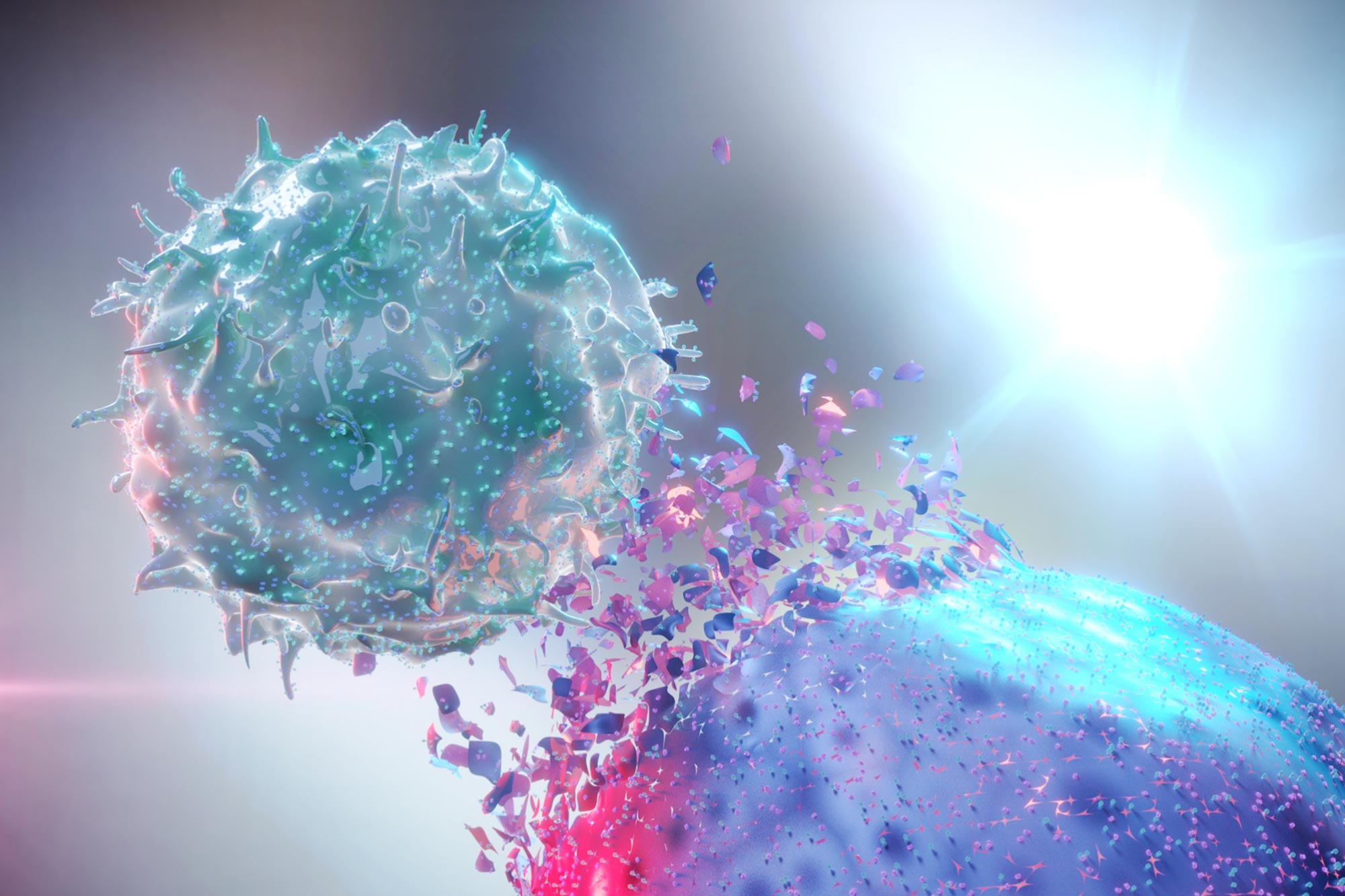
A common vitamin may be quietly helping cancer cells evade death.
The body depends on vitamin B2, also called riboflavin, but it cannot make the nutrient itself. That means it has to come from food, including dairy products, eggs, meat, and green vegetables. Inside cells, riboflavin is converted into helper molecules that support metabolism and protect against oxidative damage.
That sounds entirely beneficial, but researchers have now uncovered a troubling tradeoff. The same vitamin-linked system that helps protect healthy cells can also help cancer cells stay alive.
Scientists at the Rudolf Virchow Centre (RVZ) at Julius-Maximilians-Universität Würzburg (JMU) have found that this protective role has an unexpected downside. The same mechanism can also help cancer cells survive.
“Vitamin B2 plays a crucial role in protecting cancer cells from ferroptosis, a special form of programmed cell death,” says PhD student Vera Skafar. She is a member of the research group led by José Pedro Friedmann Angeli, Professor of Translational Cell Biology. The results have been published in the renowned journal Nature Cell Biology.
How Vitamin B2 and ferroptosis are connected
The body relies on programmed cell death to remove damaged or harmful cells in a controlled way that avoids inflammation. Ferroptosis is one such process and has been linked to conditions such as cancer and neurodegenerative diseases.
Unlike other forms of cell death, ferroptosis occurs when iron-driven damage to cell membranes overwhelms the cell’s antioxidant defenses. Cancer cells can escape this fate by strengthening their internal defense systems.
This research shows that vitamin B2 metabolism plays a key role in those defenses. It suggests that interfering with riboflavin-related molecules could reduce cancer cells’ resistance to ferroptosis and make tumors easier to target.
A potential inhibitor
The protein FSP1 is one of the components that helps protect healthy cells from dying. Vitamin B2 supports FSP1 in carrying out this function. Using genome editing and cancer cell models, the researchers found that when vitamin B2 levels are low, cancer cells become more vulnerable to ferroptosis.
This points to a potential treatment strategy: blocking vitamin B2 metabolism to selectively trigger cancer cell death. “However, an inhibitor that can do this is still missing,” says Skafar.
To explore this idea, the team tested roseoflavin, a naturally occurring compound made by bacteria that closely resembles vitamin B2.
On the way to targeted cancer therapies using ferroptosis
In lab experiments with cancer cells, Friedmann Angeli’s team evaluated this compound. “It turned out that roseoflavin triggers ferroptosis in low concentrations,” says the group leader. “Our experiments show the feasibility of this concept.”
These results suggest a possible path toward developing cancer treatments that specifically induce ferroptosis.
Next, the RVZ team plans to develop compounds that block vitamin B2 metabolism and test them in preclinical cancer models.
Friedmann Angeli adds: “Ferroptosis is not only relevant to cancer. Increasing evidence suggests that it also contributes to pathological processes in neurodegenerative diseases and in tissue damage following organ transplantation or ischemia-reperfusion injury.” Understanding how vitamin B2 metabolism affects ferroptosis could have broader implications for diseases where this process is either overactive or insufficient.
Reference: “Riboflavin metabolism shapes FSP1-driven ferroptosis resistance” by Vera Skafar, Izadora de Souza, Biplab Ghosh, Ancely Ferreira dos Santos, Florencio Porto Freitas, Zhiyi Chen, Shibo Sun, Merce Donate Castillo, Palina Nepachalovich, Lars Seufert, Sebastian Bothe, Juliane Tschuck, Apoorva Mathur, Ariane Nunes-Alves, Jannik Buhr, Camilo Aponte-Santamaría, Werner Schmitz, Matthias Mack, Martin Eilers, Ralf Bargou, Milena Chaufan, Mayher Kaur, Mario Palma, Jessalyn M. Ubellacker, Ulrich Elling, Hellmut G. Augustin, Kamyar Hadian, Svenja Meierjohann, Bettina Proneth, Marcus Conrad, Maria Fedorova, Hamed Alborzinia and José Pedro Friedmann Angeli, 13 March 2026, Nature Cell Biology.
DOI: 10.1038/s41556-025-01856-x
The study received funding from the priority programme “Ferroptosis: from Molecular Basics to Clinical applications” (SPP2306) of the German Research Foundation (DFG). It also ran under the DeciFerr (Deciphering and exploiting ferroptosis regulatory mechanism in cancer) project led by Professor Friedmann Angeli. This has been funded by the European Research Council (ERC) since May 2024 with an ERC Consolidator Grant and almost two million euros.
Never miss a breakthrough: Join the SciTechDaily newsletter.
Follow us on Google and Google News.
5 Comments
So what’s the medicine too beat it
Can u give me the medicine too beat it
Can u give me the medicine too beat it I already know what it is .
Nevermind
How rude, they never got back to you Bruce!