
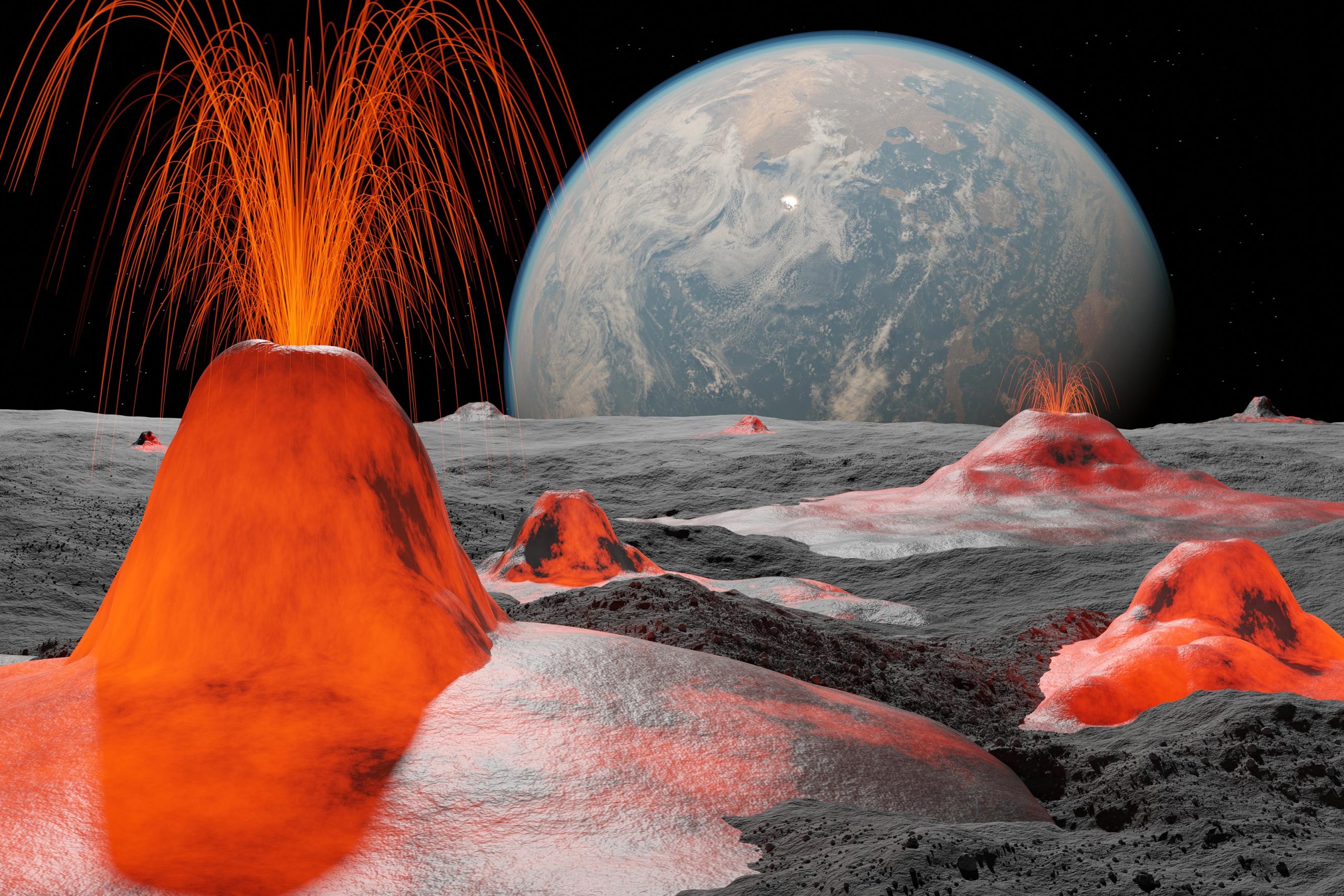
The Moon is far older than we once believed — but its fiery past has kept its true age hidden.
New research reveals that, a few hundred million years after its formation, the Moon experienced such extreme volcanic activity that its entire crust melted and reformed multiple times, resetting its geological clock. Back then, the Moon orbited much closer to Earth, and the intense tidal forces from this proximity superheated its interior, fueling the violent eruptions. Only Io, Jupiter’s moon and the most volcanically active body in the Solar System, offers a similar example of such extraordinary conditions.
This fresh perspective, published in Nature by an international team from the University of California Santa Cruz, the Max Planck Institute for Solar System Research, and the Collège de France, resolves long-standing contradictions about the Moon’s age. According to their findings, the Moon was formed 4.43 to 4.51 billion years ago. However, its crust — reshaped by volcanic fury — appears at least 80 million years younger.
Lunar Age Discrepancies
The Moon has proven to be elusive when it comes to revealing its true age. Scientists’ estimates vary by several hundred million years, with some proposing it formed 4.35 billion years ago, while others suggest 4.51 billion years ago.
The inconsistency largely comes down to the rocks: most lunar rock samples point to the younger age, but a few rare crystals of zirconium silicate, known as zircons, date much older. How can this be?
A new study offers an explanation. Researchers calculate that after the Moon’s formation, its crust was largely remelted. While most materials succumbed to these intense conditions, a handful of zircons remained intact, preserving a glimpse of the Moon’s earlier history.
Unraveling Lunar Origins Through Collision
The history of the Moon begins with a massive collision. In the early days of the Solar System, a chunk about the size of Mars crashed into the still-young Earth. The collision generated so much heat that our planet melted completely and hurled a huge amount of material into space.
By and by this material clumped together to form the Moon, initially covered by a huge ocean of hot, liquid rock. In the millions of years that followed, the newly formed body cooled and moved further and further away from the Earth until it reached its current orbit at a distance of around 384,400 kilometers.
Tidal Forces and Lunar Heating
“We are particularly interested in the phase when the distance between the Earth and the Moon was about one-third of today’s distance,” explains Prof. Dr. Francis Nimmo from the University of California Santa Cruz, first author of the new study. At this time, there were various changes in the position and shape of the Moon’s orbit. Among other things, it became more elliptical, so that the speed of the Moon and its distance from the Earth varied noticeably within each orbit. The forces acting in this way “churned” through the Moon’s interior to such an extent that it heated up. A similar situation is still known today from Jupiter’s moon Io, which travels around the gas giant also in a slightly elliptical orbit. The enormous tidal forces of Jupiter make the small moon the most volcanically active body in the Solar System. Earth’s early Moon was likely a match even to Io.
As the researchers’ calculations show, the heat flow from the lunar interior was sufficient to melt and churn through the entire mantle. While at no time during this phase a magma ocean covered the entire Moon, over the course of several million years the heat from the interior gradually reached every part of the surface liquifying most of the crustal rock — possibly even several times. In some places the hot lava penetrated to the surface, in others magma was injected beneath the surface, heating the rocks around it.
The Impact of Volcanic Activity on Lunar Dating
This volcanic history is decisive for determining the age of the crustal rock. Since their formation, lunar rocks (like terrestrial rocks) contain radioactive isotopes. Isotopes are variations of certain atoms that differ only in the number of neutrons in the atomic nucleus. As the isotopes’ decay times are known, it is possible to deduce the age of the rock from their current concentration. The decisive factor: As long as the rock is hot, it can exchange isotopes with its surroundings. When it cools, it locks in its composition. The trapped radioactive isotopes begin to decay — and the geological clock starts ticking.
“The strong volcanism likely reset the Moon’s geological clock,” explains Prof. Dr. Thorsten Kleine, Director at the MPS and co-author of the study. “Lunar rocks samples therefore don’t reveal their original age, but only when they were last strongly heated,” he adds. Only a few heat-resistant zircons provide evidence of the more distant past, the researchers show in their calculations. In some places where the lava did not reach the surface, the zircon grains remained cool so that their internal clock was not affected.
“The lunar rock samples tell us the Moon’s entire, turbulent history. They tell us about its formation and its later violent volcanism. Until now, we just didn’t read these clues correctly,” says Kleine. According to the researcher’s results, the Moon itself is between 4.43 and 4.51 billion years old. The violent volcanism shaped its crust around 4.35 billion years ago.
Resolving Lunar Mysteries With New Research
The new findings also resolve many other contradictions that had previously puzzled scientists. For example, the comparatively few craters on the Moon argued against its old age. In such a long time, our cosmic neighbor should have witnessed more impacts. Volcanism now offers an explanation.
“Lava from the Moon’s interior could have filled the early impact basins and thus made them unrecognizable,” says co-author Prof. Dr. Alessandro Morbidelli from the Collège de France.
The composition of the lunar mantle posed another puzzle for researchers. This is the layer of rock that lies directly beneath the Moon’s crust. Its list of ingredients differs from that of the Earth in key respects. However, if the Moon’s interior was molten a second time around, some substances could have escaped from the mantle into the iron core below.
“The new results mean that all the pieces of the puzzle that previously didn’t fit together now form a coherent overall picture of the Moon’s formation,” says Kleine.
For more on this paper, see Did Earth’s Gravity Give the Moon a Volcanic Makeover?
Reference: “Tidally driven remelting around 4.35 billion years ago indicates the Moon is old” by Francis Nimmo, Thorsten Kleine and Alessandro Morbidelli, 18 December 2024, Nature.
DOI: 10.1038/s41586-024-08231-0
Never miss a breakthrough: Join the SciTechDaily newsletter.
Follow us on Google and Google News.
3 Comments
A STATEMENT WAS MADE THAT THE THEIR RESULTS WERE BASED, IN PART, ON THE MOON SAMPLES COLLECTED BY NASA DURING THE APOLLO 11. 12, 14, 15, 16, AND 17 MANNED MOON MISSIONS. THOSE SAMPLES WERE NEVER COMPLETELY ANALYZED BY NASA. NASA, BASED ON THE PUBLIDHED DATA TO DATE, HAS NOT TOLD THE COMPLETE STORY. NOT MENTION IS HOW THEY DTERMINED Y
THE CORE OF THE MOON IS YOUNGER, OR OLDER THAN, 4.3 TO 4.5 Ga? CAN ZIRCONS FORM FROM SECONDAY GEOCHEMICAL REACTIONS AND IF SO, WILL THIS AFFECTED THE AGE DATES? WILL INCLUSIONS OF CONTAMINATED SEDIMENTS AND FOSSILS, AFFECT THE AGE DATING?
THE STORY LINE IN THIS ARTICAL IS INTERESTING, BUT NOT COMPLETELY ACCURATE. THE SCIENTISTS HAVE ONLY LOOKED AT A SMALL AMOUNT OF DATA, THERE IS A LOT MORE ANALYTICAL INFORMATION THAT NEEDS TO ANALYZED BEFORE A FINAL STORY CAN BE WRITTEN CONCERNING THE HISTORY OF THE EARTH AND EARTH’S MOON.
That the moon formed by a collision is a hypothesis. There is a competing hypothesis, that the moon blew off the earth as a result of spontaneous nuclear fission. The collision hypothesis doesn’t hold as no model can keep the moon in its current place if there had been a collission
Great article,Very helpful and well-written. Thanks