
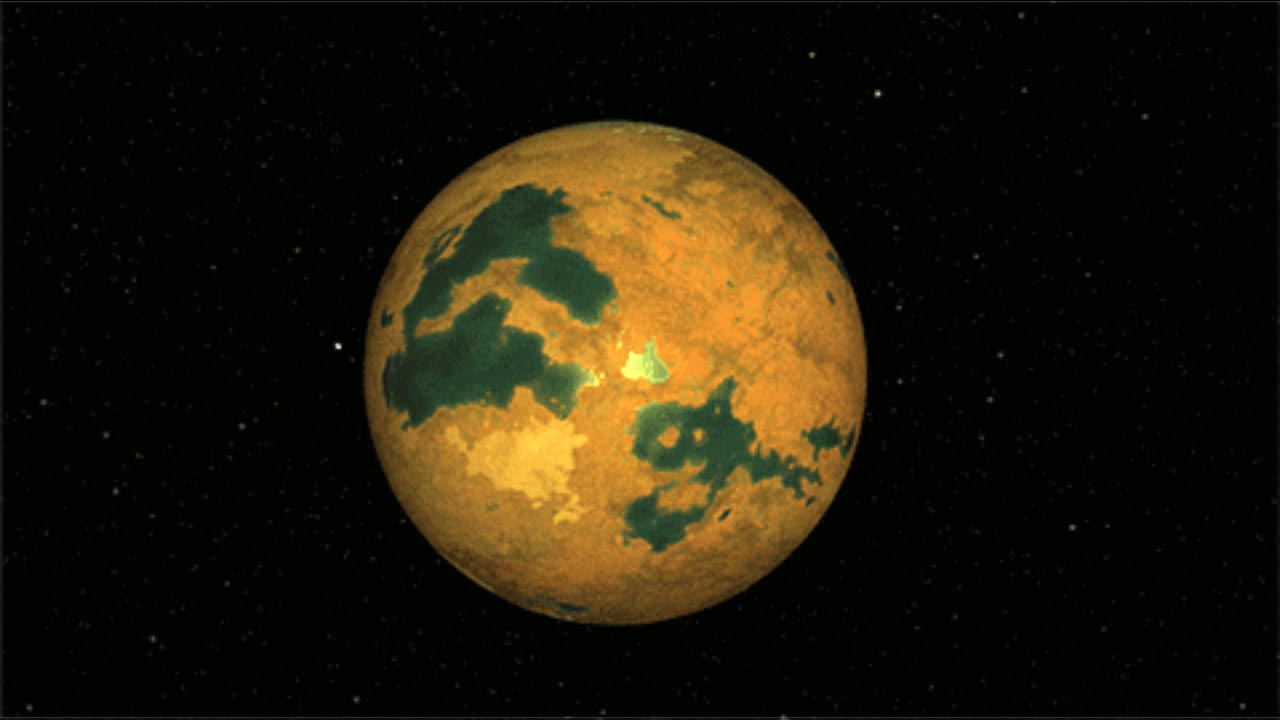
New research refutes the existence of Vulcan, a planet thought to orbit 40 Eridani A, attributing detected signals to the star’s surface activity.
A planet thought to orbit the star 40 Eridani A – host to Mr. Spock’s fictional home planet, Vulcan, in the “Star Trek” universe – is really a kind of astronomical illusion caused by the pulses and jitters of the star itself. This is according to a new study published in The Astronomical Journal.
Initial Excitement and Subsequent Doubts
The possible detection of a planet orbiting a star that Star Trek made famous drew excitement and plenty of attention when it was announced in 2018. Only five years later, the planet appeared to be on shaky ground when other researchers questioned whether it was there at all. Now, precision measurements using a NASA-NSF instrument, installed a few years ago atop Kitt Peak in Arizona, seem to have returned the planet Vulcan even more definitively to the realm of science fiction.
Exoplanet Detection Methods
Two methods for detecting exoplanets – planets orbiting other stars – dominate all others in the continuing search for strange new worlds. The transit method, watching for the tiny dip in starlight as a planet crosses the face of its star, is responsible for the vast majority of detections. But the “radial velocity” method also has racked up a healthy share of exoplanet discoveries. This method is especially important for systems with planets that don’t, from Earth’s point of view, cross the faces of their stars. By tracking subtle shifts in starlight, scientists can measure “wobbles” in the star itself, as the gravity of an orbiting planet tugs it one way, then another. For very large planets, the radial velocity signal mostly leads to unambiguous planet detections. But not-so-large planets can be problematic.
Questioning the Existence of Vulcan
Even the scientists who made the original, possible detection of planet HD 26965 b – almost immediately compared to the fictional Vulcan – cautioned that it could turn out to be messy stellar jitters masquerading as a planet. They reported evidence of a “super-Earth” – larger than Earth, smaller than Neptune – in a 42-day orbit around a Sun-like star about 16 light-years away. The new analysis, using high-precision radial velocity measurements not yet available in 2018, confirms that caution about the possible discovery was justified.
NEID Instrument Clarifies Doubts
The bad news for Star Trek fans comes from an instrument known as NEID, a recent addition to the complex of telescopes at Kitt Peak National Observatory. NEID, like other radial velocity instruments, relies on the “Doppler” effect: shifts in the light spectrum of a star that reveal its wobbling motions. In this case, parsing out the supposed planet signal at various wavelengths of light, emitted from different levels of the star’s outer shell, or photosphere, revealed significant differences between individual wavelength measurements – their Doppler shifts – and the total signal when they were all combined. That means, in all likelihood, the planet signal is really the flickering of something on the star’s surface that coincides with a 42-day rotation – perhaps the roiling of hotter and cooler layers beneath the star’s surface, called convection, combined with stellar surface features such as spots and “plages,” which are bright, active regions. Both can alter a star’s radial velocity signals.
Potential for Future Discoveries
While the new finding, at least for now, robs star 40 Eridani A of its possible planet Vulcan, the news isn’t all bad. The demonstration of such finely tuned radial velocity measurements holds out the promise of making sharper observational distinctions between actual planets and the shakes and rattles on surfaces of distant stars.
Even the destruction of Vulcan has been anticipated in the Star Trek universe. Vulcan was first identified as Spock’s home planet in the original 1960s television series. But in the 2009 film, “Star Trek,” a Romulan villain named Nero employs an artificial black hole to blow Spock’s home world out of existence.
A science team led by astronomer Abigail Burrows of Dartmouth College, and previously of NASA’s Jet Propulsion Laboratory, published a paper describing the new result, “The death of Vulcan: NEID reveals the planet candidate orbiting HD 26965 is stellar activity,” in The Astronomical Journal in May 2024 (Note: HD 26965 is an alternate designation for the star, 40 Eridani A.)
Reference: “The Death of Vulcan: NEID Reveals That the Planet Candidate Orbiting HD 26965 Is Stellar Activity*” by Abigail Burrows, Samuel Halverson, Jared C. Siegel, Christian Gilbertson, Jacob Luhn, Jennifer Burt, Chad F. Bender, Arpita Roy, Ryan C. Terrien, Selma Vangstein, Suvrath Mahadevan, Jason T. Wright, Paul Robertson, Eric B. Ford, Gumundur Stefánsson, Joe P. Ninan, Cullen H. Blake, Michael W. McElwain, Christian Schwab and Jinglin Zhao, 26 April 2024, The Astronomical Journal.
DOI: 10.3847/1538-3881/ad34d5
Never miss a breakthrough: Join the SciTechDaily newsletter.
Follow us on Google and Google News.
1 Comment
Or.. Nero did what he does, and sucked it into an artificial black hole. 😉