
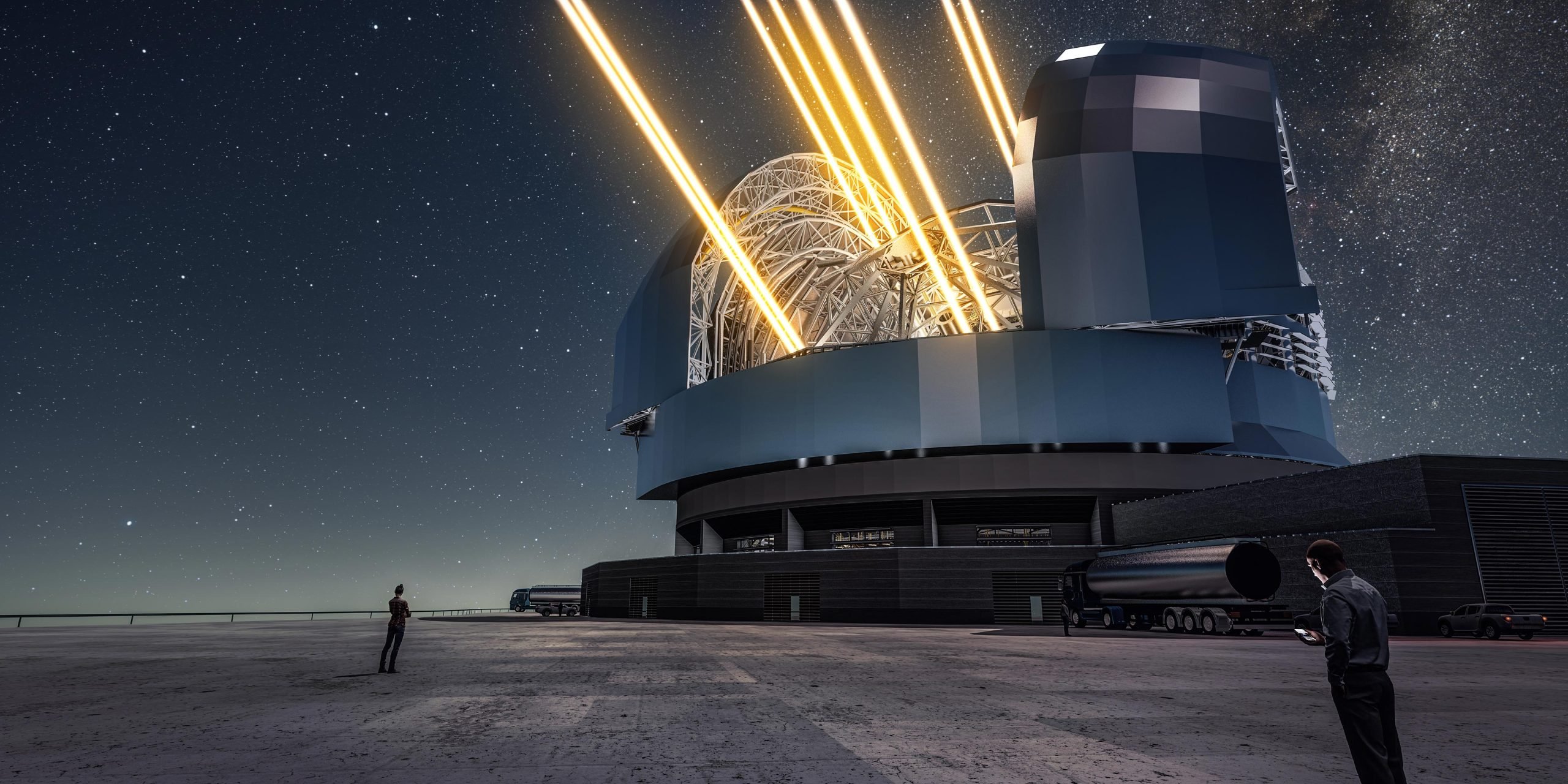
The ELT is leaping toward the stars, quite literally — its massive dome, once skeletal, is now clad in protective armor, shielding delicate optics from the desert.
Inside, a cutting-edge marvel is taking shape, including the 39-meter-wide mirror built from 798 segments that promises to collect celestial light like never before. With groundbreaking developments in adaptive optics and instrumentation, 2024 was packed with milestones, setting the stage for an exhilarating 2025.
A Year of Incredible Progress
Last year marked remarkable progress in the construction of the European Southern Observatory’s Extremely Large Telescope (ELT). The time-lapse video below offers a glimpse into how much has changed over the past twelve months.
Early in the year, the telescope’s dome appeared as a bare steel framework. Since then, it has been gradually covered with shiny, protective cladding. This new outer shell, made of aluminum panels and thermal insulation materials, serves two key purposes: it helps maintain a stable internal temperature by matching the expected nighttime conditions, and it protects the interior from the harsh desert environment, including sand and dust.
Building the ELT’s Heart: Mirror Housing and Structure
The time-lapse also highlights the construction of the ELT’s main support structure. Rising at the center of the dome, the lightweight yet robust framework will eventually hold the telescope’s massive mirrors. One of the most impressive components is the 39-meter-wide mirror cell at the base, which will house 798 individual mirror segments that make up the primary mirror, known as M1. This mirror is engineered to collect light tens of millions of times more efficiently than the human eye, directing it through the ELT’s optical system, which includes four additional mirrors. Three of those mirrors will be positioned within a newly installed central tower.
Milestones in 2024: Mirrors, Lasers, and Instruments
There was also plenty to celebrate in 2024, which hasn’t been captured in this timelapse. For example, in January, the first segments of the M1 arrived in Chile, which were then coated with reflective silver later in March. A few months later, the (unpolished) blank of the fifth mirror, M5, was completed, and the cell that will hold it (while adjusting the position of the mirror up to 10 times a second) finished construction in September.
In the same month, the last of 6 ELT laser sources was built — part of the telescope’s adaptive-optics system, which will correct for atmospheric disturbances. Meanwhile, the development of the ELT’s scientific instruments has been barrelling forward, with METIS and MICADO passing their final design reviews, and the construction agreement for ANDES being signed. With all of these fantastic achievements in just twelve months, we’re left to wonder: what great things might be in store for 2025?
Never miss a breakthrough: Join the SciTechDaily newsletter.
Follow us on Google and Google News.
3 Comments
Very Sci-Fi picture! Thanks.
“The telescope is shown using lasers to create artificial stars high in the atmosphere.”
umm… no
I would check this out;
https://en.m.wikipedia.org/wiki/Adaptive_optics