

Scientists have found that water, under extreme pressure and cold temperatures, can split into two different liquid phases. This was theorized decades ago but never proven—until now.
Advanced molecular simulations, leveraging AI and quantum mechanics, have made it possible to model this elusive behavior, hinting at potential future applications in materials science and environmental technology.
The Unique Nature of Water
Water is a truly unique substance. It is one of the few materials that can naturally exist as a solid, liquid, and gas at the same time under normal conditions, for example, think of ice floating on a pond, liquid water beneath it, and water vapor forming clouds above. It is also unusual because its solid form, ice, is less dense than its liquid form, which is why it floats.
Now, researchers at the University of California San Diego have uncovered another remarkable property of water. Under extreme pressure and low temperatures, liquid water can separate into two distinct liquid phases—one denser than the other. This discovery, published in Nature Physics, provides new insight into water’s complex behavior.
Molecular Modeling: A New Approach
Francesco Paesani, a professor of chemistry and biochemistry at UC San Diego, leads a team that combines chemistry, physics, and computer science to develop advanced models of molecular behavior. Using machine learning and computational algorithms, his group creates highly realistic simulations that closely match experimental observations.
“Our water model is so realistic you can almost drink it,” Paesani said.
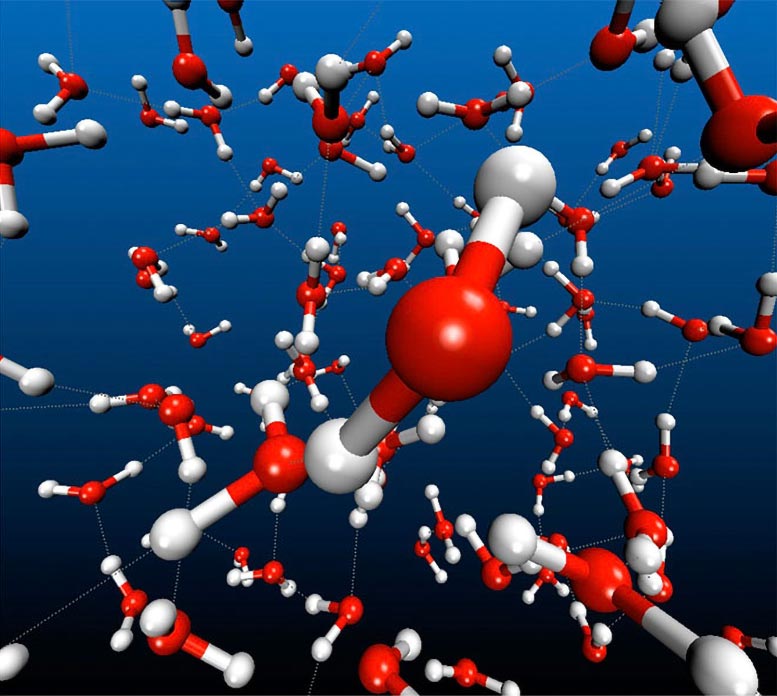
Water’s Critical Point Revealed
Most liquids are homogenous — they all flow together and you can’t distinguish one liquid molecule from the next. Indeed, this is mostly true of water. However, in 1992 researchers theorized that at a certain temperature and pressure, liquid water would reach a critical point at which it would no longer be homogenous.
Paesani’s team conducted simulations that revealed the critical point at which the temperature is low enough (198 Kelvin or -103 Fahrenheit) and the pressure is high enough (1,250 atmospheres) for water to spontaneously separate into high-density and low-density liquids.
At this critical point, water exhibits wild oscillations between high- and low-density phases. Below this pressure, water returns to its low-density phase; above it, it shifts entirely to the high-density phase. This is an unexpected phenomenon unfolding at the molecular level.
Advancing Computational Models
The 1992 simulation was crude. Since then, researchers have tried to create this spontaneous separation experimentally, but without success. Over the past three decades, advancements in computational modelling have made more detailed, accurate simulations possible — particularly the advent of data-driven many-body potentials, in which Paesani’s group specializes.
The data-driven many-body model of water (MB-pol) developed by the Paesani group is trained on high-level quantum mechanical calculations (data-driven) and rather than calculating the energy of an entire system at once, they deconstruct energy in terms of individual contributions (many-body). These reference energies are fed into a machine learning model that is then able to provide realistic simulations of water across the entire phase diagram.
Understanding Water at the Quantum Level
Paesani explains the MB-pol model in this way: a person alone in a room behaves a certain way. If someone else enters the room, the first person’s behavior changes to accommodate the second person. If a third person enters, the dynamic of the first two changes. On and on until there are so many people in the room that the addition of one more does not significantly impact the behavior of any single person.
This is how MB-pol works. In the short range, there are quantum mechanical effects that directly modify the behavior of the water molecules, just as one person influences the behavior of another. However, at a certain point, the effects are averaged out over the entire system, just as adding one more person to an already crowded room doesn’t impact the behavior of another individual.
Supercomputers and the Future of Research
“Quantum mechanical simulations can be extremely expensive. You might be able to calculate the energies of five or six water molecules. Our method, using MB-pol and machine learning, allows us to run simulations for up to several microseconds,” stated Paesani. “This is something computational molecular scientists have dreamed about for a long time.”
However, the discovery didn’t come easy. Running simulations for this research took nearly two years of non-stop calculations using some of the world’s most powerful supercomputers, including Expanse at the San Diego Supercomputer Center, which is a pillar of UC San Diego’s new School of Computing, Information and Data Sciences.
Synthetic Liquids and Future Possibilities
In the future, as technology develops, Paesani hopes this research might be used to devise synthetic liquids that undergo a similar liquid-liquid transition as water, but can do so in everyday conditions. Porous liquids that can move from low to high density would behave similarly to sponges, and could be used to capture pollutants or aid in water desalinization.
“The simulation took almost two years, so this is a really exciting accomplishment,” stated Paesani. “I think our estimate is very realistic. Now it’s up to the experimental researchers to see whether our predictions are correct.”
The Challenge of Experimental Proof
Currently, recreating these conditions in a laboratory remains a challenge. However, nanodroplet technology could offer a way forward by creating tiny water droplets that generate high internal pressure through surface tension, potentially leading to experimental confirmation of this phenomenon.
For now, this discovery offers the most accurate prediction yet of a phenomenon scientists have long suspected, but never directly observed. And when that day comes, it may change the way we think about water forever.
Reference: “Constraints on the location of the liquid–liquid critical point in water” by F. Sciortino, Y. Zhai, S. L. Bore and F. Paesani, 3 February 2025, Nature Physics.
DOI: 10.1038/s41567-024-02761-0
Full list of authors: Yaoguang Zhai, Sigbjørn Løland Bore, Francesco Paesani (all UC San Diego), and Francesco Sciortino (Sapienza Università di Roma).
This research was supported in part by the Air Force Office of Scientific Research (FA9550-20-1-0351) and the National Science Foundation (CHE230052).
Never miss a breakthrough: Join the SciTechDaily newsletter.
Follow us on Google and Google News.