
Close Menu
    Facebook X (Twitter) Instagram
    SciTechDaily
    • Biology
    • Chemistry
    • Earth
    • Health
    • Physics
    • Science
    • Space
    • Technology
    Facebook X (Twitter) Pinterest YouTube RSS
    SciTechDaily
    Home»Space»Webb Space Telescope Reaches Destination a Million Miles From Earth – Achieves “Halo” Orbit Around L2
    Space

    Webb Space Telescope Reaches Destination a Million Miles From Earth – Achieves “Halo” Orbit Around L2

    By NASAJanuary 24, 2022No Comments3 Mins Read
    Facebook Twitter Pinterest Telegram LinkedIn WhatsApp Email Reddit
    Share
    Facebook Twitter LinkedIn Pinterest Telegram Email Reddit
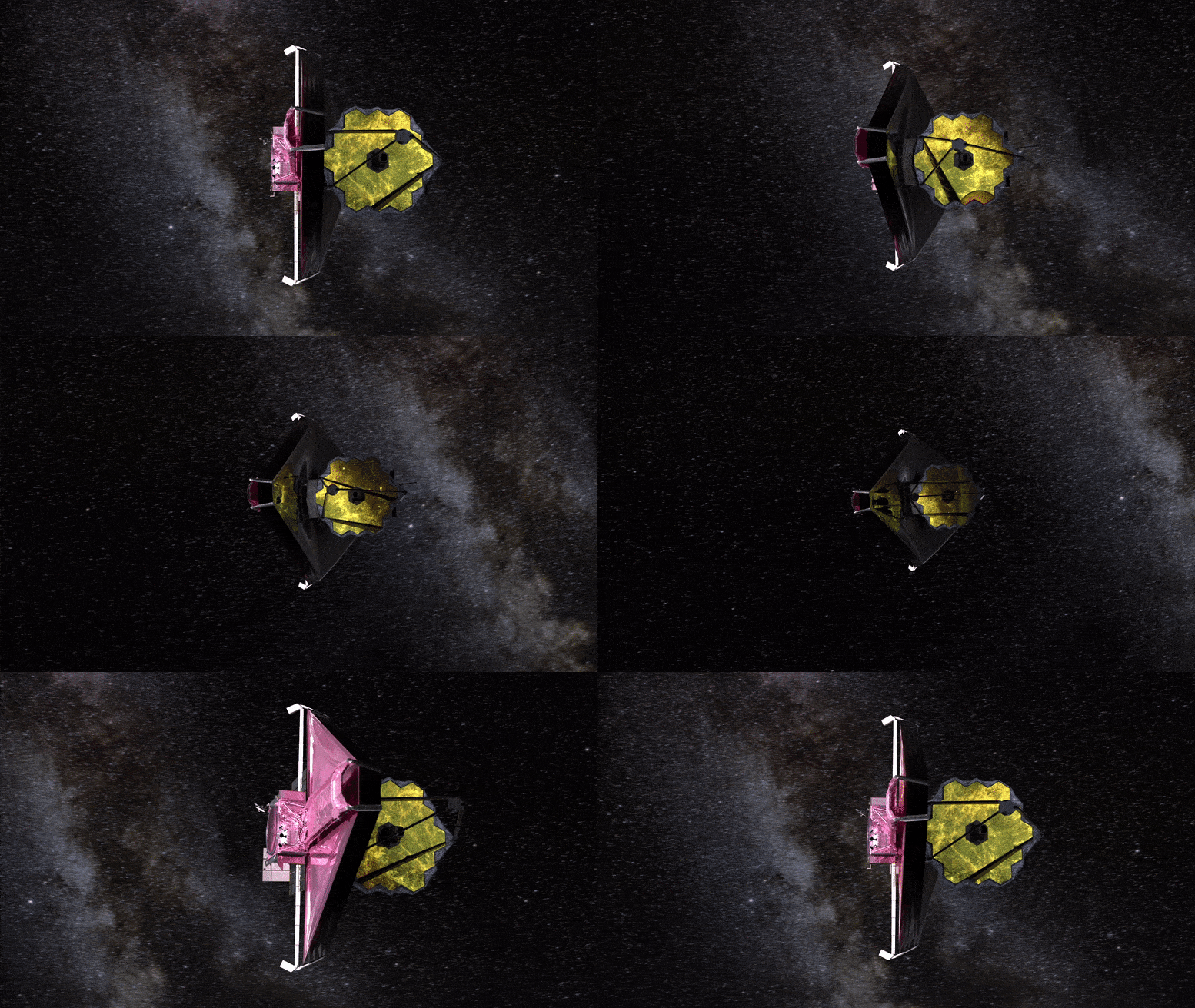
    Webb Telescope L2 Flyby
    The James Webb Space Telescope (JWST) is the next of NASA’s Great Observatories; following in the line of the Hubble Space Telescope, the Compton Gamma-ray Observatory, the Chandra X-ray Observatory, and the Spitzer Space Telescope. JWST combines qualities of two of its predecessors, observing in infrared light, like Spitzer, with fine resolution, like Hubble. Credit: NASA, SkyWorks Digital, Northrop Grumman, STScI

    The JWST successfully executed its final trajectory adjustment to reach the L2 point, completing a critical phase of its journey. With its mirrors ready for alignment, Webb is set to begin a new chapter in space observation, offering unprecedented views of the universe.

    Today, at 2 p.m. EST, Webb fired its onboard thrusters for nearly five minutes (297 seconds) to complete the final postlaunch course correction to Webb’s trajectory. This mid-course correction burn inserted Webb toward its final orbit around the second Sun-Earth Lagrange point, or L2, nearly 1 million miles away from the Earth.

    The final mid-course burn added only about 3.6 miles per hour (1.6 meters per second) – a mere walking pace – to Webb’s speed, which was all that was needed to send it to its preferred “halo” orbit around the L2 point.

    “Webb, welcome home!” said NASA Administrator Bill Nelson. “Congratulations to the team for all of their hard work ensuring Webb’s safe arrival at L2 today. We’re one step closer to uncovering the mysteries of the universe. And I can’t wait to see Webb’s first new views of the universe this summer!”
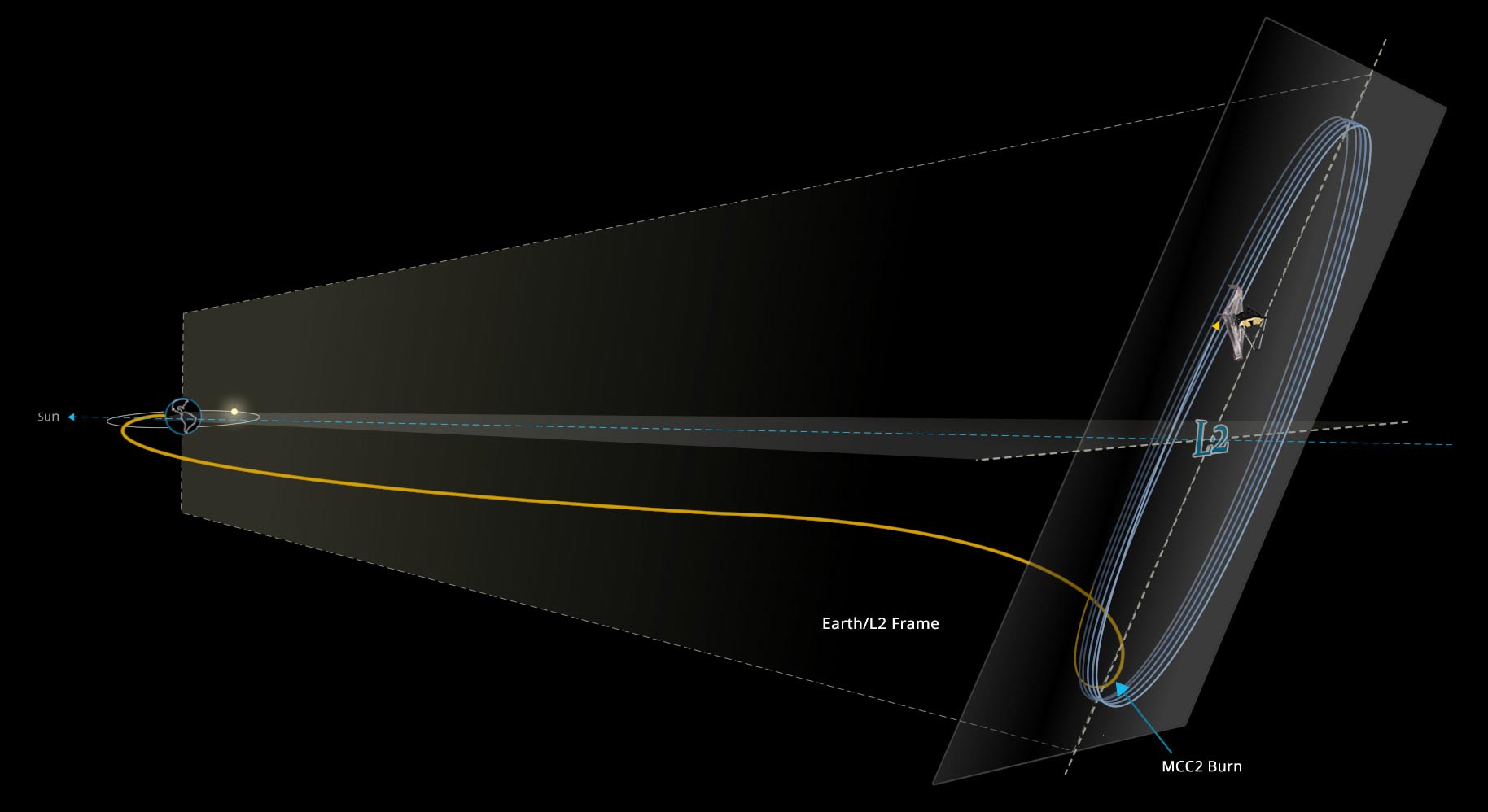
    Webb Orbit MCC2 Burn
    Click on the trajectory diagram for a full-screen version. Credit: Steve Sabia/NASA Goddard

    Webb’s orbit will allow it a wide view of the cosmos at any given moment, as well as the opportunity for its telescope optics and scientific instruments to get cold enough to function and perform optimal science. Webb has used as little propellant as possible for course corrections while it travels out to the realm of L2, to leave as much remaining propellant as possible for Webb’s ordinary operations over its lifetime: station-keeping (small adjustments to keep Webb in its desired orbit) and momentum unloading (to counteract the effects of solar radiation pressure on the huge sunshield).

    “During the past month, JWST has achieved amazing success and is a tribute to all the folks who spent many years and even decades to ensure mission success,” said Bill Ochs, Webb project manager at NASA’s Goddard Space Flight Center. “We are now on the verge of aligning the mirrors, instrument activation and commissioning, and the start of wondrous and astonishing discoveries.”

    Now that Webb’s primary mirror segments and secondary mirror have been deployed from their launch positions, engineers will begin the sophisticated three-month process of aligning the telescope’s optics to nearly nanometer precision.

    Never miss a breakthrough: Join the SciTechDaily newsletter.
    Follow us on Google and Google News.

    James Webb Space Telescope NASA Popular
    Share. Facebook Twitter Pinterest LinkedIn Email Reddit

    Related Articles

    Another Primary Webb Space Telescope Instrument Gets the “Go for Science”

    One of Webb Space Telescope’s Primary Instruments Ready To See Cosmos in Over 2,000 Infrared Colors

    Capturing Images and Spectra From Celestial Objects: The Modes of the Webb Space Telescope’s NIRISS

    The James Webb Space Telescope: Prepare for a New Way To See the Universe

    NASA’s $10 Billion Webb Space Telescope Struck by Micrometeoroid

    Coming Soon: First Images From NASA’s Webb Space Telescope

    Webb Space Telescope’s Quest for Primeval Black Holes

    Webb Space Telescope To Provide Details of Two Intriguing “Super-Earths” in the Milky Way

    Incredibly Sharp Webb Space Telescope Test Images Hint at New Possibilities for Science

    Leave A Reply Cancel Reply

    • Facebook
    • Twitter
    • Pinterest
    • YouTube

    Don't Miss a Discovery

    Subscribe for the Latest in Science & Tech!

    Trending News

    Largest-Ever Study Finds Medicinal Cannabis Ineffective for Anxiety, Depression, PTSD

    250-Million-Year-Old Egg Solves One of Evolution’s Biggest Mysteries

    Living With Roommates Might Be Changing Your Gut Microbiome Without You Knowing

    Century-Old Cleaning Chemical Linked to 500% Increased Risk of Parkinson’s Disease

    What if Your Memories Never Happened? Physicists Take a New Look at the Boltzmann Brain Paradox

    One of the Universe’s Largest Stars May Be Getting Ready To Explode

    Scientists Discover Enzyme That Could Supercharge Ozempic-Like Weight Loss Drugs

    Popular Sweetener Linked to DNA Damage – “It’s Something You Should Not Be Eating”

    Follow SciTechDaily
    • Facebook
    • Twitter
    • YouTube
    • Pinterest
    • Newsletter
    • RSS
    SciTech News
    • Biology News
    • Chemistry News
    • Earth News
    • Health News
    • Physics News
    • Science News
    • Space News
    • Technology News
    Recent Posts
    • The Most Elusive Number in Physics Just Got Even More Mysterious
    • Scientists Uncover Hidden Trigger Behind Stem Cell Aging
    • Scientists Discover Coral Reefs Are Teeming With Previously Unknown Life
    • Scientists Find Way to Reverse Fatty Liver Disease Without Changing Diet
    • Could Humans Regrow Limbs? New Study Reveals Promising Genetic Pathway
    Copyright © 1998 - 2026 SciTechDaily. All Rights Reserved.
    • Science News
    • About
    • Contact
    • Editorial Board
    • Privacy Policy
    • Terms of Use

    Type above and press Enter to search. Press Esc to cancel.