
Close Menu
    Facebook X (Twitter) Instagram
    SciTechDaily
    • Biology
    • Chemistry
    • Earth
    • Health
    • Physics
    • Science
    • Space
    • Technology
    Facebook X (Twitter) Pinterest YouTube RSS
    SciTechDaily
    Home»Space»Webb Space Telescope Unveils the Hidden Wonders of a Lonely Galaxy
    Space

    Webb Space Telescope Unveils the Hidden Wonders of a Lonely Galaxy

    By ESA/WebbSeptember 18, 2024No Comments3 Mins Read
    Facebook Twitter Pinterest Telegram LinkedIn WhatsApp Email Reddit
    Share
    Facebook Twitter LinkedIn Pinterest Telegram Email Reddit
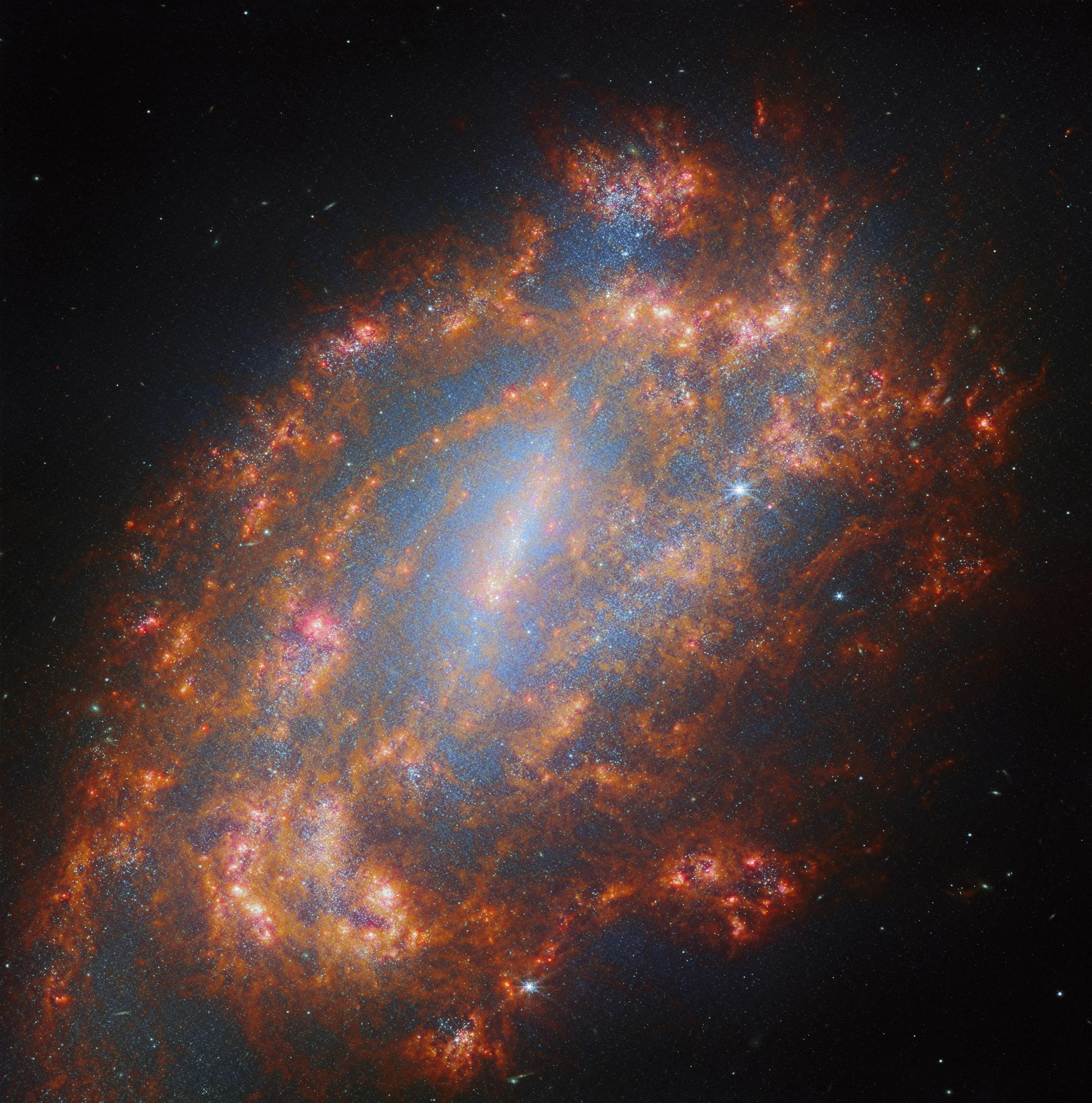
    Galaxy NGC 1559 Webb
    The James Webb Space Telescope provides this detailed view of NGC 1559, a lonely galaxy in the constellation Reticulum, focusing on its spiral arms and interstellar medium as part of a broader astronomical study. Credit: ESA/Webb, NASA & CSA, A. Leroy, J. Lee and the PHANGS Team

    NGC 1559, a barred spiral galaxy, is brilliantly depicted through the James Webb Space Telescope’s advanced instruments, highlighting its stellar and interstellar components.

    This observation is part of a larger effort to understand galactic structures and star formation processes across the universe.

    This image features the barred spiral galaxy NGC 1559 as seen by the James Webb Space Telescope. The galaxy hosts a visible central region with a distinct open pattern in the loosely-wound spiral arms. NGC 1559 resides approximately 35 million light-years away in the little-observed southern constellation Reticulum (The Reticule).

    Webb’s Instruments in Action

    The data featured in this portrait make use of two of Webb’s instruments: the Mid-InfraRed Instrument (MIRI) and Near-InfraRed Camera (NIRCam). Here MIRI captures the glow of interstellar dust grains, which trace out the interstellar medium, the fuel for future star formation. NIRCam shows the light from stars, even young stars hidden behind prodigious amounts of dust. NIRCam also captures emissions from ionized nebulae around young stars.

    Comprehensive Galaxy Survey

    The data were collected by the PHANGS team as part of an observing program in which Webb will observe 55 galaxies that have also been mapped by the Atacama Large Millimeter/submillimeter Array (ALMA) radio telescope, the NASA/ESA Hubble Space Telescope and more. By combining Webb’s unprecedented view of the dust and stars with data from these other facilities, the team aims to obtain a new, highly detailed view of how stars are born, live, and die in galaxies across the Universe.

    This is also a Treasury program, which means that the data will have no exclusive access period and so the scientific community (and others, including the general public) can access the data immediately. This has the advantage that more research can be done with the data more quickly.

    NGC 1559’s Position and Speed

    NGC 1559 has massive spiral arms that abound with star formation, and it is receding from us at a speed of about 1300 kilometers per second. Although NGC 1559 appears to sit near one of our nearest neighbors in the sky — the Large Magellanic Cloud (LMC) — this is just a trick of perspective. In reality, NGC 1559 is physically nowhere near the LMC in space; in fact it truly is a loner, lacking the company of any nearby galaxies or membership of any galaxy cluster.

    NGC 1559 may be alone in space, but with Webb we are admiring from far away.

    Never miss a breakthrough: Join the SciTechDaily newsletter.
    Follow us on Google and Google News.

    Astronomy European Space Agency James Webb Space Telescope
    Share. Facebook Twitter Pinterest LinkedIn Email Reddit

    Related Articles

    James Webb Space Telescope – Cosmic Observatory Will Offer a New View of the Universe

    $10 Billion James Webb Space Telescope Fueled for Launch

    Unboxing the $10 Billion James Webb Space Telescope [Video]

    James Webb Space Telescope’s Journey to Space [Video]

    $10 Billion Webb Space Telescope Arrives at Europe’s Spaceport

    NASA’s $10 Billion New Observatory: James Webb Space Telescope Gets a Launch Date

    $10B Webb Space Telescope Completes Testing and Prepares for Trip to Europe’s Spaceport

    James Webb Space Telescope Passes Key Launch Clearance Review

    First James Webb Space Telescope General Observer Scientific Programs Selected

    Leave A Reply Cancel Reply

    • Facebook
    • Twitter
    • Pinterest
    • YouTube

    Don't Miss a Discovery

    Subscribe for the Latest in Science & Tech!

    Trending News

    One of the Universe’s Largest Stars May Be Getting Ready To Explode

    Scientists Discover Enzyme That Could Supercharge Ozempic-Like Weight Loss Drugs

    Popular Sweetener Linked to DNA Damage – “It’s Something You Should Not Be Eating”

    Ancient “Rock” Microbes May Reveal How Complex Life Began

    Researchers Capture Quantum Interference in One of Nature’s Rarest Atoms

    “A Plague Is Upon Us”: The Mass Death That Changed an Ancient City Forever

    Scientists Discover Game-Changing New Way To Treat High Cholesterol

    This Small Change to Your Exercise Routine Could Be the Secret to Living Longer

    Follow SciTechDaily
    • Facebook
    • Twitter
    • YouTube
    • Pinterest
    • Newsletter
    • RSS
    SciTech News
    • Biology News
    • Chemistry News
    • Earth News
    • Health News
    • Physics News
    • Science News
    • Space News
    • Technology News
    Recent Posts
    • Scientists Prove There Are Just Six Degrees of Separation in a Social Network
    • Bee Bacteria Could Fix a Major Flaw in Plant-Based Milk
    • Scientists Discover a Surprising Way To Make Bread Healthier and More Nutritious
    • Natural Compounds Boost Bone Implant Success While Killing Bacteria and Cancer Cells
    • After 60 Years, Scientists Uncover Unexpected Brain Effects of Popular Diabetes Drug Metformin
    Copyright © 1998 - 2026 SciTechDaily. All Rights Reserved.
    • Science News
    • About
    • Contact
    • Editorial Board
    • Privacy Policy
    • Terms of Use

    Type above and press Enter to search. Press Esc to cancel.