
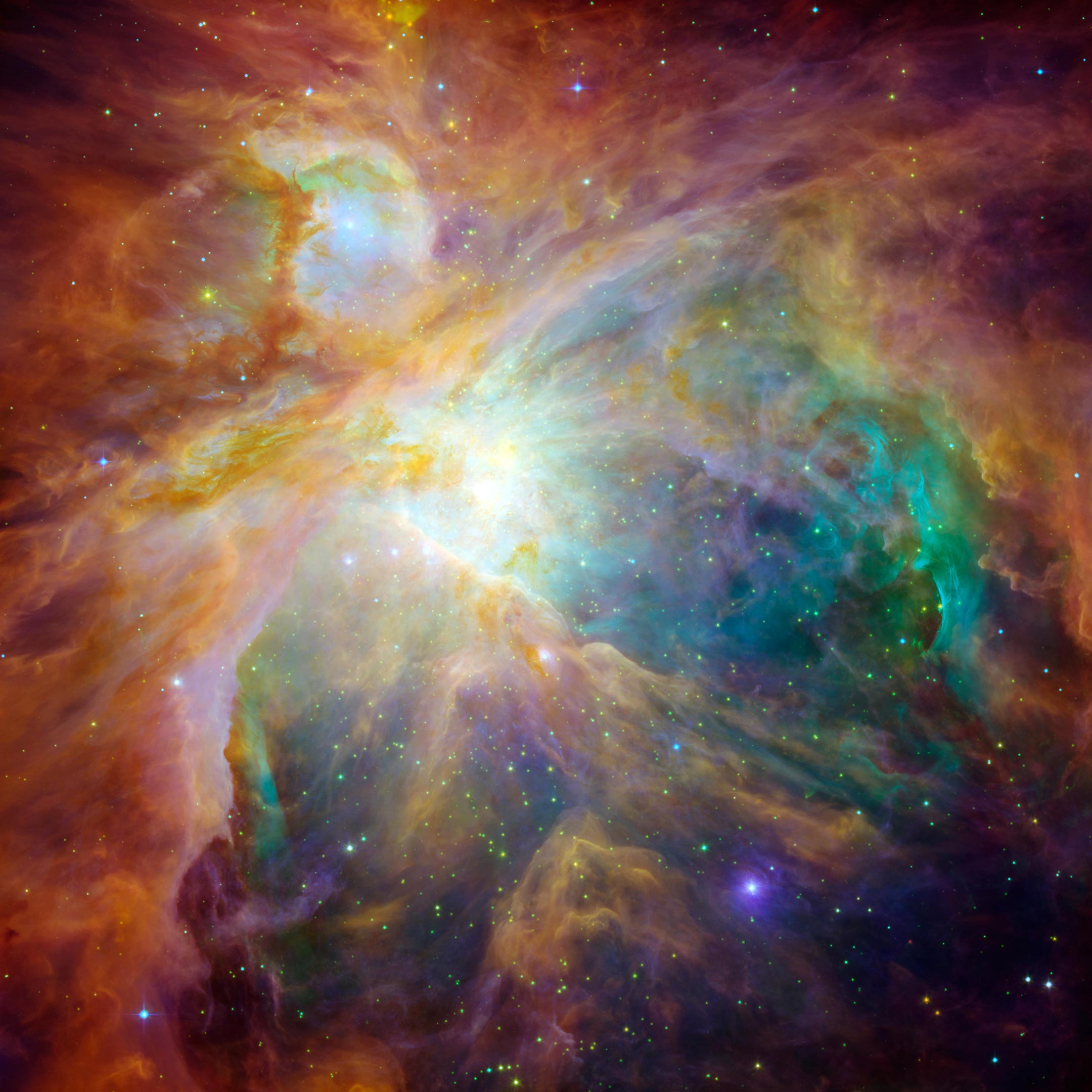
With unprecedented infrared resolution, Webb will identify and quantify PAH types, advancing space dust research.
NASA’s James Webb Space Telescope is gearing up to deliver incredible new images of distant worlds and far-flung galaxies, but the new infrared space observatory will also give us an unprecedented look at a tiny component of our universe: space dust. One category of dust could shed new light on some big processes, such as the formation and evolution of stars and galaxies.
Technically speaking, the tiniest of these dust particles are polycyclic aromatic hydrocarbons. They go by their initials, PAHs (sounds like “pa’s” as in “Grandpa’s slippers”), and they’re one of the most abundant types of molecules in space. They include a whole family of large molecules with a structure like chicken wire – a latticework of hexagons organized in different patterns.
After they were first identified in the 1980s, astronomers discovered PAHs just about everywhere they pointed their telescopes: in some of the earliest galaxies, in gas clouds where stars form, and – closer to home – in the atmosphere of Saturn’s moon, Titan.
In the past, astronomers were hampered by space dust because telescopes couldn’t see through the dark, massive dust clouds spread across galaxies. With the advent of infrared astronomy, telescopes were able to see through those obscuring clouds, and we discovered that space dust is actually a vital part of star and planet formation. Now Webb is poised to be a game-changer for unlocking its secrets.
“Webb has capabilities that dwarf those of previous infrared telescopes and will revolutionize astronomy,” said Louis Allamandola, one of the pioneers of the PAH field and a researcher at NASA’s Ames Research Center in California’s Silicon Valley.
Unprecedented Detail Ahead in Webb’s Dust Data
When NASA’s Spitzer telescope launched in 2003, with its next-generation infrared technology, PAH research took off.
“Now, Webb will bring superb spatial and spectral resolution,” said Christiaan Boersma, an astronomer at Ames and joint principal investigator on a project that will use Webb to study PAHs in space. “We’ll be able to see details – better details – on smaller scales than ever before. This will reveal how PAHs form and evolve in very different astronomical environments. And that will allow us to unravel the photophysics and chemistry that drive how star-forming structures arise and explain the remarkable diversity of objects we observe, from exoplanets and stars to galaxies.”
Deciphering the Fingerprints of Light
Boersma is excited about the detailed spectra Webb will provide. These are like fingerprints for light. When dust molecules are heated by the Sun or another star’s rays, they emit infrared light to cool off. The light patterns, or spectra, can help identify the different types of PAH molecules the light came from – if we can capture it well enough.
With lower-resolution infrared telescope technology, astronomers have detected broad PAH populations or families. Deciphering the spectrum of a single type of PAH is possible, but it’s painstaking work, requiring the synergy of telescope observations, lab work, and advanced computing that underlies Ames’ Laboratory Astrophysics group. The field was brought to maturity at Ames, allowing scientists to recreate in the lab the PAH-forming conditions of interstellar space and measure the spectral fingerprints of the molecules that result.
So far, they’ve nailed down the “light fingerprint” of around 100 different PAHs by studying molecules in the lab and another 4,000 with the help of computers. Armed with all that data, astronomers match known spectra to PAH populations observed in the sky.
It’s a big job, but researchers expect the powerful Webb telescope will bring a whole new approach.
“The holy grail for us is to be able to identify and quantify – directly from the telescope data – the specific PAH types making up the families we see,” said Boersma. “We’re closer than ever, thanks to the fundamental work that came before.”
With Webb’s resolution, they’ll be able to tease out smaller PAH subsets – defined by characteristics such as size, shape, and electric charge – that contribute to the observed spectra. To analyze and interpret the PAH observations, researchers will turn to a database of research built up by NASA scientists. The NASA Ames PAH IR Spectroscopic Database is freely available to the global scientific community and offers libraries of data and sophisticated tools.
“We’re entering the era of ‘PAH research 2.0’,” said Allamandola. “Looking at a spectrum is like listening to a symphony. Webb will allow us to hear all the different kinds of PAHs in the orchestra for the very first time. That is a giant step forward.”
The James Webb Space Telescope is the world’s premier space science observatory. Webb will solve mysteries in our solar system, look beyond to distant worlds around other stars, and probe the mysterious structures and origins of our universe and our place in it. Webb is an international program led by NASA with its partners, ESA (European Space Agency) and the Canadian Space Agency.
Never miss a breakthrough: Join the SciTechDaily newsletter.
Follow us on Google and Google News.
1 Comment
There is no dust in space; space is a vacuum. And the space vacuum vacuums up all the dust. The real question is, where is the dust bag kept? A black hole? Or does it just get burned up by a star or something?
On a side note, they are finally going to show the f*ucking big bang tomorrow. We are going to see the damn beginning of the universe and all the sh*t just f*ucking pop into existence or whatever the hell it does.