

Close Menu
    Facebook X (Twitter) Instagram
    SciTechDaily
    • Biology
    • Chemistry
    • Earth
    • Health
    • Physics
    • Science
    • Space
    • Technology
    Facebook X (Twitter) Pinterest YouTube RSS
    SciTechDaily
    Home»Health»Weight Loss Unlocks Key to Better Metabolism: The Kallistatin Effect
    Health

    Weight Loss Unlocks Key to Better Metabolism: The Kallistatin Effect

    By German Center for Diabetes ResearchMarch 28, 2024No Comments3 Mins Read
    Facebook Twitter Pinterest Telegram LinkedIn WhatsApp Email Reddit
    Share
    Facebook Twitter LinkedIn Pinterest Telegram Email Reddit
    Weight Loss Scale Concept
    A recent study reveals that Kallistatin levels rise after weight loss, offering potential new treatments for obesity and type 2 diabetes through its positive effects on metabolism and hepatic insulin sensitivity.

    Following weight loss, individuals previously classified as overweight or obese exhibit increased levels of the protein Kallistatin in their subcutaneous white adipose tissue, according to a recent study conducted by researchers at the DZD.

    In addition, Kallistatin improves metabolism and could open up new therapeutic options for people with obesity and type 2 diabetes in the future. The results have now been published in Molecular Metabolism.

    An increasing number of people are developing type 2 diabetes and obesity. These are highly complex and multifaceted diseases. In order to treat them sustainably, new approaches to therapy are needed. Clinical studies on humans have shown that heavily overweight individuals produce less Kallistatin. Kallistatin is a protein that has various effects in the body. Among other things, it is involved in counteracting inflammation and healing wounds.
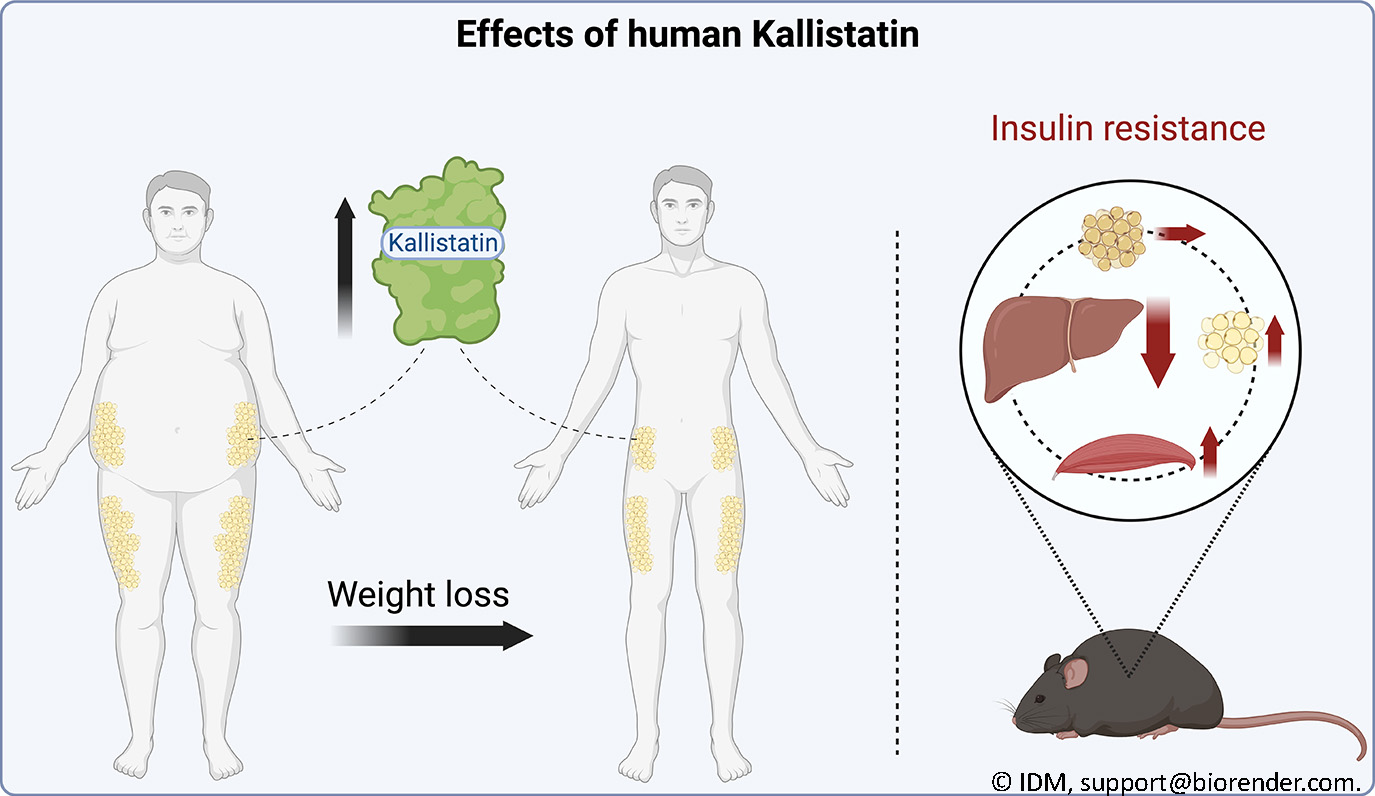
    Effects of Human Kallistatin Graphic
    Expression of the protein Kallistatin increases after weight reduction. In mice, it improves hepatic insulin sensitivity. Credit: IDM, [email protected]

    The role that Kallistatin plays in glucose metabolism and its potential suitability as a therapeutic target are currently being investigated by researchers from the German Center for Diabetes Research (DZD), the Institute for Diabetes Research and Metabolic Diseases (IDM) of Helmholtz Munich at the Eberhard-Karls-University of Tübingen, and the Department of Diabetology, Endocrinology and Nephrology at the University Hospital Tübingen.

    Kallistatin Expression Increases After Weight Loss

    To this end, they measured Kallistatin expression in subcutaneous white adipose tissue in 47 individuals with overweight to obesity before and after weight loss. The result: Kallistatin expression increases after weight loss.

    Kallistatin Improves Hepatic Insulin Sensitivity

    Additionally, the researchers examined the effect of the protein in an animal model. In the process, they observed that human Kallistatin improves hepatic insulin sensitivity in diet-induced obese mice.

    “Our results suggest that Kallistatin may be an interesting, yet challenging, therapeutic target for people with obesity and insulin resistance,” says lead author Leontine Sandforth. “Because Kallistatin has insulin-sensitizing effects in the liver, it should be investigated as a potential liver-specific target for emulating the beneficial effects of weight loss and potentially treating type 2 diabetes and obesity,” adds last author Prof. Andreas Birkenfeld.

    Reference: “Role of human Kallistatin in glucose and energy homeostasis in mice” by Leontine Sandforth, Sebastian Brachs, Julia Reinke, Diana Willmes, Gencer Sancar, Judith Seigner, David Juarez-Lopez, Arvid Sandforth, Jeffrey D. McBride, Jian-Xing Ma, Sven Haufe, Jens Jordan and Andreas L. Birkenfeld, 29 February 2024, Molecular Metabolism.
    DOI: 10.1016/j.molmet.2024.101905

    Never miss a breakthrough: Join the SciTechDaily newsletter.
    Follow us on Google and Google News.

    Diabetes Obesity Weight Loss
    Share. Facebook Twitter Pinterest LinkedIn Email Reddit

    Related Articles

    New Obesity Treatment Delivers Dramatic Weight Loss – Benefits of Gastric Bypass Without Surgery

    Does Intermittent Fasting Actually Work? Study Finds Meal Frequency Matters More Than Timing

    Low-Carb vs. Low-Fat: Science Reveals Which Diet Is Better for Weight Loss and Diabetes Control

    A Potential Cure for Obesity – New Particles Stop the Absorption of Fat and Carbs

    New Game-Changing Obesity Drug Dramatically Reduces Risk of Type 2 Diabetes

    Weight Loss Medication Shows Promise for People With Diabetes and Obesity

    Weight Loss of 15% or More Should Be Central Focus of Type 2 Diabetes Management

    Diabetes Medication Semaglutide Reduces Excess Body Fat in People With Obesity

    Same Metabolic Benefits Gained From Major Weight Loss – Whether From Diet or Gastric Bypass Surgery

    Leave A Reply Cancel Reply

    • Facebook
    • Twitter
    • Pinterest
    • YouTube

    Don't Miss a Discovery

    Subscribe for the Latest in Science & Tech!

    Trending News

    Breakthrough Bowel Cancer Trial Leaves Patients Cancer-Free for Nearly 3 Years

    Natural Compound Shows Powerful Potential Against Rheumatoid Arthritis

    100,000-Year-Old Neanderthal Fossils in Poland Reveal Unexpected Genetic Connections

    Simple “Gut Reset” May Prevent Weight Gain After Ozempic or Wegovy

    2.8 Days to Disaster: Scientists Warn Low Earth Orbit Could Suddenly Collapse

    Common Food Compound Shows Surprising Power Against Superbugs

    5 Simple Ways To Remember More and Forget Less

    The Atomic Gap That Could Cost the Semiconductor Industry Billions

    Follow SciTechDaily
    • Facebook
    • Twitter
    • YouTube
    • Pinterest
    • Newsletter
    • RSS
    SciTech News
    • Biology News
    • Chemistry News
    • Earth News
    • Health News
    • Physics News
    • Science News
    • Space News
    • Technology News
    Recent Posts
    • Total Solar Eclipse Made Cities Go Eerily Quiet Beneath the Surface
    • This Common Plant Could Be an Unexpected New Source of Protein
    • Birds in Cities Fear Women More Than Men and Scientists Don’t Know Why
    • Scientists Warn That This Common Pet Fish Can Wreck Entire Ecosystems
    • Scientists Just Made Carbon Capture Much Cheaper and Easier
    Copyright © 1998 - 2026 SciTechDaily. All Rights Reserved.
    • Science News
    • About
    • Contact
    • Editorial Board
    • Privacy Policy
    • Terms of Use

    Type above and press Enter to search. Press Esc to cancel.