

Close Menu
    Facebook X (Twitter) Instagram
    SciTechDaily
    • Biology
    • Chemistry
    • Earth
    • Health
    • Physics
    • Science
    • Space
    • Technology
    Facebook X (Twitter) Pinterest YouTube RSS
    SciTechDaily
    Home»Biology»Chilling Findings: Scientists Shed Light on How the Brain Perceives Temperature
    Biology

    Chilling Findings: Scientists Shed Light on How the Brain Perceives Temperature

    By University of OklahomaMarch 28, 2024No Comments4 Mins Read
    Facebook Twitter Pinterest Telegram LinkedIn WhatsApp Email Reddit
    Share
    Facebook Twitter LinkedIn Pinterest Telegram Email Reddit
    Cold Brain Ice Frozen
    New research highlights the critical role of TRPM8 receptors in the mouth for perceiving cooling sensations and distinguishing them from warmth. By studying mice with and without these receptors, the team found that TRPM8 is essential for the brain to correctly interpret temperatures, influencing future studies on taste, eating preferences, and the broader understanding of temperature sensing in health. Credit: SciTechDaily.com

    The research on oral temperature perception was funded by the NIH.

    Christian Lemon, Ph.D., an associate professor in the School of Biological Sciences at the University of Oklahoma, often thinks about temperature sensation and the brain when eating a chilled mint cookie. Now, research from his lab examining oral temperature perception has been published in The Journal of Neuroscience.

    In their research, Lemon’s team investigates how cold receptors in the mouth are activated by cooling temperatures, how those signals are transmitted to the brain and how those transmissions are generated into a cooling sensation.
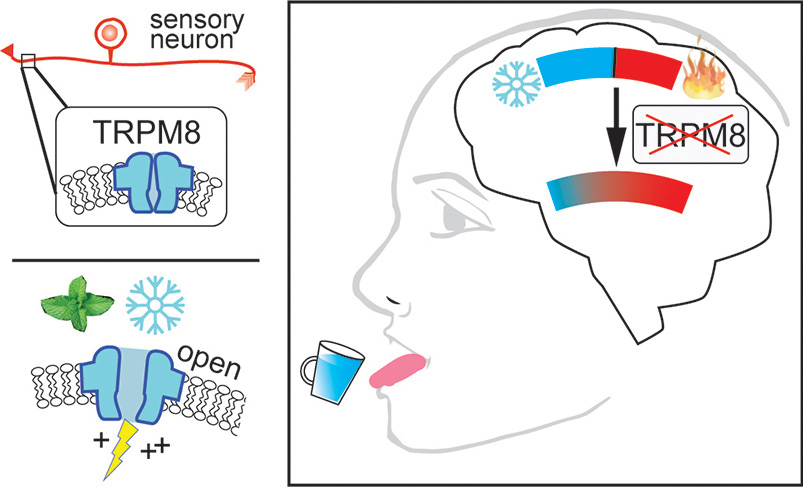
    TRPM8 Diagram
    Diagram depicting the role of TRPM8. Credit: Christian H. Lemon

    “These receptors respond to cooling temperatures but are also activated by menthol from mint plants. This feature is probably why the flavor of a mint cookie can appear enhanced when eaten cold,” he said. “While sometimes called a cold and menthol receptor, it’s technically known as TRPM8. These receptors begin to activate when temperature falls a few steps below your core body temperature.”

    According to prior research, TRPM8 receptors are activated by temperatures below about 86 degrees Fahrenheit, 30 degrees Celsius, and are strongly stimulated by colder temperatures near 50 degrees Fahrenheit, 10 degrees Celsius.

    Findings from Lemon’s Research

    “Our study found that genetically removing TRPM8 receptors in a mouse model reduced the brain’s response to mild cooling in the mouth, while responses to significantly colder temperatures remained partly intact,” he said. “Interestingly, this process also impacted how the brain responded to warm temperatures. We found that without input from TRPM8 receptors, the brain’s response to warmth moved down into the cool range, essentially making cooler temperatures appear as warmer by the brain’s response.”

    Lemon’s team theorized that the brain might be confusing, or “blurring,” cooling and warming sensations when TRPM8 was silenced. To explore this idea, they precisely controlled the temperature of liquids consumed to monitor oral temperature preference behavior. These results compared how temperature messages from TRPM8 receptors in the mouth tracked along nerve fibers into the brain and influenced how the brain may interpret those signals.
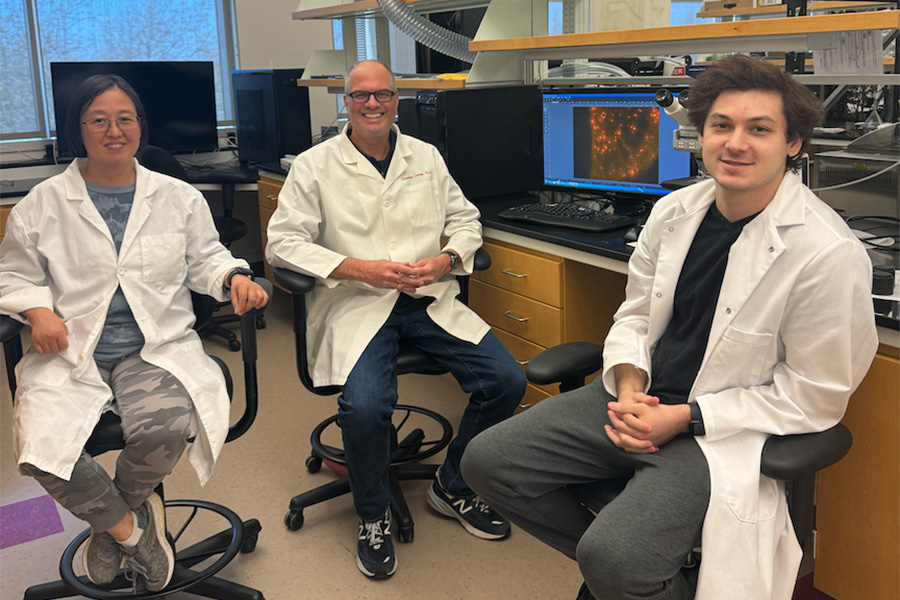
    Jinrong Li, Christian H. Lemon, and Kyle Zumpano
    Jinrong Li, Ph.D., Christian H. Lemon, Ph.D., and graduate student Kyle Zumpano. Credit: Christian H. Lemon

    “We found that the control group with intact TRPM8 receptors preferred to drink mild cool and colder fluids and avoided warmed fluids. Those without the TRPM8 receptor, however, avoided sampling both warm and mild cool fluids,” he said. “This common reaction to cool and warm temperatures agreed with the blurring of these temperature ranges we observed in the brain responses of TRPM8 silenced mice. This receptor appears to be required for the brain to correctly recognize warm temperatures inside the mouth and to distinguish them from cooling.”

    Based on these findings and because temperature is such a big component of oral sensation, Lemon’s team plans to explore how temperature sensory signals from TRPM8 and other pathways affect taste and eating preferences. They believe this could help understand the role of temperature sensing in a unique health-related context.

    “Combining our research findings with those from other labs and other papers will start to tell us the basics of how temperature recognition works in the brain in different settings,” he said. “There’s still a lot of mysteries in the brain that we don’t understand, but the basic principles being defined in studies like ours are the building blocks to future discoveries.”

    Reference: “Separation of Oral Cooling and Warming Requires TRPM8” by Jinrong Li, Kyle T. Zumpano and Christian H. Lemon, 12 March 2024, Journal of Neuroscience.
    DOI: 10.1523/JNEUROSCI.1383-23.2024

    The study was funded by the National Institutes of Health.

    Never miss a breakthrough: Join the SciTechDaily newsletter.
    Follow us on Google and Google News.

    Brain Neuroscience Perception University of Oklahoma
    Share. Facebook Twitter Pinterest LinkedIn Email Reddit

    Related Articles

    New Brain Pathway Reveals Why the Same Touch Feels Different

    Converting Sounds to Actions: Unraveling the Brain’s Split-Second Choices

    How the Brain Links Smells to Places – Transporting Us Across Time and Space

    Gut and Heart Signals Affect How We See Ourselves: Weak Connections Linked to Body Shame and Weight Preoccupation

    Scientists Discover a New Class of Memory Cells in the Brain – The Closest Thing to a “Grandmother Neuron”

    Scientists Solve Long-Standing Brain Mystery by a Whisker

    How the Brain Distinguishes Speech From Noise: New Neural Circuit Identified

    Mother’s Nurturing Results in Larger Hippocampus in Children

    Neuroscientists Study Cortical Areas Specialized in Processing Visual Inputs in Mice

    Leave A Reply Cancel Reply

    • Facebook
    • Twitter
    • Pinterest
    • YouTube

    Don't Miss a Discovery

    Subscribe for the Latest in Science & Tech!

    Trending News

    Monster Storms on Jupiter Unleash Lightning Beyond Anything on Earth

    Scientists Create “Liquid Gears” That Spin Without Touching

    The Simple Habit That Could Help Prevent Cancer

    Millions Take These IBS Drugs, But a New Study Finds Serious Risks

    Scientists Unlock Hidden Secrets of 2,300-Year-Old Mummies Using Cutting-Edge CT Scanner

    Bread Might Be Making You Gain Weight Even Without Eating More Calories

    Scientists Discover Massive Magma Reservoir Beneath Tuscany

    Europe’s Most Active Volcano Just Got Stranger – Here’s Why Scientists Are Rethinking It

    Follow SciTechDaily
    • Facebook
    • Twitter
    • YouTube
    • Pinterest
    • Newsletter
    • RSS
    SciTech News
    • Biology News
    • Chemistry News
    • Earth News
    • Health News
    • Physics News
    • Science News
    • Space News
    • Technology News
    Recent Posts
    • 25-Year Study Uncovers Hidden Paths and Early Warning Signs of Blood Cancer
    • Not Just Snoring – New Research Reveals Sleep Apnea May Be Damaging Your Muscles
    • Scientists Discover a Surprising Reason Intermittent Fasting Extends Life
    • Scientists Discover a New Meteor Shower From a Mysterious Crumbling Asteroid
    • This Simple Fruit Wash Could Make Produce Safer and Last Days Longer
    Copyright © 1998 - 2026 SciTechDaily. All Rights Reserved.
    • Science News
    • About
    • Contact
    • Editorial Board
    • Privacy Policy
    • Terms of Use

    Type above and press Enter to search. Press Esc to cancel.