

Two of the universe’s most extreme objects—black holes and neutron stars—can spiral into cosmic collisions that crack crusts, unleash monster shock waves, and momentarily mimic pulsars.
Scientists at Caltech have used advanced simulations to capture these dramatic events, predicting radio and X-ray flares that could be spotted by telescopes in the final seconds before a neutron star vanishes into a black hole.
Celestial Duets: Black Holes and Neutron Stars
Across the universe, many stars exist in pairs, orbiting each other in a kind of cosmic dance. But some of the most dramatic duos are not stars at all—they’re black holes, the ultra-dense remnants of massive stars that exploded in powerful supernova blasts. When two black holes orbit close together, they eventually spiral inward and collide, forming an even larger black hole.
In other cases, a black hole is partnered with a neutron star. Neutron stars are also born from supernova explosions, but they’re smaller and less massive than black holes. If the two objects get close enough, the black hole usually wins the battle, devouring the neutron star completely.
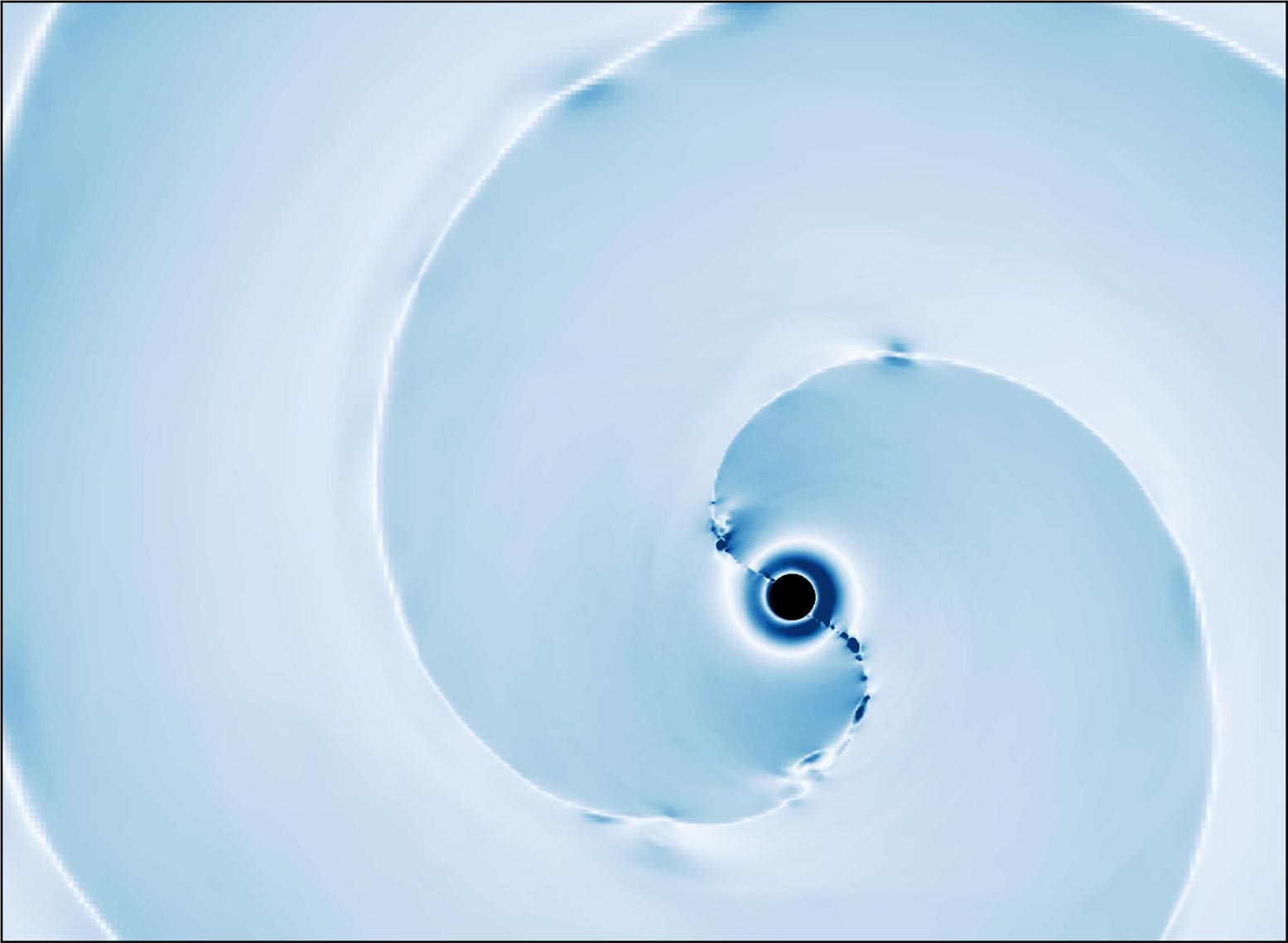
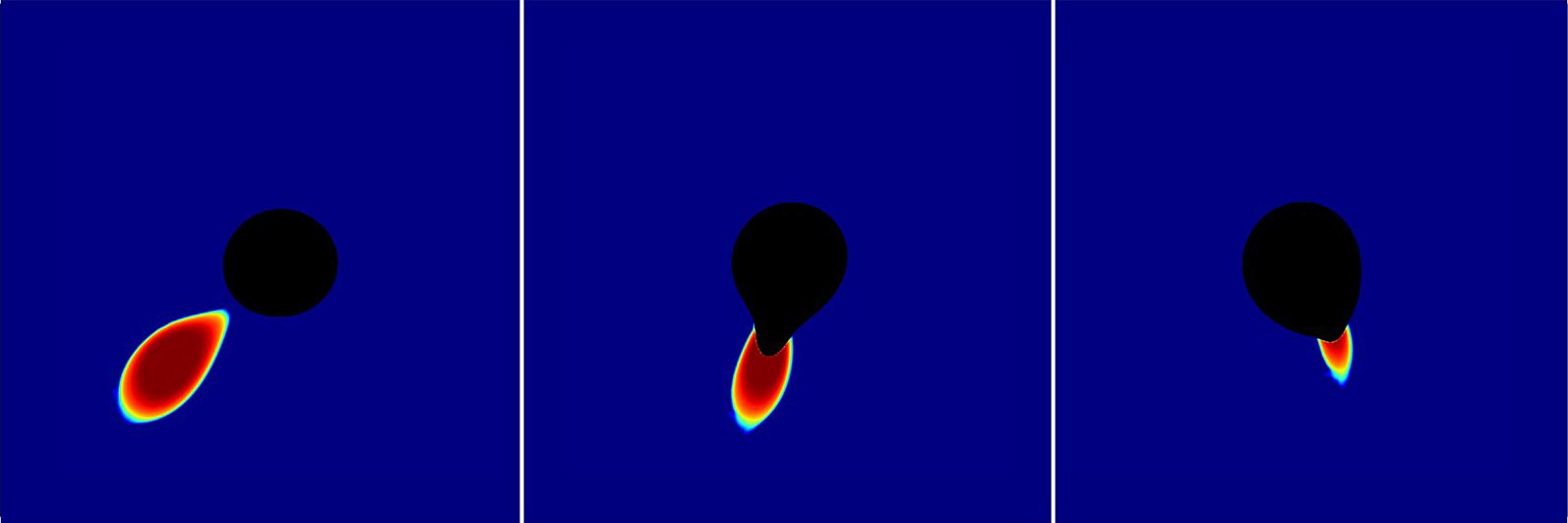
To explore the extreme physics behind this violent cosmic encounter, researchers at Caltech have turned to supercomputers. In a recent study published in The Astrophysical Journal Letters, a team led by theoretical astrophysicist Elias Most created the most detailed simulation yet of what happens just before a neutron star is swallowed. Their model shows how, about one second before the merger, the neutron star’s crust begins to crack apart in a massive quake triggered by the black hole’s intense gravity.
“The neutron star’s crust will crack open just like the ground in an earthquake,” Most says. “The black hole’s gravity first shears the surface, causing quakes in the star and the opening of rifts.”
Visualizing the Unseen: Light From Stellar Cracks
While scientists had long suspected that neutron stars might crack before being consumed, this is the first time a simulation has shown what kind of light flares such an event could produce. These flares could help astronomers detect and study these dramatic mergers using telescopes here on Earth and in space.
“This goes beyond educated models for the phenomenon—it is an actual simulation that includes all the relevant physics taking place when the neutron star breaks like an egg,” says co-author Katerina Chatziioannou, assistant professor of physics at Caltech and a William H. Hurt Scholar.
Birth of Monster Shock Waves
In a second, more recent paper in The Astrophysical Journal Letters, published March 31 of this year, the team used a supercomputer to simulate what happens after the neutron star fractures—a brief milliseconds-long window when monster shock waves, the most powerful predicted shock waves in the universe, shoot outward from the star. These monster shock waves had only recently been predicted by co-author Andrei Beloborodov of Columbia University. Now, the simulation, along with another from a different study published by the team last year, are the first to show how they form.
What is more, the most recent simulation does not stop when the monster shock waves form—it proceeds to show the neutron star being swallowed, which then triggers the creation of an exotic object called a “black hole pulsar.”
Emergence of the Black Hole Pulsar
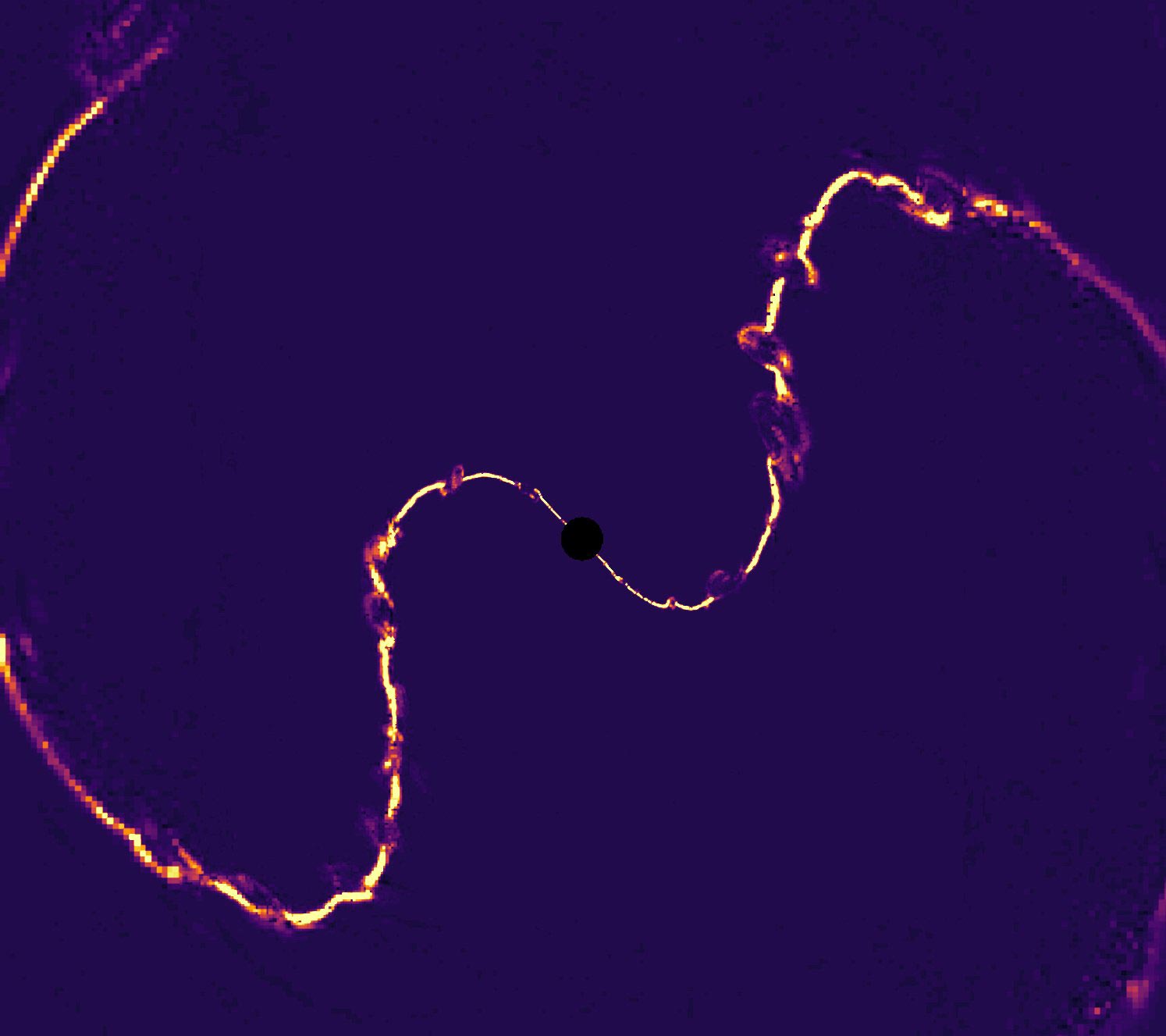
A classic pulsar is a highly magnetized neutron star that emits beams of radiation, which sweep around like a lighthouse beacon as the star spins on its axis. A black hole pulsar is a hypothetical object in which a black hole launches magnetic winds that would also sweep around it as it spins, mimicking the appearance of a pulsar. While black hole pulsars had been previously conjectured, the simulation is the first to show how such a rare object could actually form in nature from the collision of a neutron star and black hole.
“When the neutron star plunges into the black hole, the monster shock waves are launched,” says Yoonsoo Kim (MS ’24), a Caltech graduate student working with Most, and lead author of the study on monster shock waves and black hole pulsars. “After the star is sucked in, whipping winds are formed, creating the black hole pulsar. But the black hole cannot sustain its winds and will become quiet again within seconds.”
Like the simulation depicting how a neutron star cracks, this one also predicts the characteristics of the resulting flares astronomers might see through telescopes. In the fleeting moments when monster shock waves rip outward and a black hole pulsar forms, telescopes may be able to catch outbursts of radio waves or a combination of X-rays and gamma rays. In short, the simulations performed by Most and colleagues provide a deeper understanding of the physics driving some of the most energetic events in the universe.
This snippet from a supercomputer simulation shows the aftermath of a collision between a black hole and a neutron star. After the black hole consumes the magnetized neutron star, a hypothetical object called a “black hole pulsar” is formed, in which magnetic outflows sweep around the black hole as it spins. The thin yellow lines represent the interface where magnetic fields pointing in opposite directions meet. Electric currents form at this interface and heat up plasma, which can power bright gamma and X-ray emissions. This movie covers a period of about eight milliseconds.
Gravitational Waves: Echoes of Violent Collisions
When two black holes collide, they generate not only shock waves and flares of light but also another type of radiation known as gravitational waves. These ripples in the fabric of space and time itself were first predicted more than 100 years ago by Albert Einstein. The Caltech- and MIT-led LIGO (Laser Interferometer Gravitational-wave Observatory), which is funded by the National Science Foundation (NSF), famously made the first direct detection of gravitational waves, generated from the coalescence of two black holes, in 2015. The achievement would later earn three of the collaboration’s leading teammates the 2017 Nobel Prize in Physics.
In 2017, LIGO and Virgo, its European sister observatory, observed a different kind of collision: that between two neutron stars. The fiery explosion, called a kilonova, unleashed a spray of metals, including the element gold. That event emitted both gravitational waves and light. LIGO–Virgo first caught the blast in gravitational waves and then notified astronomers around the world who followed up with telescopes in space and on the ground to detect a broad range of electromagnetic, or light, wavelengths, ranging from high-energy gamma rays to low-energy radio waves.
A Race Against Time: Spotting Mergers Early
Whether a neutron star–black hole collision would also produce a similar light show is not clear, but so far none have been seen. Still, it is possible that the neutron star–black hole mergers, even if they fail to produce a cloud of glowing material, might flash with brief radio and/or other electromagnetic signals right before and during the collisions. Simulations like those from Most and his colleagues help astronomers know which electromagnetic signals to look for.
To aid in the hunt for these precursor signals, the LIGO team is working to detect mergers up to a minute before they occur, which would give astronomers more time to point their telescopes at the blasts and search for tell-tale signs of an impending crash.
“LIGO can detect mergers before they happen because the pair of colliding objects emit gravitational waves in the frequency band that LIGO detects as they spiral closer and closer together,” says Chatziioannou, who is part of the LIGO team. “Currently, we can detect the collisions just seconds before they occur, and we are working up to a full minute. The gravitational waves are one piece of the puzzle while the electromagnetic radiation is another. We want to put the puzzle pieces together.”
The Most Advanced Computers
A major factor in the success of the team’s recent neutron star–black hole simulations is the use of supercomputers containing GPUs (graphics processing units). For these recent studies, the team used the Perlmutter supercomputer located at the Lawrence Berkeley National Laboratory in Berkeley (named after astronomer Saul Perlmutter, who won the 2011 Nobel Prize in Physics with two other scientists for discovering that the universe is accelerating). GPUs provide processing power for video games and AI programs like ChatGPT; in this case, the massive parallel computing power of GPUs allowed the Perlmutter supercomputer to handle the codes needed to simulate the intricate interactions between a converging neutron star and black hole.
“When you simulate two black holes merging,” Most says, “you need the equations of general relativity to describe the gravitational waves. But when you have a neutron star, there’s a lot more physics taking place including the complex nuclear physics of the star and plasma dynamics around it.”
The actual simulations take about four to five hours to run. Most and his team had been working on similar simulations for about two years using supercomputers without GPUs before they ran them on Perlmutter. “That’s what unlocked the problem,” Most says. “With GPUs, suddenly, everything worked and matched our expectations. We just did not have enough computing power before to numerically model these highly complex physical systems in a sufficient detail.”
The Physics Behind the Fracture
The first cracking simulation reveals the drama of what unfolds as the neutron star gets close to its partner black hole. First, gravitational forces from the massive black hole shear the dead star’s surface, causing it to shatter. Neutron stars are surrounded by an intense magnetic field, and when their surface shatters due to these so-called tidal forces, the magnetic field wiggles around. This leads to magnetic ripples called Alfvén waves, named after the Swedish physicist Hannes Alfvén who won the 1970 Nobel Prize in Physics for his work on magnetohydrodynamics, a theory that describes how electromagnetic fields behave in a plasma.
“The magnetic field can be thought of as strings attached to the neutron star,” Most says. “The neutron star’s quake violently shakes these strings like a whip, and then it makes a cracking sound.”
The Alfvén waves eventually transform into a blast wave that produces a burst of radio waves about a second before the neutron star is swallowed. In the future, Caltech’s planned Deep Synoptic Array-2000, or DSA-2000—an array of 2,000 radio dishes to be built in the Nevada desert—may be able to pick up these radio wave bursts, (called fast radio bursts or FRBs), indicating the death of the neutron star.
“Before this simulation, people thought you could crack a neutron star like an egg, but they never asked if you could hear the cracking,” Most says. “Our work predicts that, yes, you could hear or detect it as a radio signal.”
The Monster Shock Wave
The team’s second simulation reveals what happens further along in the neutron’s star demise. When the dead star is slurped up by the black hole, some of the strongest shock waves in the universe are produced.
“It’s like an ocean wave,” Kim says. “The ocean is initially quiet, but as the waves come ashore, they steepen until they finally break. In our simulation, we can see the magnetic field waves break into a monster shock wave.”
Those monster shock waves would convert into blast waves that are stronger than the ones generated by the neutron star’s cracking, and they too would produce radio signals. That means astronomers observing a neutron star and black hole in the second before they collide might detect two radio signals, one after the other.
“What this means is that a neutron star-black hole collision, while it might not erupt with material like a neutron star–neutron star collision, could power strong signals that telescopes can detect,” Most says.
Fleeting Echoes of a Star’s End
Finally, after the neutron star is gulped down by the black hole, the second simulation shows how a black hole pulsar is born.
“If the black hole eats up the neutron star, it’s also eating up its magnetic field,” Most explains. “And it needs to get rid of that. The black hole doesn’t want the magnetic field; it repels it. What the simulation shows is that it actually does that in a way that forms a state that looks like a pulsar.”
The black hole essentially drags the unwanted magnetic field around with it, and this creates magnetic winds that whip around the black hole, making it resemble a pulsar for a brief period lasting just under a second. The data show that such an event would emit a short burst of high-energy X-rays and/or higher-energy gamma rays.
In the future, the researchers hope to explore whether this same phenomenology extends to other types of binary systems. With the help of supercomputers, they aim to unravel the wondrous physics driving the universe’s most cataclysmic events.
References:
“Nonlinear Alfvén-wave Dynamics and Premerger Emission from Crustal Oscillations in Neutron Star Mergers” by Elias R. Most, Yoonsoo Kim, Katerina Chatziioannou and Isaac Legred, 20 September 2024, The Astrophysical Journal Letters.
DOI: 10.3847/2041-8213/ad785c
“Black Hole Pulsars and Monster Shocks as Outcomes of Black Hole–Neutron Star Mergers” by Yoonsoo Kim, Elias R. Most, Andrei M. Beloborodov and Bart Ripperda, 31 March 2025, The Astrophysical Journal Letters.
DOI: 10.3847/2041-8213/adbff9
The neutron-star cracking study, titled “Nonlinear Alfvén-wave Dynamics and Premerger Emission from Crustal Oscillations in Neutron Star Mergers,” was funded by NSF and the Simons Foundation. Other authors include Caltech graduate student Isaac Legred (MS ’24).
The monster shock waves and black hole pulsar study, titled “Black Hole Pulsars and Monster Shocks as Outcomes of Black Hole–Neutron Star Mergers,” was funded by the Sherman Fairchild Foundation, NSF, NASA, Natural Sciences & Engineering Research Council of Canada, the Canadian Space Agency, and the Simons Foundation. Other authors include Bart Ripperda from the Canadian Institute for Theoretical Astrophysics.
Never miss a breakthrough: Join the SciTechDaily newsletter.
Follow us on Google and Google News.
2 Comments
Very well written article. Thanks.
Great information! Thanks!