
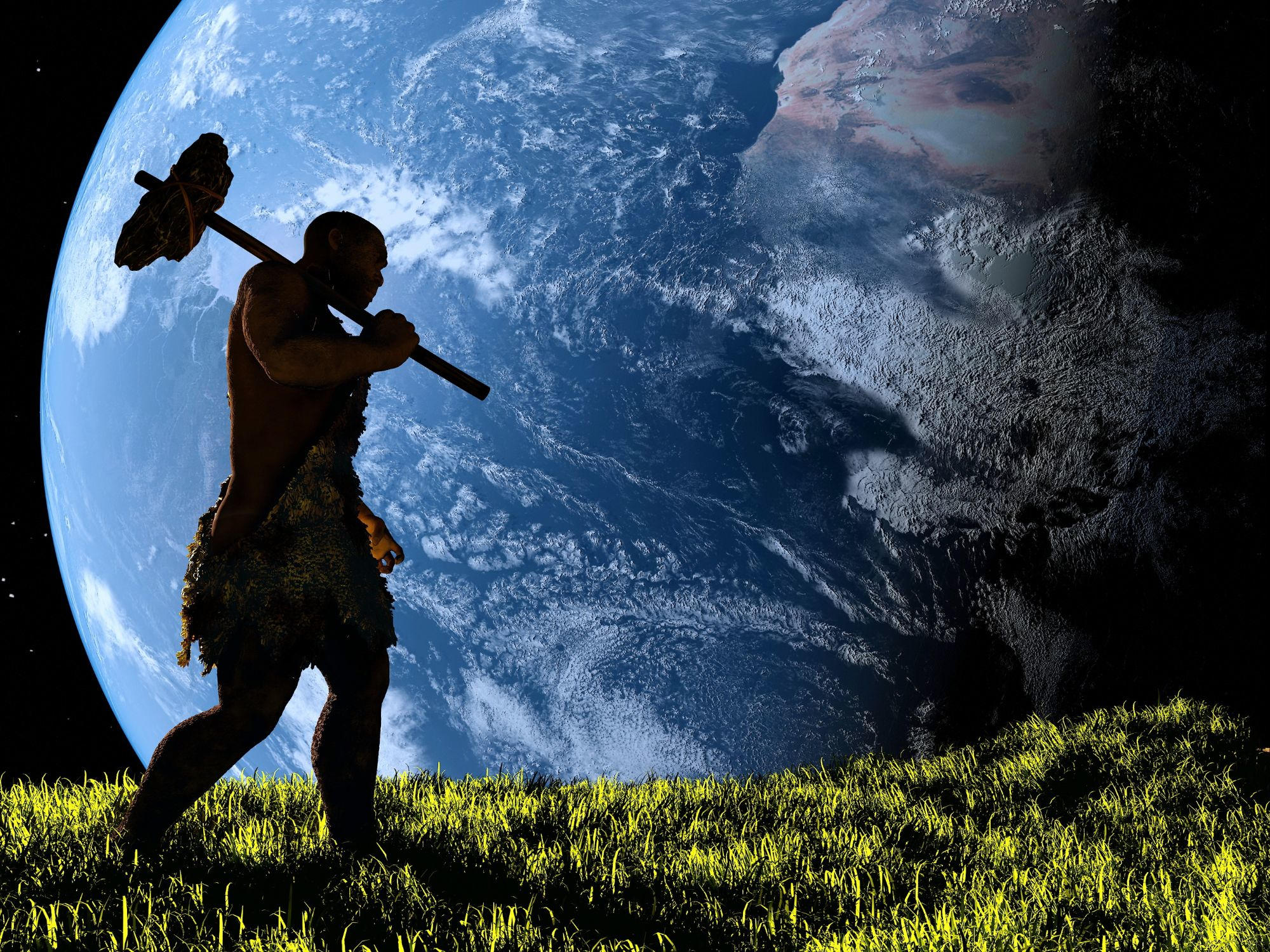
An ASU evolutionary anthropologist offers a groundbreaking theory on why humans have come to dominate the world over other animals.
Why is human culture — the shared body of knowledge passed down across generations — so much more powerful than animal cultures?
“What’s special about our species?” is a question scientists have wrestled with for centuries, and now a scientist at Arizona State University has a new hypothesis that could change the way we perceive ourselves, and the world around us.
“Ten years ago it was basically accepted that it was the ability of human culture to accumulate and evolve that made us special, but new discoveries about animal behavior are challenging these ideas and forcing us to rethink what makes our cultures, and us as a species, unique,” said evolutionary anthropologist Thomas Morgan in a new research paper published in Nature Human Behavior.
Morgan is a research scientist with the Institute of Human Origins and associate professor with the School of Human Evolution and Social Change.
Just as humans pass on knowledge to our children, when a new queen leafcutter ant hatches, she collects a little mouthful of her mother’s fungus and takes it with her to start a new colony. This has been happening for so long — millions of years — that the fungus within these colonies is genetically different from the wild fungus outside of the colonies.
Similar to how human languages change, new data shows that humpback whale songs evolve, spread between groups and become more complex over time. Like humans, chimpanzees learn to use tools and we now have evidence that they have been doing so for thousands, perhaps millions, of years. Even locusts use complex evolving systems to adapt to local conditions, relying on epigenetic changes – how factors like age and environment can change gene activity without altering DNA sequence – to quickly evolve between calm and green or swarming and yellow-and-black forms based on overpopulation.
These discoveries, along with others, have shown that not only do animals have culture, but there are also examples of accumulation in their culture, something that for a long time was believed to be uniquely human.
“It used to be thought that other species just didn’t have culture,” said Morgan. “And now we know that lots of other species do. Then it was thought that only human cultures accumulate or evolve over time. But now we know animal cultures can do this too. So, if animals do have evolving cultures, then what’s special about human culture that differentiates us from other animals?”
Open-endedness
Morgan and Stanford University Professor Marcus Feldman address this question in a new paper published in Nature Human Behaviour.
They present a new hypothesis: that we humans dominate and are so special because of “open-endedness,” – our ability to communicate and understand an infinite number of possibilities in life.
“The way that animals think about what they’re doing constrains the way that their cultures can evolve,” said Morgan. “One way might be that they can’t imagine elaborate sequences very easily, or they can’t imagine subgoals.”
“For example, when I’m making my boys’ breakfast in the morning, it’s a nested, multistep process. First, I need to get the bowls and pots and other equipment. Then I need to put the ingredients in the pot and start cooking, all in the right amounts and order. Then I need to cook it, stirring and monitoring temperature until it reaches the right consistency, and then I need to serve it up,” he said.
“Each of these steps is a subgoal, and these subgoals have steps within them that I need to execute in the right order, so this whole thing is an elaborate procedure.”
When it comes to the limit of this system, human brains just keep going; we are able to build and retain sequences of instructions that are deeply complicated and this allows us to perform a near-infinite set of behaviors – this is open-endedness.
Beyond culture
While other scientists have compared human and animal cultures before, Morgan and Feldman’s research is unusual because it also compares animal examples of epigenetic inheritance and parental effects. The leafcutter ants is an example of a parental effect and the locust an example of cumulative epigenetic inheritance.
While both epigenetic inheritance and parental effects are stable and accumulate in non-human species, they eventually stop developing, explains Morgan. “Just like animal cultures, there are constraints that these systems run-up against and that halt their evolution.”
“I think the key question is what is special about human culture, and we tried to answer that by comparing human cultures with animal cultures, with epigenetics, and with parental effects – as many evolving systems as we can think of. And in the end, we concluded that the special thing about human culture is its open-endedness. It can accumulate but then it never has to stop, it just keeps going.”
Reference: “Human culture is uniquely open-ended rather than uniquely cumulative” by Thomas J. H. Morgan, and Marcus W. Feldman, 7 November 2024, Nature Human Behaviour.
DOI: 10.1038/s41562-024-02035-y
Never miss a breakthrough: Join the SciTechDaily newsletter.
Follow us on Google and Google News.