
Potential Pitfalls in Gravitational Wave Catalog Analysis
Small modeling errors may accumulate faster than previously expected when physicists combine multiple gravitational wave events (such as colliding black holes) to test Albert Einstein’s theory of general relativity, suggest researchers at the University of Birmingham in the United Kingdom.
The findings, published on June 16, 2021, in the journal iScience, suggest that catalogs with as few as 10 to 30 events with a signal-to-background noise ratio of 20 (which is typical for events used in this type of test) could provide misleading deviations from general relativity, erroneously pointing to new physics where none exists. Because this is close to the size of current catalogs used to assess Einstein’s theory, the authors conclude that physicists should proceed with caution when performing such experiments.
“Testing general relativity with catalogs of gravitational wave events is a very new area of research,” says Christopher J. Moore, a lecturer at the School of Physics and Astronomy & Institute for Gravitational Wave Astronomy at the University of Birmingham in the United Kingdom and the lead author of the study. “This is one of the first studies to look in detail at the importance of theoretical model errors in this new type of test. While it is well known that errors in theoretical models need to be treated carefully when you are trying to test a theory, we were surprised by how quickly small model errors can accumulate when you start combining events together in catalogs.”
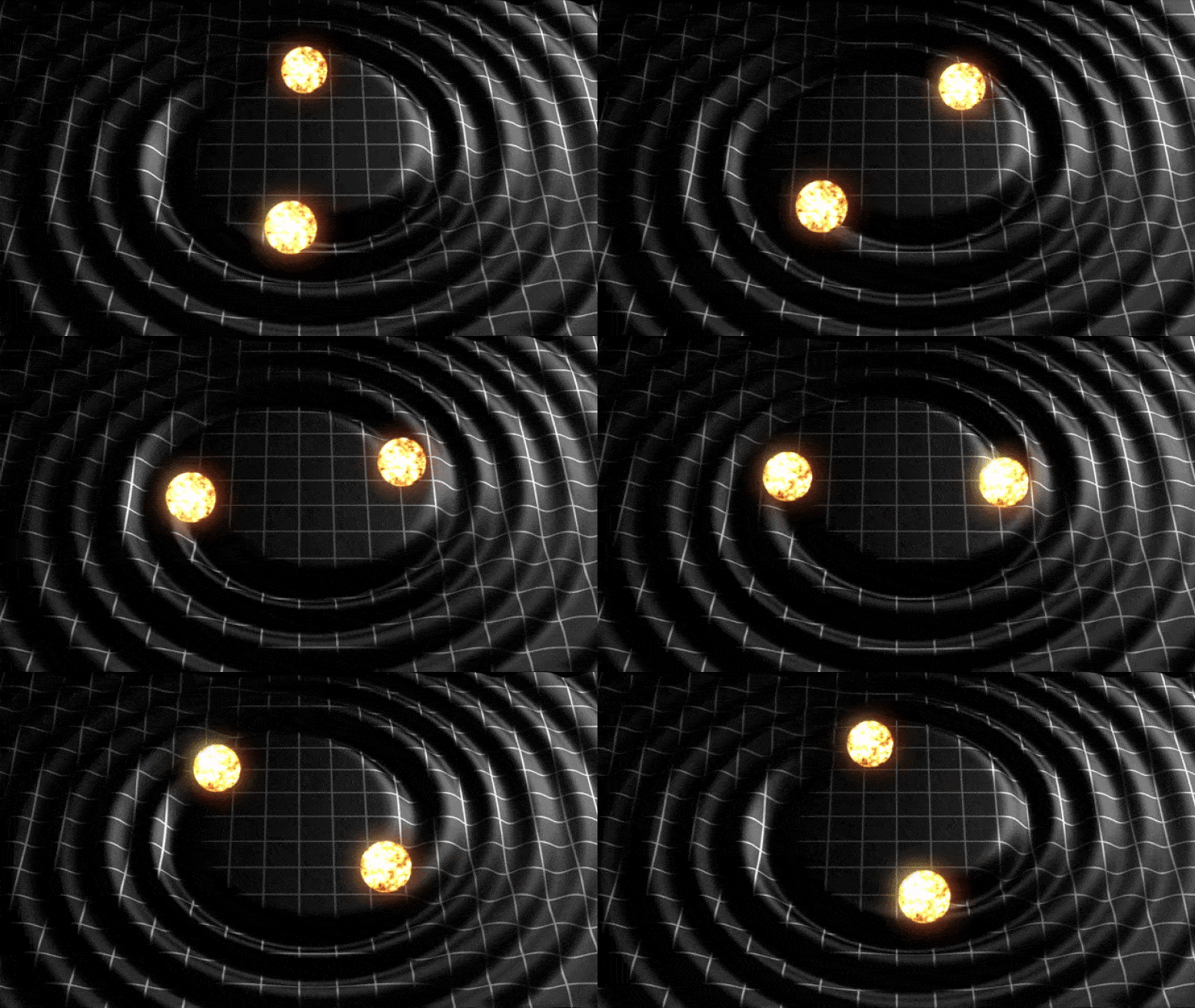
In 1916, Einstein published his theory of general relativity, which explains how massive celestial objects warp the interconnected fabric of space and time, resulting in gravity. The theory predicts that violent outer space incidents such as black hole collisions disrupt space-time so severely that they produce ripples called gravitational waves, which zoom through space at the speed of light. Instruments such as LIGO and Virgo have now detected gravitational wave signals from dozens of merging black holes, which researchers have been using to put Einstein’s theory to the test. So far, it has always passed. To push the theory even further, physicists are now testing it on catalogs of multiple grouped gravitational wave events.
“When I got interested in gravitational wave research, one of the main attractions was the possibility to do new and more stringent tests of general relativity,” says Riccardo Buscicchio, a PhD student at the School of Physics and Astronomy & Institute for Gravitational Wave Astronomy and a co-author of the study. “The theory is fantastic and has already passed a hugely impressive array of other tests. But we know from other areas of physics that it can’t be completely correct. Trying to find exactly where it fails is one of the most important questions in physics.”
Waveform Models and the Risk of Compounding Errors
However, while larger gravitational wave catalogs could bring scientists closer to the answer in the near future, they also amplify the potential for errors. Since waveform models inevitably involve some approximations, simplifications, and modeling errors, models with a high degree of accuracy for individual events could prove misleading when applied to large catalogs.
To determine how waveform errors grow as catalog size increases, Moore and colleagues used simplified, linearized mock catalogs to perform large numbers of test calculations, which involved drawing signal-to-noise ratios, mismatch, and model error alignment angles for each gravitational wave event. The researchers found that the rate at which modeling errors accumulate depends on whether or not modeling errors tend to average out across many different catalog events, whether deviations have the same value for each event, and the distribution of waveform modeling errors across events.
“The next step will be for us to find ways to target these specific cases using more realistic but also more computationally expensive models,” says Moore. “If we are ever to have confidence in the results of such tests, we must first have as a good an understanding as possible of the errors in our models.”
Reference: “Testing general relativity with gravitational-wave catalogs: the insidious nature of waveform systematics” by Christopher J. Moore, Eliot Finch, Riccardo Buscicchio and Davide Gerosa, 16 June 2021, iScience.
DOI: 10.1016/j.isci.2021.102577
This work was supported by a European Union H2020 ERC Starting Grant, the Leverhulme Trust, and the Royal Society.
Never miss a breakthrough: Join the SciTechDaily newsletter.
Follow us on Google and Google News.
7 Comments
Wouldn’t the error lie in the fact that time is only relevant to the observer? Without taking into account the theory of an expanding universe it’s hard to pinpoint an observer.
…in another words if you are driving in a truck with big tiers you don’t feel a thing, but if you are using a bike you would fill the difference …
Wouldnt gravitational waves over lap and interfere w each other ? Wouldnt massive objects alter the intensity of the waves over light years of space n time ?
Gàĺaxìès’ ròtation wiĺl çause the error in measurement of reĺativìty.Bùt as this is an arbitŕary random effect and variabĺe is ùnàbĺe to prodùce any proportional ŕesuĺt
Standard model is a joke pure BS stacked up . we live in a plasma universe electricity and plasma is all that you need from the universe to the atom electricity rules the show. There are no islands in space. Black holes are plasmoids relativity is wrong. Stars are electric powered from outside thru birkland currents
I am afraid we are creating a theory to justify a gravitational assumption. If we have droughts about the theoretical basis we should gracefully abandon it. The other problem I see science and theories are becoming political battles rather a true quest for the truth and reality.
Does that mean that the space time theory is not good.