
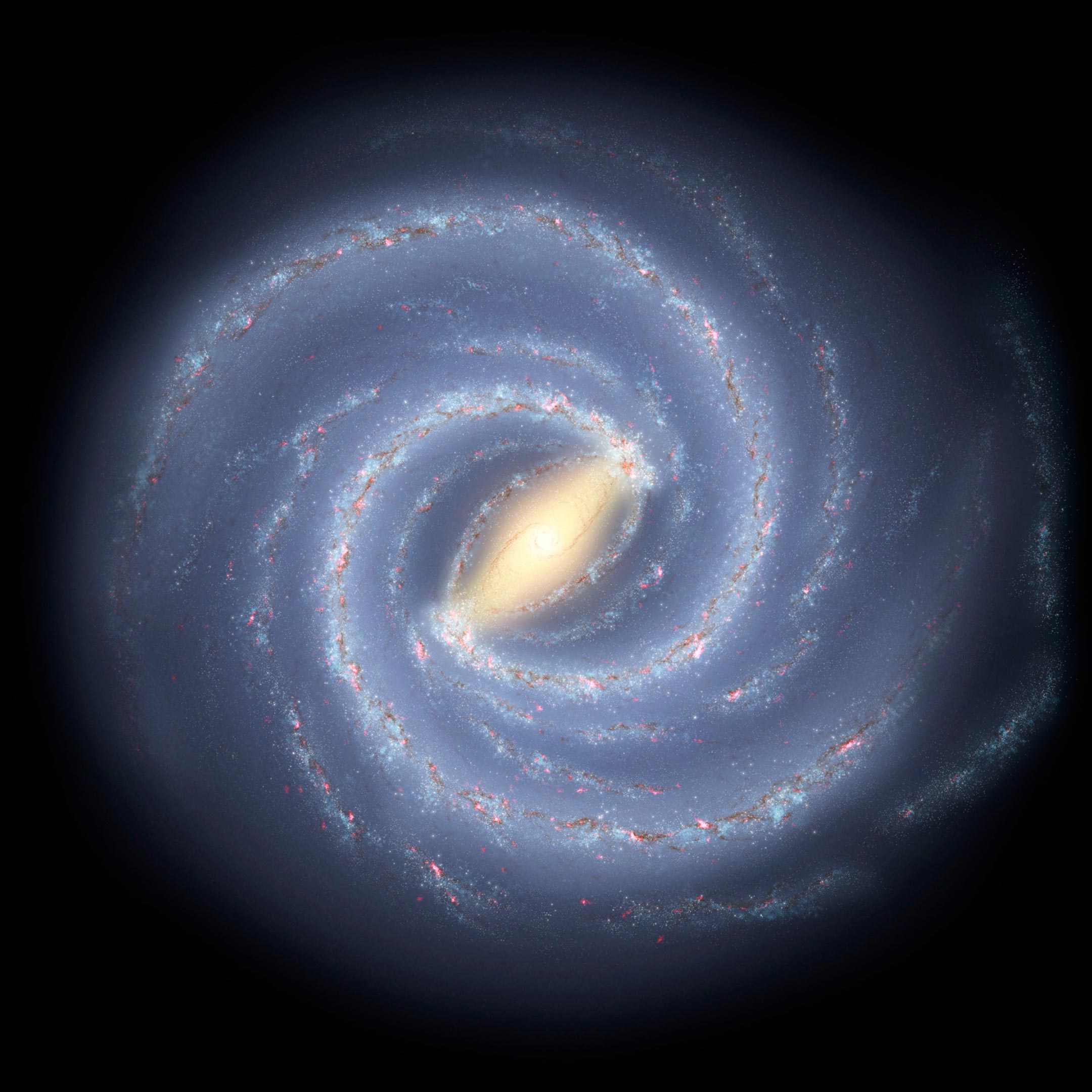
A halo is a large region filled with hot gas that surrounds a galaxy, also known as a “circumgalactic medium.” The heated gaseous halo around the Milky Way was the incubator for the Milky Way’s formation some 13 billion years ago and could help solve a longstanding puzzle about where the missing matter of the universe might reside.
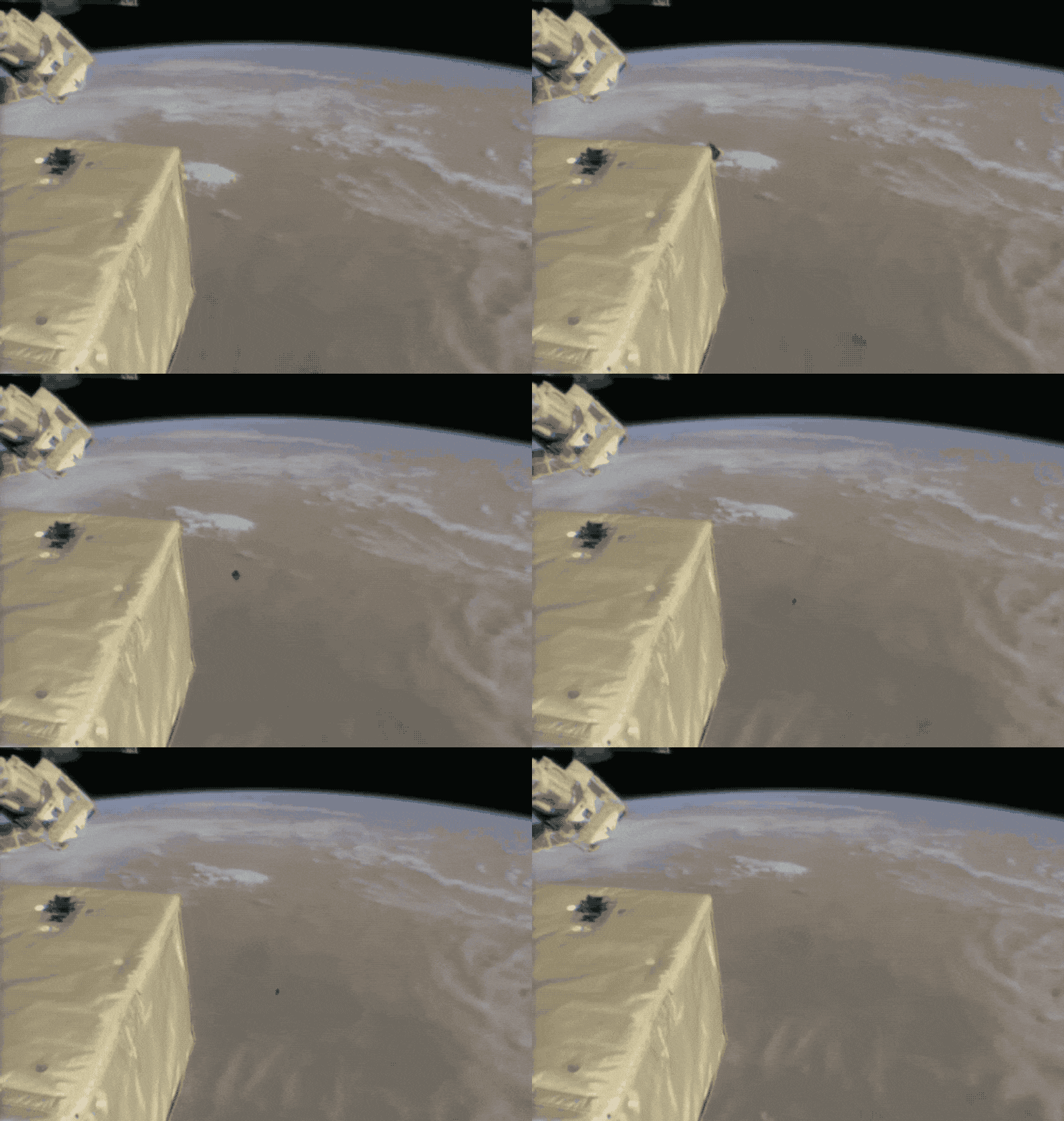
The new findings come from observations made by a small spacecraft called HaloSat. It is in a class of minisatellites called CubeSats and is roughly the size of a toaster, measuring 4-by-8-by-12 inches (about 10-by-20-by-30 centimeters) and weighing about 26 pounds (12 kilograms). Built by the University of Iowa, HaloSat was launched from the International Space Station in May 2018 and is the first CubeSat funded by NASA’s Astrophysics Division.
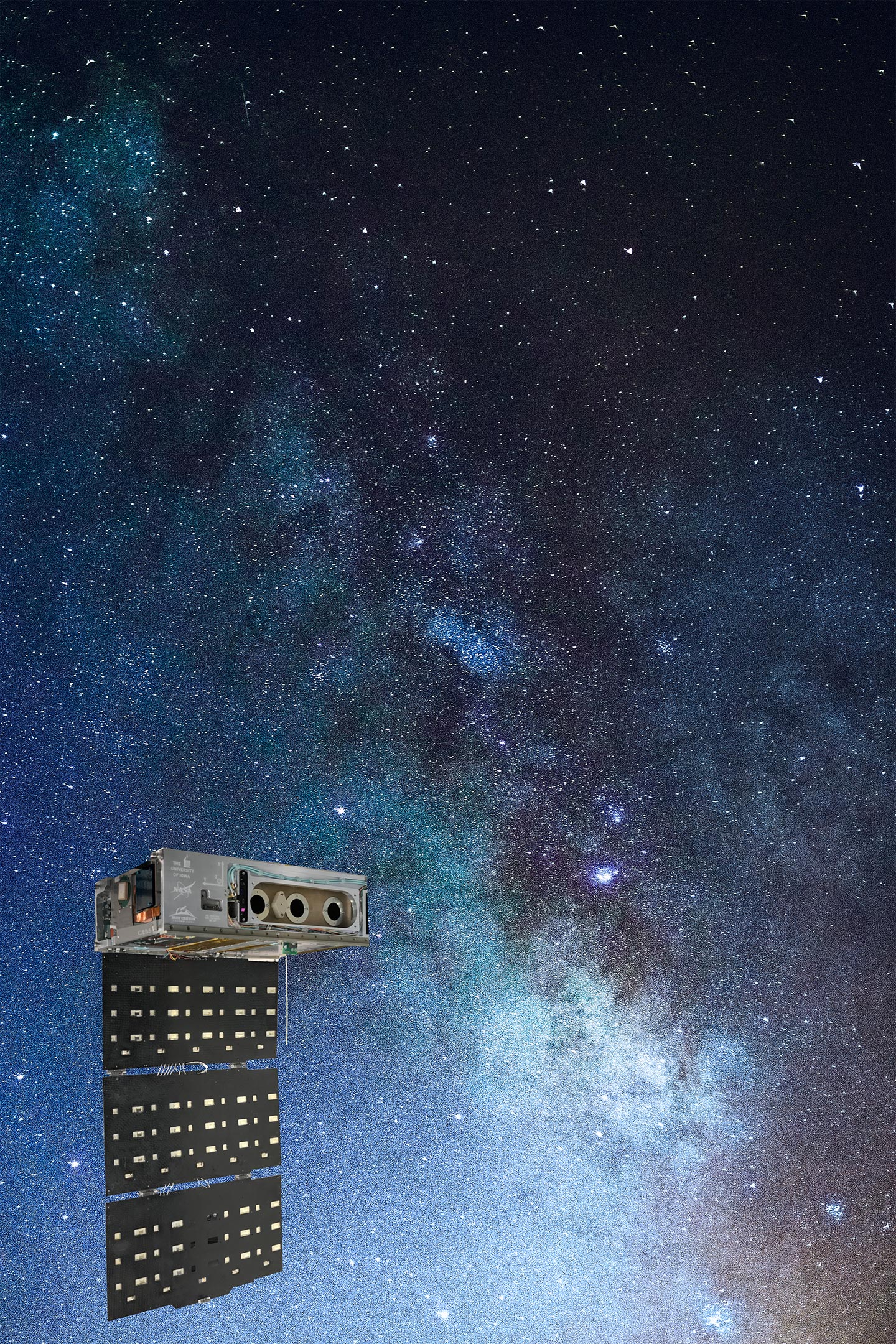
While tiny compared to NASA’s Chandra X-ray Observatory, HaloSat’s X-ray detectors view a much wider piece of the sky at once and therefore are optimized to doing the sort of wide-area survey needed to measure the galactic halo.
Because of their small size, CubeSats allow NASA to conduct low-cost scientific investigations in space. Six CubeSats to date have been selected in this Astrophysics Division series.
In the new study, researchers conclude the circumgalactic medium has a disk-like geometry, based on the intensity of X-ray emissions coming from it.
“The X-ray emissions are stronger above the parts of the Milky Way where star formation is more vigorous,” says Philip Kaaret, professor in the Department of Physics and Astronomy at Iowa and corresponding author on the study. “That suggests the circumgalactic medium is related to star formation, and it is likely we are seeing gas that previously fell into the Milky Way, made stars, and now is being recycled into the circumgalactic medium.”
Every galaxy has a circumgalactic medium, and these regions are crucial to understanding not only how galaxies formed and evolved but also how the universe progressed from a kernel of helium and hydrogen to a cosmological expanse teeming with stars, planets, comets, and all other sorts of celestial constituents.
HaloSat searches for baryonic matter — that is, the same kind of particles that compose the visible world — believed to be missing since the universe’s birth nearly 14 billion years ago. The satellite has been observing the Milky Way’s circumgalactic medium for evidence that the missing baryonic matter may reside there. Baryonic matter is distinct from dark matter, which is invisible and does not interact through any force except gravity. Scientists can only account for about two-thirds of the baryonic matter that should be present in the universe.
To look for the missing matter, Kaaret and his team wanted to get a better handle on the circumgalactic medium’s configuration.
More specifically, the researchers wanted to find out how big the circumgalactic medium really is. If it’s a huge, extended halo that is many times the size of our galaxy, it could house enough material to solve the missing baryon question. But if the circumgalactic medium is mostly comprised of recycled material, it would be a relatively thin, puffy layer of gas and an unlikely host of the missing baryonic matter.
“What we’ve done is definitely show that there’s a high-density part of the circumgalactic medium that’s bright in X-rays,” Kaaret says. “But there still could be a really big, extended halo that is just dim in X-rays. And it might be harder to see that dim, extended halo because there’s this bright emission disk in the way.
“So it turns out with HaloSat alone, we really can’t say whether or not there really is this extended halo” around the Milky Way, Kaarat says.
Kaaret says he was surprised by the circumgalactic medium’s clumpiness, expecting its geometry to be more uniform. The denser areas are regions where stars are forming, and where material is being traded between the Milky Way and the circumgalactic medium.
“It seems as if the Milky Way and other galaxies are not closed systems,” Kaaret says. “They’re actually interacting, throwing material out to the circumgalactic medium and bringing back material as well.”
The next step is to combine the HaloSat data with data from other X-ray observatories to determine whether there’s an extended halo surrounding the Milky Way, and if it’s there, to calculate its density. That, in turn, could solve the missing baryonic matter puzzle.
“Those missing baryons better be somewhere,” Kaaret says. “They’re in halos around individual galaxies like our Milky Way or they’re located in filaments that stretch between galaxies.”
Read HaloSat Reveals the Milky Way Galaxy Is Surrounded by a Heated, Clumpy Halo for more on this research.
The study is titled, “A disc-dominated and clumpy circumgalactic medium of the Milky Way seen in X-ray emission.” Study co-authors include Jesse Bluem, a graduate student in physics at Iowa; Hannah Gulick, a graduate student in astronomy at the University of California, Berkeley who graduated from Iowa last May; Daniel LaRocca, who earned his doctorate at Iowa last July and is now a postdoctoral researcher at Pennsylvania State University; Rebecca Ringuette, a postdoctoral researcher with Kaaret who joined NASA’s Goddard Space Flight Center this month; and Anna Zayczyk, a former postdoctoral researcher with Kaaret and a research scientist at both NASA Goddard and University of Maryland, Baltimore County.
Reference: “A disk-dominated and clumpy circumgalactic medium of the Milky Way seen in X-ray emission” by P. Kaaret, D. Koutroumpa, K. D. Kuntz, K. Jahoda, J. Bluem, H. Gulick, E. Hodges-Kluck, D. M. LaRocca, R. Ringuette and A. Zajczyk, 19 October 2020, Nature Astronomy.
DOI: 10.1038/s41550-020-01215-w
HaloSat is a NASA CubeSat mission led by the University of Iowa in Iowa City. Additional partners include NASA’s Goddard Space Flight Center in Greenbelt, Maryland, NASA’s Wallops Flight Facility on Wallops Island, Virginia, Blue Canyon Technologies in Boulder, Colorado, Johns Hopkins University in Baltimore and with important contributions from partners in France. HaloSat was selected through NASA’s CubeSat Launch Initiative as part of the 23rd installment of the Educational Launch of Nanosatellites missions.
Never miss a breakthrough: Join the SciTechDaily newsletter.
Follow us on Google and Google News.