
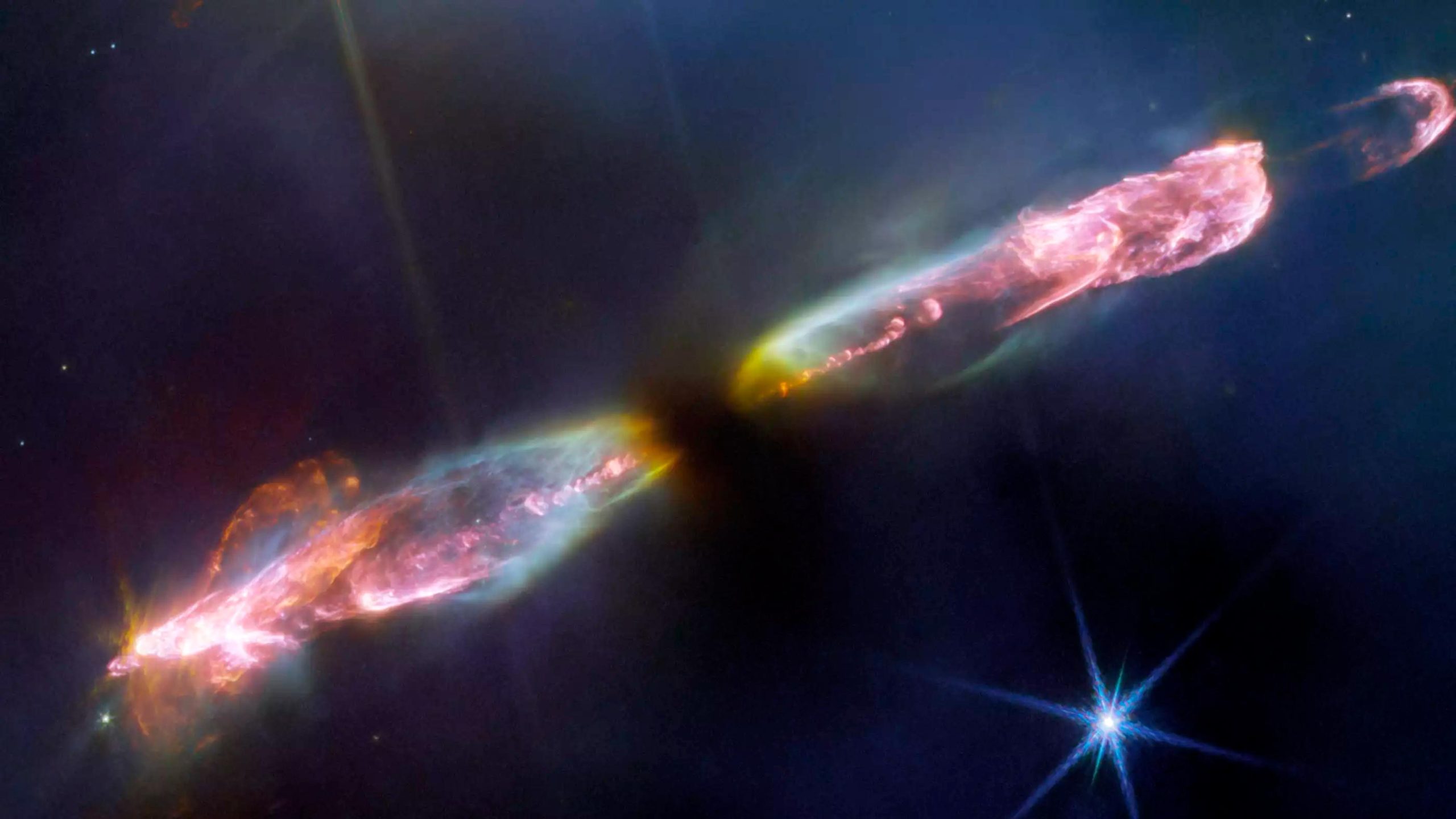
JWST’s detailed infrared image of HH 211 uncovers the dynamics of a young protostar’s outflows, offering new insights into early star formation, including the slow movement and molecular nature of the ejected material.
The so-called Herbig-Haro objects (HHs) are luminous jets of gas signaling the growth of infant stars. Using the NASA/ESA/CSA James Webb Space Telescope (JWST), an international team of astronomers, involving scientists from the Max Planck Institute for Astronomy (MPIA), have obtained a spectacular image of HH 211, a bipolar jet traveling through interstellar space at supersonic speeds. At roughly 1,000 light-years away from Earth in the constellation Perseus, the object is one of the youngest and nearest protostellar outflows, making it an ideal target for the JWST.
Introduction to Herbig-Haro Objects
Herbig-Haro objects surround newborn stars and are formed when stellar winds or jets of gas spewing from these newborn stars form shockwaves colliding with nearby gas and dust at high speed. A new exciting JWST image of HH 211 reveals an outflow from a Class 0 protostar, an infantile analog of our Sun when it was no more than a few tens of thousands of years old and with a mass of only 8% of the present-day Sun (it will eventually grow into a star like the Sun). Protostars have not yet reached the stage of nuclear fusion.
Infrared Imaging and Stellar Insights
Infrared imaging is powerful in studying newborn stars and their outflows because such stars are invariably still embedded within the gas from the molecular cloud in which they formed. The infrared emission of the star’s outflows penetrates the obscuring gas and dust, making a Herbig-Haro object like HH 211 ideal for observation with JWST’s sensitive infrared instruments. Molecules excited by the turbulent conditions, including molecular hydrogen, carbon monoxide, and silicon monoxide, emit infrared light that JWST can collect to map out the structure of the outflows.
Details Unveiled by JWST
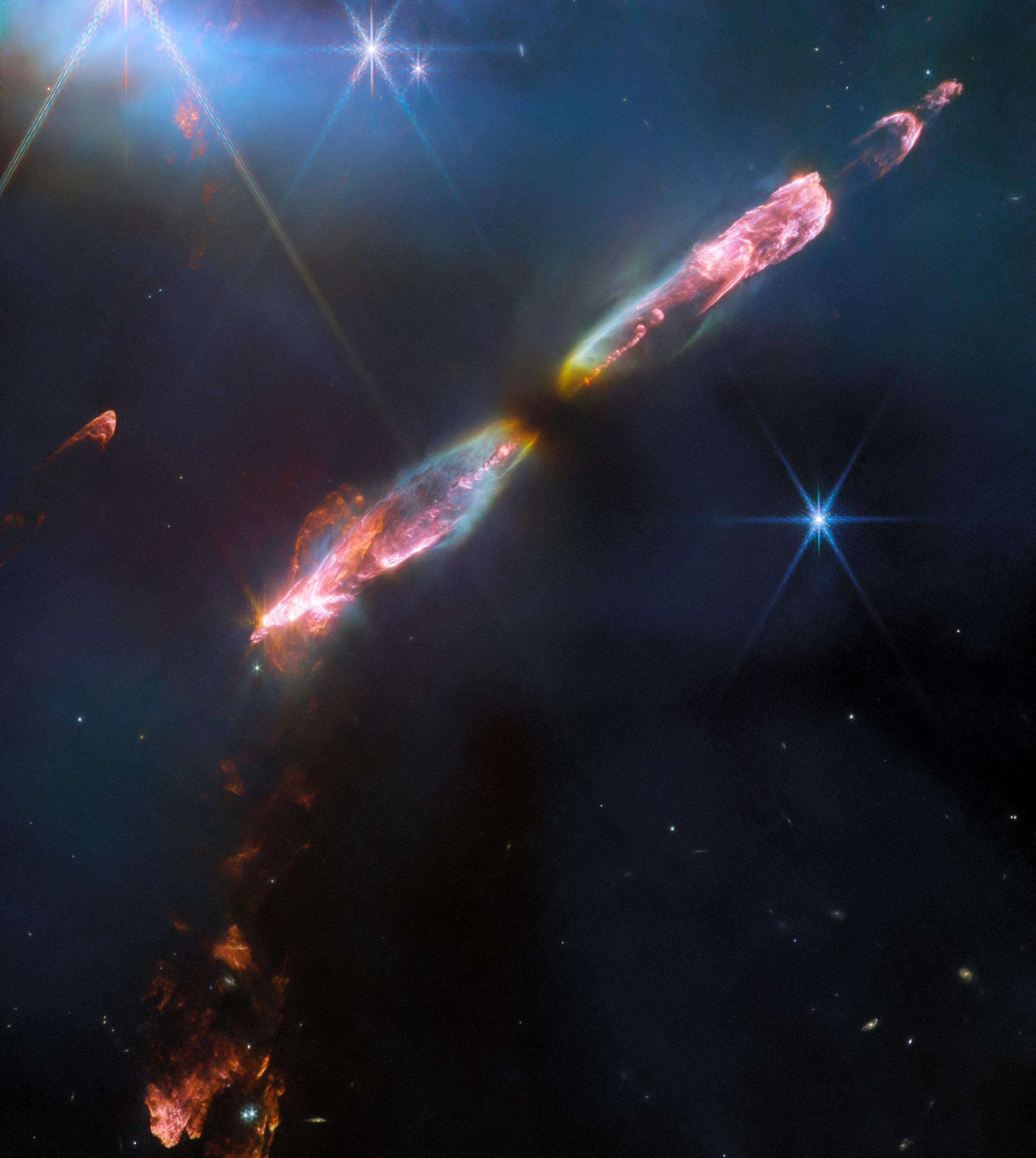
The image taken with the NIRCam instrument showcases a series of bow shocks, i.e. radiation triggered by gas collisions, to the southeast (lower-left) and northwest (upper-right), as well as the embedded narrow bipolar jet that powers them in unprecedented detail — roughly 5 to 10 times higher spatial resolution than any previous images of HH 211. This series of shock events indicates an episodic release of gas, which is directly related to the growth of the protostar by infalling dust and gas.
Inner Jet Observations and Binary Star Possibilities
The inner jet is seen to “wiggle” with mirror symmetry on either side of the central protostar. This is in agreement with observations on smaller scales and suggests that the protostar may, in fact, be an unresolved binary star.
“Such observations with the JWST do not only produce stunning images. They also provide us with a tool to study the maturation of the direct predecessors of stars in unprecedented detail,” says Thomas Henning, director of the Max Planck Institute for Astronomy (MPIA) in Heidelberg, Germany. “Thus, the observations generate invaluable information in our quest to understand star formation.”
Advancements in Observing Gas Motion
Earlier observations of HH 211 with ground-based telescopes showed gas motion along the outflow by measuring a wavelength shift in the emitted radiation. Now, the team found huge red-shifted (northwest) and blue-shifted (southeast) bow shocks and cavity-like structures in the light of shock-excited hydrogen and carbon monoxide, respectively, and a knotted and meandering double-sided jet in the light of silicon monoxide. With these new observations with NIRCam and NIRSpec on board the JWST, the researchers found that the object’s gas flow is relatively slow compared to similar but more evolved protostars.
Outflow Velocity Measurements
The team measured the velocities of the innermost outflow structures to be roughly 80 to 100 kilometers per second. However, the difference in velocity between these sections of the outflow and the leading material they’re colliding with – the shockwave velocity – is much smaller. They concluded that outflows from the youngest stars, like that in the center of HH 211, are mostly made up of molecules due to the comparatively low shockwave velocities, which are not energetic enough to break the molecules apart into simpler atoms and ions.
For more on this observation, see Webb Captures Supersonic Outflow From a Newborn Star.
More Information
The MPIA scientists involved in this research are H. Beuther (Co-I), Th. Henning, M. Güdel (also ETH Zürich, Switzerland and University of Vienna, Austria), and G. Perotti.
The astronomers observed HH 211 as part of the JWST Cycle 1 Observation Program 1257, “The Young Protostellar Outflow HH211” (PI: Thomas Ray).
The James Webb Space Telescope (JWST) is the world’s leading observatory for space research. JWST is an international program led by NASA with its partners, ESA (European Space Agency) and CSA (Canadian Space Agency).
The Near-Infrared Camera (NIRCam) and the Near-Infrared Spectrograph (NIRSpec) are two of JWST’s four scientific instruments. NIRCam is JWST’s primary near-infrared imager, providing high-resolution imaging and spectroscopy for a wide variety of investigations. NIRSpec provides low, medium, and high-resolution spectroscopic observations in the near-infrared (from 0.6 to 5.0 microns). It was built by European industry according to ESA’s specifications. MPIA supplied the mechanisms of the filter and grating wheels.
Never miss a breakthrough: Join the SciTechDaily newsletter.
Follow us on Google and Google News.